

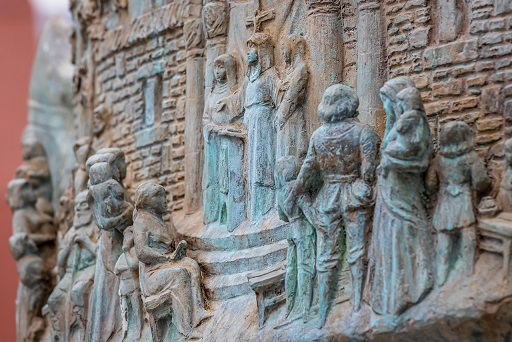
Around the year 1141, a nun in her early forties sat in a monastery above the Rhine and began to write down what she described as visions. She had experienced them, by her own account, since childhood, and had kept them secret for most of her life. Within a decade, she had produced a visionary book, a cycle of sacred songs, and the first of the works that would earn her a place among the most remarkable people of the Middle Ages.
Her name was Hildegard, and nine centuries later, she’s still read, sung, and studied. She’s a saint, a Doctor of the Church, a composer whose music is performed in concert halls, and one of the best-known women of medieval Germany. This is her story.
From Bermersheim to the Cloister
Hildegard was born in 1098 in Bermersheim, near Alzey in the Rheinhessen region, the tenth child of the nobleman Hildebert of Bermersheim and his wife, Mechthild. As a young girl, she was given to the Church, a common practice for large noble families, and she grew up under the care of the anchoress Jutta at the Benedictine monastery of Disibodenberg. She took her vows around 1112.
When Jutta died, Hildegard was elected leader of the women’s community in 1136, with the title magistra. By then, the community had grown, and Disibodenberg was becoming crowded. Around 1150, she founded a new convent on the Rupertsberg, a hill near the town of Bingen, and moved there with about twenty nuns. In 1165, she founded a second house across the Rhine at Eibingen. The Rupertsberg convent grew to house more than fifty nuns, supported by donations from the local nobility.
A Visionary and a Writer
Hildegard’s first and best-known work, Scivias (“Know the Ways”), was written between 1141 and 1151. It describes a series of visions and their theological meaning, and was assisted by the monk Volmar, her secretary and confidant. Church authorities examined the work at a synod in Trier in the late 1140s, which helped to establish her credibility as a visionary. From then on, her voice carried unusual weight for a woman of her time.
She wrote several other works over the following decades, covering theology, nature, and medicine. Two of them, Physica and Causae et Curae, deal with natural science and healing. She also corresponded widely with popes, rulers, abbots, and ordinary people seeking advice, and she is known to have made preaching journeys along the Rhine, an extraordinary thing for a woman in the 12th century.
A few of her ideas have become famous:
- Viriditas. A term she used for the “greenness” or life force that flows through creation and the soul.
- Lingua ignota. A constructed “unknown language,” with its own vocabulary and alphabet, which she created for reasons scholars still debate.
The Music
Hildegard was also a composer, and her music survives in remarkable quantity. Her cycle of sacred songs, the Symphonia armonie celestium revelationum, contains 77 liturgical chants, including antiphons, responsories, hymns, and sequences. She is often credited with leaving more surviving chants than any other composer of the Middle Ages, and the music has a soaring, wide-ranging quality unlike most chant of the period.
Her Ordo Virtutum (“Play of the Virtues”), written for solo voices and a chorus, is a sung drama in which Virtues battle the Devil for a human soul. It’s considered the earliest known morality play, and it’s still performed today.
Death and Sainthood
Hildegard died on 17 September 1179 at the Rupertsberg convent. She was venerated as a saint locally for centuries, but the Church only recognized her formally in the 21st century. On 10 May 2012, Pope Benedict XVI officially canonized her, and on 7 October 2012, he named her a Doctor of the Church, one of the Church’s most respected teachers. She was the fourth woman in Church history to receive that title. Her feast day is 17 September, and her relics are kept at the parish church in Eibingen.
Hildegard Today
Interest in Hildegard has grown dramatically over the past decades, in several different directions.
- Music. Recordings and concerts of her chants are popular far beyond religious circles.
- History and religion. Scholars study her as a theologian, scientist, and writer at a time when few women had a public voice.
- “Hildegard medicine.” In German-speaking countries, you’ll find products and diets marketed under her name, including spelt-based foods and herbal remedies. Historians and medical experts caution that many of these modern products rely on later interpretations, and that her medical writings reflect the ideas of her own time, not modern science.
- Cultural symbol. Feminist writers and many readers see her as an early example of female intellectual authority.
Visiting Hildegard’s Rhine Valley
Several places in the Rhine region are connected with her life.
- Bingen am Rhein. The town near which she founded Rupertsberg. Little of the original convent remains, but the town has Hildegard-themed museums and walks.
- Eibingen Abbey and parish church, near Rüdesheim. The site of her second convent and the place where her relics are kept. St. Hildegard’s Abbey in Eibingen is a major pilgrimage destination.
- Disibodenberg. The ruins of the monastery where she spent her early life, near Odernheim am Glan.
- Bermersheim. Her birthplace in Rheinhessen.
- The Rhine Valley. The wine villages and castles around Rüdesheim and Bingen make this a rewarding region to visit on their own.
Check opening hours and visitor information before you go, as small museums and abbeys often have limited schedules. For other great figures in German history, browse our Famous Germans section, including Martin Luther, whose Reformation reshaped the religious landscape she knew.
FAQ
Who was Hildegard von Bingen?
A 12th-century German Benedictine abbess, visionary, writer, and composer, canonized as a saint and named a Doctor of the Church in 2012.
When did Hildegard von Bingen live?
She was born in 1098 and died on 17 September 1179.
What is Hildegard von Bingen known for?
Her visionary book Scivias, her large body of surviving sacred music, the play Ordo Virtutum, and her writings on nature and medicine.
Was Hildegard von Bingen really a saint?
She was venerated as one for centuries, and Pope Benedict XVI formally canonized her on 10 May 2012 and declared her a Doctor of the Church on 7 October 2012.