

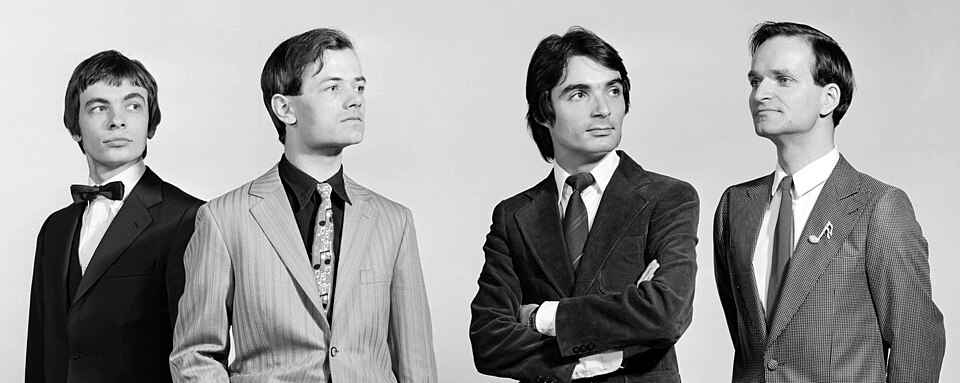
In 1977, a group of journalists boarded a train in Paris, bound for Reims. There was no concert and no press conference waiting at the other end. The train itself was the venue. Over the journey, they were played the band’s new album, Trans-Europe Express, a record about trains, launched on a train.
It was a typical move for Kraftwerk, the German band that treated music as an exercise in design. Where other groups of the 1970s built their image on guitars, sweat, and rebellion, Kraftwerk’s members stood motionless behind electronic equipment, dressed in neat suits, and sang about motorways, pocket calculators, and radio waves. At first, many critics didn’t know what to make of them. Within a few decades, their sound could be heard in almost every corner of modern music.
Two Students in Düsseldorf
The name Kraftwerk means “power plant.” The band was formed in Düsseldorf in 1970 by Ralf Hütter and Florian Schneider, two students who met in the late 1960s while studying classical music at the city’s conservatory. They were part of a lively experimental scene in West Germany, and their early records, made with a changing circle of musicians, belonged loosely to what later became known as krautrock.
In 1970, they set up their own Kling Klang Studio in Düsseldorf, where they could build and modify their own equipment. With their 1973 album Ralf & Florian, they relied more and more on synthesizers and drum machines, and by the next record they had found the style that made them famous.
The Sound of Everyday Life
The core idea behind Kraftwerk’s music was to make art from the sounds and rhythms of modern life. That concept was first fully realized on Autobahn (1974), whose 22-minute title track imitates a drive on a German motorway, complete with engine noise, car horns, and the steady hum of travel. The edited single brought the band international attention, though its influence, especially on other musicians such as David Bowie, was far greater than its sales.
Over the next decade, the band released a series of albums that mapped out the themes of the machine age.
| Year | Album | Theme |
|---|---|---|
| 1974 | Autobahn | Motorways and driving |
| 1975 | Radio-Aktivität (Radio-Activity) | Radio waves and radioactivity |
| 1977 | Trans-Europa Express | Trains and European travel |
| 1978 | Die Mensch-Maschine (The Man-Machine) | Humans, robots, and mannequins |
| 1981 | Computerwelt (Computer World) | Computers and the information age |
The band described its style as “robot pop,” blending electronic sounds with catchy melodies. For The Man-Machine, it presented itself as mannequins and robots, and the album was launched in 1978 at the newly completed Tour Montparnasse in Paris. After The Man-Machine, the band took a long break, returning in 1981 with Computer World, a prescient reflection on the growing influence of technology.
Why Germany?
Kraftwerk’s themes are very German in some ways. The Autobahn has long been a symbol of postwar German engineering, and the band’s obsession with trains, machines, and precision plays with the country’s image as a land of technology. At the same time, the members often said they wanted to create something distinct from the Anglo-American rock that dominated radio, a modern, European sound. For a young generation of West Germans growing up in the shadow of recent history, that approach offered a way to look forward.
An Influence Almost Impossible to Overstate
Kraftwerk’s reach is difficult to exaggerate. Music critics and historians commonly credit the band with influencing synth-pop, hip-hop, post-punk, techno, house, ambient, and club music.
- Hip-hop. Afrika Bambaataa’s hit “Planet Rock,” a cornerstone of New York hip-hop, drew on Kraftwerk’s work.
- Techno. Detroit’s pioneers of techno cited the band as a key influence.
- Pop and rock. David Bowie, Björk, and Dr. Dre are among the artists who have been inspired by the band.
The recognition came late but in force. In 2014, the Recording Academy gave Kraftwerk a Grammy Lifetime Achievement Award. Their live album 3-D The Catalogue won the 2018 Grammy for Best Dance/Electronic Album, and in 2021 they were inducted into the Rock and Roll Hall of Fame in the “early influence” category.
The Band Today
Over the years, the lineup has changed. Wolfgang Flür and Karl Bartos, who played alongside Hütter and Schneider on the classic records, left in the late 1980s and 1990. Schneider left the group in 2008 and died in 2020, and Hütter is now the only original member. Kraftwerk has continued to tour, with a multimedia stage show built around the band’s catalog and 3D visuals, and it marked its 50th anniversary with live performances, including a concert at Vienna’s Schönbrunn Palace in 2024.
Where to Start Listening
If you’ve never heard Kraftwerk, these five tracks are a good introduction:
- “Autobahn” (1974), the long, hypnotic road song that started it all.
- “Trans-Europe Express” (1977), the rhythm of a train turned into music.
- “The Robots” (1978), the best-known track from The Man-Machine.
- “The Model” (1978), a surprise pop hit.
- “Computer Love” (1981), an early vision of loneliness in a digital world.
Visiting Kraftwerk’s Düsseldorf
Düsseldorf remains the band’s home, and the city is also known for its Rhine promenade, its art scene, and its Altbier. For more German cultural icons, browse our Famous Germans section.
FAQ
What does Kraftwerk mean?
It’s German for “power plant” or “power station.”
Where is Kraftwerk from?
Düsseldorf, West Germany, where Ralf Hütter and Florian Schneider formed the band in 1970.
What genre is Kraftwerk?
Electronic music, often described as synth-pop or “robot pop,” with roots in the German krautrock scene.
Which Kraftwerk album should I start with?
Trans-Europe Express (1977) or The Man-Machine (1978) are good starting points, along with Autobahn (1974).