

On the evening of 5 December, German children across the country polish a pair of boots and put them outside the door. By morning, if they’ve behaved, the boots will be filled with sweets, nuts, and mandarins. Meanwhile, in a small town in the Alps, a few dozen men in shaggy fur costumes, horned masks, and enormous cowbells are charging down the street, rattling chains and chasing the screaming spectators.
Both scenes belong to the same festival. They’re two sides of one very old Advent tradition: a kind saint who rewards good children, and a darker companion who deals with the rest. In 2026, 6 December falls on a Sunday, which makes this one of the best weekends of the season to see the tradition in action.
Nikolaus: The Gift-Giver
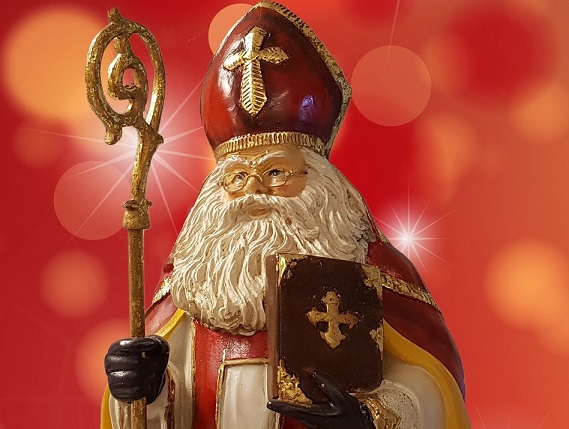
St. Nikolaus (Nicholas) is the beloved figure at the center of it all. He’s based on Nicholas of Myra, a bishop from what is now Turkey, whose feast day is 6 December, traditionally the date of his death. He became the patron saint of children, and over the Middle Ages the custom developed of a person dressed as a bishop visiting children, praising the good ones and scolding the naughty.
Today, the custom comes in two forms. At home, children polish their boots on the evening of 5 December and find treats inside the next morning. At schools, kindergartens, and community events, someone dressed in a red bishop’s robe and mitre often arrives in person, reads from a “golden book” about the children’s behavior, and hands out treats.
Knecht Ruprecht: The Northern Companion
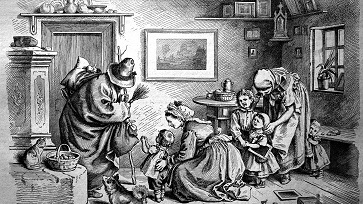
Across northern and central Germany, especially in Protestant regions, Nikolaus is accompanied by Knecht Ruprecht, a dark-clothed servant who carries a sack and a switch. In older versions, he represents the threat that naughty children might receive lumps of coal or a beating with the rod instead of sweets. Often he’s also the one who carries Nikolaus’s gift sack.
A few details make him distinctive:
- He’s usually alone. Unlike the Krampus, Ruprecht tends to appear as a single figure.
- He has many names, including Ruppknecht, Knecht Nikolas, Pelznickel, Rumpelklas, and Hans Muff, depending on the region.
- His origins are debated. One theory links him to a servant of Frau Perchta, a figure from Alpine folklore who punished misbehavior in winter. Another connects him to older pagan figures who drove away evil spirits.
Today, the image has softened considerably. Most children are no longer expected to fear Ruprecht, and many families treat him as a character from stories rather than a real threat.
Krampus: The Alpine Demon
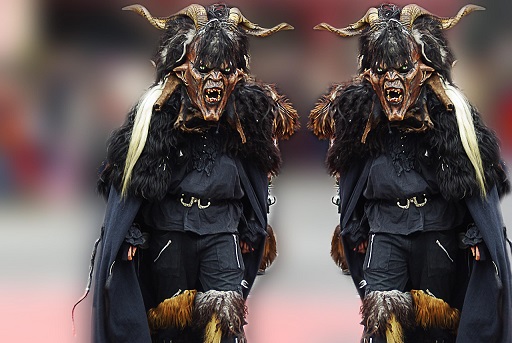
The Krampus is a far more frightening version of the same idea. He belongs to the Alpine region: southern Bavaria, the Upper Palatinate, Austria, South Tyrol, and neighboring countries including Slovenia, Croatia, Hungary, the Czech Republic, and Slovakia.
Unlike Ruprecht, the Krampus isn’t a human servant but a demonic creature, with shaggy fur, a horned mask, a long tongue, and a collection of chains, bells, and switches. He appears in groups, not alone, and he’s always subordinate to Nikolaus. That hierarchy is the whole point: it shows good winning over evil. In the traditional story, Nikolaus rewards the good children while the Krampus punishes the naughty ones, sometimes by stuffing them into a sack or basket.
The custom is centuries old. Folklorists say the Krampus tradition has existed in the Alps for roughly 500 years, and some suggest its roots go back to pre-Christian or even late-antique figures. Whatever the origin, it’s still very much alive.
Krampustag and the Krampuslauf
The evening of 5 December is known as Krampustag, and the main event is the Krampuslauf (Krampus run), a procession in which costumed participants parade through the streets, ringing bells, rattling chains, and playfully menacing the crowd. Runs take place on and around 5 December, and some begin in November and continue into mid-December.
Don’t confuse the Krampus with the Perchten. The Perchten are a separate tradition with their own runs, held mainly during the Rauhnächte, the twelve nights around Christmas and New Year, and meant to drive away winter spirits. The costumes can look almost identical, but the meaning is different.
Who Is Who: A Quick Guide
| Figure | Where | Role | Appearance |
|---|---|---|---|
| Nikolaus | Germany, Austria, Switzerland | Rewards good children on 6 December | Bishop’s robe, mitre, staff |
| Knecht Ruprecht | Northern and central Germany | Warns or punishes naughty children | Dark robe, sack, switch, often alone |
| Krampus | Bavaria, Austria, South Tyrol and beyond | Punishes naughty children, serves Nikolaus | Horned, furry demon, chains and bells, in groups |
| Schmutzli | Switzerland | Accompanies Nikolaus | Dark-clothed helper |
| Weihnachtsmann | Across Germany | Brings gifts on 24 December | Red suit and beard, similar to Santa |
| Christkind | Mostly Catholic and southern regions | Brings gifts on 24 December | Angelic child figure, often with blond curls |
What About the Weihnachtsmann?
Nikolaus and Knecht Ruprecht belong to 6 December. The gift-bringer on 24 December is a different figure. In many northern and Protestant regions, it’s the Weihnachtsmann (Father Christmas), who developed in the 19th century and combines elements of Nikolaus and Ruprecht. The name Santa Claus comes from the Dutch version of Nikolaus, which Dutch emigrants brought to America.
In many southern and Catholic regions, the gifts come from the Christkind, a child-like angel figure. Martin Luther is often credited with promoting it as an alternative to the saint’s cult. For how the evening of 24 December works in practice, see our Christmas in Germany 2026 guide.
Seeing a Krampuslauf in 2026
The Krampustag falls on Saturday, 5 December 2026, so many runs will take place that weekend. Dates vary by town, so check local listings.
- Munich. The city’s Krampuslauf traditionally runs through the pedestrian zone and Christkindlmarkt in the afternoon, with roughly 25 to 30 groups and 300 or more participants in past editions.
- Freilassing (Bavaria). Known as the largest in Bavaria, with up to 70 groups and more than 1,000 Krampusse in the past.
- Klagenfurt (Austria). Home to Austria’s largest Krampuslauf.
- Smaller towns across Bavaria and Austria. Often more local, more traditional, and less crowded.
Tips for visitors:
- Arrive early to get a spot behind the barriers.
- Don’t touch or provoke the Krampusse. Part of the tradition is that they chase and swat onlookers, and the older ones can be rough.
- Be careful with small children, who may find it truly frightening.
- Dress warmly, since it’s outdoors in December.
- Confirm event times with the local tourism office before you go.
A Scary Season of Our Own
If Halloween feels like an imported holiday, the Krampus offers a homegrown answer: a centuries-old Alpine tradition of masks, noise, and the pleasure of being frightened. It also connects to older folk beliefs described in our guides to haunted Germany and Walpurgisnacht. For the wider Advent atmosphere, see Advent in Germany and our guide to Christmas markets.
FAQ
What is the difference between Krampus and Knecht Ruprecht?
Krampus is a demonic, horned figure from the Alpine regions who appears in groups, while Knecht Ruprecht is a human-like servant from northern and central Germany who typically appears alone.
When is Nikolaustag in 2026?
Sunday, 6 December 2026. Children put out boots on the evening of Saturday, 5 December.
What is Krampustag?
The evening of 5 December, when Krampus runs (Krampusläufe) take place in Alpine regions.
Is Krampus the same as Santa Claus?
No. Santa Claus developed from the Dutch Sinterklaas, a version of Nikolaus, while Krampus is a separate, frightening companion in Alpine tradition.