

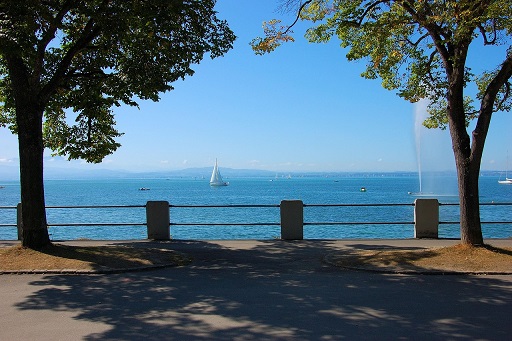
At the harbor in Konstanz, a nine-meter statue turns slowly on a pedestal at the entrance to the port. She’s called Imperia, and she is a tongue-in-cheek memorial to the courtesans who followed the church council that met here from 1414 to 1418, the same council that put a Bohemian reformer on trial and had him burned at the stake. A few hundred meters away, the lake stretches to the horizon, with the Alps showing faintly on the other side.
That lake is the Bodensee, known in English as Lake Constance, and it’s one of the most appealing regions in Germany. Few places combine islands, medieval towns, vineyards, and mountain views so compactly. It’s also one of the few large lakes in the world that nobody has formally divided: Germany, Austria, and Switzerland all touch its shores, and they’ve never agreed on where the borders in the water run.
What Is Lake Constance?
Lake Constance covers around 536 square kilometers, making it one of the largest lakes in Central Europe. It measures about 63 kilometers long and up to 14 kilometers wide. It’s divided into three main parts: the Obersee (upper lake), the Untersee (lower lake) to the southwest, and the Seerhein, a short stretch that connects them near Konstanz. The name comes from Bodman, an 8th-century Carolingian palace on the shore.
The German side runs along the north and west, Austria’s short shoreline lies in the east around Bregenz, and Switzerland holds the south. The lake region has a long history of settlement: the stilt-house settlements preserved at Unteruhldingen date back to prehistoric times and are part of a UNESCO World Heritage listing.
The Highlights at a Glance
| Place | Known for |
|---|---|
| Konstanz | A well-preserved medieval old town, the harbor and Imperia statue, the Council of Constance, beaches |
| Reichenau Island | A UNESCO World Heritage Site with a monastery founded in 724 and three Romanesque churches, plus market gardens |
| Mainau Island | The “flower island,” with botanical gardens and a Baroque castle |
| Meersburg | A picturesque lakeside town with a medieval castle, often described as the oldest inhabited castle in Germany, and vineyards |
| Unteruhldingen | The Pfahlbauten open-air museum of reconstructed prehistoric stilt houses |
| Friedrichshafen | The birthplace of the Zeppelin airship and the Zeppelin Museum, with a long lakefront promenade |
| Lindau | An island town with a harbor guarded by a lighthouse and a Bavarian lion |
| Bregenz (Austria) | The Bregenz Festival, with open-air opera on a floating stage in summer |
The Council of Constance
Konstanz’s place in history comes from the Council of Constance (1414 to 1418), the only church council ever held north of the Alps. At the time, Europe had three rival popes, and the council set out to end the split. It also summoned the Bohemian reformer Jan Hus, who was condemned and burned at the stake on 6 July 1415. His death became a landmark in the history of religious reform, and a small museum in Konstanz is dedicated to him. To follow the story of what came next, read our guides to Martin Luther and Reformationstag.
The Islands
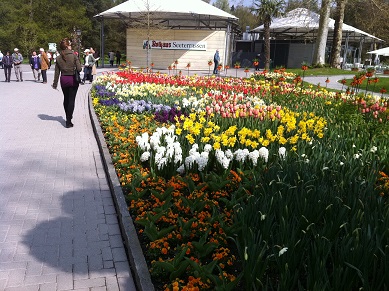
Lake Constance has 13 islands, but only three have more than 100 permanent residents and attract visitors, and all three are in Germany.
- Reichenau. West of Konstanz, between two arms of the lower lake. Its abbey and churches were inscribed as a UNESCO World Heritage Site in 2000, and the island is also known for its vegetable growing.
- Mainau. A garden island run as a botanical park, with seasonal displays and a Baroque castle.
- Lindau. The island town in the east, connected to the mainland, with a pretty old town and harbor.
Getting Around
- By train. Trains circle most of the lake, with major junctions at Radolfzell, Konstanz, Friedrichshafen, and Lindau. Service is generally better on the German and Austrian sides than the Swiss side.
- By boat. Ferries and cruise boats link many ports. A car ferry connects Konstanz and Meersburg, a catamaran carries foot passengers between Konstanz and Friedrichshafen, and in summer boats serve Mainau and the Unteruhldingen museum from several harbors. Check current timetables.
- By bike. The Bodensee-Radweg is a cycle path of roughly 260 kilometers around the lake, with many sections separated from traffic. Because it crosses three countries, it’s a popular multi-day trip.
- By car. Useful for reaching smaller places, but parking can be difficult in summer.
- Crossing borders. Konstanz sits next to the Swiss town of Kreuzlingen. Carry ID if you cross, and note that Switzerland uses Swiss francs, not euros.
What to Eat and Drink
- Wine. The slopes around Meersburg and Hagnau are the region’s main wine-growing area, and many wineries welcome visitors.
- Fish. Whitefish (Felchen) from the lake is a regional specialty, often served pan-fried.
- Hearty dishes. Kässpätzle (cheese noodles) and onion tart are common in the surrounding Swabian and Alemannic kitchens.
- Fruit. Orchards line the shore, and apples and pears appear as juice, cider, and brandy.
- On the water. Some cruise boats have restaurants on board.
When to Go
- Spring. Gardens bloom, and Mainau is at its colorful best.
- Summer. Swimming, boating, and the Bregenz Festival make this the busiest season.
- Autumn. Harvest festivals, young wine, and calmer crowds.
- Winter. Quiet, with many attractions on reduced hours or closed. Check before you go.
A Four-Day Route
Day 1: Konstanz. Walk the old town, see the Imperia statue and the Council sites, and take a lakeside walk.
Day 2: Reichenau and Mainau. Visit Reichenau’s UNESCO churches in the morning and Mainau’s gardens in the afternoon.
Day 3: Meersburg, Unteruhldingen, and Friedrichshafen. Tour Meersburg Castle, visit the stilt-house museum, and end the day at the Zeppelin Museum.
Day 4: Lindau and Bregenz. Explore Lindau’s island old town and, if the season allows, catch a performance on the floating stage in Bregenz.
Practical Tips
- Plan by boat and train. Many of the best stops are easy to link without a car.
- Bring ID if you may cross into Switzerland or Austria.
- Book ahead in summer, especially for Bregenz Festival tickets and lakeside hotels.
- Check opening hours of castles, museums, and the islands, which vary by season.
- Remember Sunday closures in shops. See our guide to Sunday closing in Germany.
Lake Constance combines well with other regions. It lies near the southern end of the Black Forest, so see our Black Forest guide, and for another classic route, read about the Romantic Road. For more destinations, browse our travel to Germany section.
FAQ
Which countries border Lake Constance?
Germany, Austria, and Switzerland. The three countries have never agreed on where the borders run through the water.
How big is Lake Constance?
About 536 square kilometers in area, roughly 63 kilometers long and up to 14 kilometers wide.
What are the best places to visit at Lake Constance?
Konstanz, Mainau Island, Reichenau Island, Meersburg, Friedrichshafen, and Lindau, plus the Bregenz Festival in Austria in summer.
Can you cycle around Lake Constance?
Yes. The Bodensee-Radweg is a cycle path of roughly 260 kilometers that circles the lake and crosses three countries.