

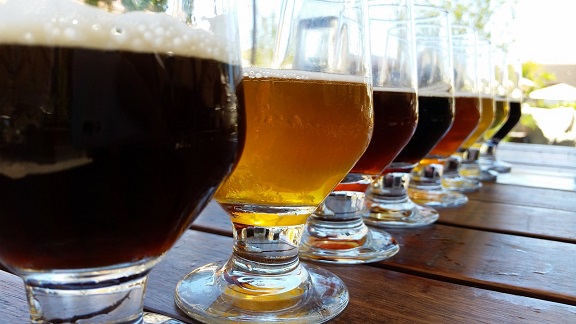
Ordering “a beer” in Germany is a bit like asking for “a cheese” in France. It’s technically possible, but the person behind the bar will want to know which one. The country has nearly 1,500 breweries and, by one count, more than 7,500 beer brands, and the styles run from crisp and bitter to smoky, sour, and strong enough to count as a dessert.
The good news is that you don’t need to memorize all of them. Start with what you like, and the right German beer is usually obvious.
Start Here: What Do You Like?
| If you like… | Try | Where it’s from |
|---|---|---|
| Crisp, golden, a clean bitter finish | Pils | Everywhere, especially the north and west |
| Mild, smooth, a little malty-sweet | Helles | Bavaria |
| Fruity, cloudy, refreshing | Weizen (Weißbier) | Bavaria |
| Light, delicate, easy to drink | Kölsch | Cologne |
| Copper-colored, bready, a touch bitter | Altbier | Düsseldorf |
| Smoke and campfire | Rauchbier | Franconia (Bamberg) |
| Strong and rich | Bock | Southern Germany |
| Sour and refreshing | Berliner Weisse or Gose | Berlin and Leipzig |
| Something light and fizzy | Radler | Nationwide |
| No alcohol | Alkoholfrei | Nationwide |
The Everyday Beers
Pils. The country’s default beer, and by a long way. According to Nielsen data for autumn 2024, Pils had a retail market share of about 48 percent, well ahead of everything else. It’s a golden, bottom-fermented lager with a pronounced hop bitterness and a dry finish, and the style takes its name from the Bohemian city of Pilsen. A good Pils is poured in stages, which is why bartenders can seem to take forever over a single glass. All Pils is lager, but not all lager is Pils.
Helles. Munich’s answer to Pils: a pale golden lager that’s softer, rounder, and maltier, with much less bitterness, usually around 4.5 to 5 percent alcohol. It’s been gaining ground, with a market share of around 10.6 percent in the same data, making it the second most popular style. In Bavaria, a Helles in a half-liter glass is the beer-garden standard.
Weizen or Weißbier. The Bavarian wheat beer: top-fermented, usually cloudy, and typically around 5 percent alcohol. It tends to taste of banana and clove, and it’s poured into a tall, curved glass with a thick foam head. Variations include Kristallweizen (filtered and clear), Dunkelweizen (dark), and Weizenbock (stronger).
Export and Märzen. Export is a smooth, slightly stronger pale lager associated with the Ruhr region. Märzen, traditionally brewed in March and stored over the summer, is the amber lager served at Oktoberfest. You can read more in our guide to Oktoberfest traditions.
The Strong and the Dark
Bock. A stronger, maltier lager, often with a sweetish, caramel character. Its name has a surprising origin: it’s a southern German corruption of “Einbeck,” the Lower Saxon town whose beer was famous in the Middle Ages. A Doppelbock is stronger still, often with names ending in “-ator,” while a Maibock is a paler spring version.
Dunkel and Schwarzbier. Dark lagers, from the deep brown Bavarian Dunkel to the black, but surprisingly light-tasting, Schwarzbier of eastern Germany.
Rauchbier. A specialty of Bamberg in Franconia, brewed with malt dried over beechwood fires, which gives it a distinctive smoky flavor. It divides people, and it’s well worth one try.
The Rhineland Rivals: Kölsch and Alt
Two neighboring cities, two top-fermented beers, and a rivalry that has run for generations.
Kölsch is pale, light-bodied, and delicate, brewed with top-fermenting yeast but cold-conditioned. By the rules of the Kölsch Convention, it may only be brewed in Cologne and the surrounding area, and it’s traditionally served in a slender 0.2-liter glass called a Stange. In a Cologne brewery pub, a waiter known as a Köbes carries a round tray, the Kranz, full of them, and will keep replacing your empty glass until you tell him to stop. A common signal, by tradition, is to lay a beer mat over the top of your glass.
Altbier (“old beer”) is Düsseldorf’s counterpart: darker, copper-colored, and maltier, usually served in a short, thick glass called a Becher. The competition between the two cities is taken half-seriously, and there’s even a mixed drink, Költ, whose slogan is “Bier statt Krieg” (“beer instead of war”), meant to end the rivalry. Cologne itself is a good place to see the contrast, and our guide to Karneval shows how seriously the city takes its identity.
Sour, Salty, and Mixed
Berliner Weisse. A pale, low-alcohol wheat beer that’s distinctly sour. It’s traditionally served with a shot of raspberry or woodruff syrup, which is a drink that nearly disappeared and has been revived by craft brewers.
Gose. A tangy, salty wheat beer from Leipzig, flavored with coriander.
Radler. A mix of Helles or Pils with lemon soda, popular in summer and with anyone who wants a lighter drink. If it’s made with mineral water instead of soda, it’s called a saures Radler (“sour Radler”), and in the north, the same drink is known as an Alster.
Alcohol-Free and Craft
Alcohol-free beer is one of the market’s growth areas. In Nielsen’s autumn 2024 data, it held a market share of 8.9 percent, making it the third most popular style behind Pils and Helles, and more than 400 alcohol-free varieties are available, covering Pils, Weizen, Radler, and even regional styles like Kölsch and Alt. Craft brewing is growing too, with IPAs and sour beers appearing next to the classics, though the Reinheitsgebot, explained in our article on the 1516 purity law, still shapes what many breweries do.
The Numbers
- Brewing. About 1,500 breweries operated in Germany in 2024, according to the Federal Statistical Office.
- Sales. German breweries sold around 83 million hectoliters of beer in 2024, a fall of 1.4 percent from the year before.
- Consumption. The German Brewers’ Association puts per-capita consumption in 2025 at roughly 84 liters, down from about 103 liters 15 years earlier.
Ordering Like a Local
- Name the style. “Ein Pils, bitte” or “Ein Weizen, bitte” beats “a beer.”
- Expect small glasses in Cologne. A Kölsch comes in a 0.2-liter Stange, so don’t be surprised by the second and third.
- Pour time is normal. A properly poured Pils takes patience.
- Say “Prost” and look people in the eye when you clink glasses. It’s the polite custom.
- Pay by round or by glass. In most places, everyone settles their own bill.
- Try something regional. If you’re in Bamberg, try the Rauchbier. In Leipzig, a Gose. In Cologne, a Kölsch.
For the cultural side of beer, see our guides to German beer and how to taste beer, and for what to eat with it, browse our German cuisine pages.
FAQ
What is the most popular beer style in Germany?
Pils, with a market share of roughly half in retail, according to Nielsen data for autumn 2024.
What is the difference between Pils and Helles?
Pils is more bitter and hoppy, while Helles is softer, rounder, and maltier. Both are pale lagers.
What is Kölsch?
A light, top-fermented beer that may legally only be brewed in and around Cologne, and which is served in a slim 0.2-liter glass.
What is a Radler?
A drink made of beer mixed with lemon soda, usually Helles or Pils, and popular in summer.