

At around eight o’clock on the Thursday before Ash Wednesday, a train arriving in Cologne looks like a very strange commuter service. A man in a banana suit is asleep against the window. Two women dressed as bees are already opening bottles of Sekt. Someone’s grandmother, dressed as a pirate, is handing out chocolate to strangers. Nobody is embarrassed, and nobody is asking why. It’s Weiberfastnacht, the unofficial start of the loudest few days in the German calendar, and the whole country west of the Rhine seems to have agreed to stop being serious.
Karneval in Germany surprises visitors who know the country mostly through its reputation for order and punctuality. For a few days each year, that reputation gets turned upside down on purpose, and the people who run the trains on time are the same ones throwing candy from a decorated float. Understanding why this works says a lot about how German culture actually functions.
What Karneval Actually Is (and Why It Has Three Names)
Depending on where you are, the same festival goes by Karneval, Fasching, or Fastnacht. It’s a pre-Lenten celebration rooted in the Catholic calendar, a last stretch of feasting, drinking, and general foolishness before the forty days of fasting that lead up to Easter. That’s why the main events cluster in the days before Ash Wednesday, and why the dates shift every year with Easter. In 2027, for example, the big Rosenmontag parades fall on February 8.
The name you hear tells you roughly where you are. Karneval is the term along the Rhine, in Cologne, Düsseldorf, and Mainz. Fasching dominates in Bavaria and parts of eastern Germany. Fastnacht or Fasnet belongs to the southwest, especially the Swabian-Alemannic region around the Black Forest. These aren’t just different words for the same party. Each region has developed its own customs, costumes, and attitude toward the whole thing.
The Fifth Season Starts on 11/11
Rhineland Karneval officially opens at 11:11 a.m. on November 11, a moment known as the start of the “fifth season” (die fünfte Jahreszeit). The number eleven is a long-standing in-joke tied to the idea of foolishness, and the date has become a major street party in Cologne’s Old Town, with tens of thousands of costumed people packing the squares by mid-morning.
After that opening, things go quiet through the Christmas period, then pick up again in January with Sitzungen, formal stage shows held in decorated halls where local performers deliver satirical speeches (Büttenreden), music acts, and dance numbers. These shows are surprisingly structured, with an elected council of eleven (the Elferrat), a master of ceremonies, and a long-standing script of traditions that audiences know by heart. It’s closer to a regional theater season than a drunken free-for-all, though there’s plenty of the latter too.
The Big Days: From Weiberfastnacht to Aschermittwoch
The street festival itself runs from Thursday to Tuesday, with each day carrying its own rituals.
Weiberfastnacht
On the Thursday, women symbolically take over. Tradition says that at 11:11 a.m., women storm city halls and take the keys from the mayor, and in everyday practice, they also snip off men’s ties with scissors. If you wear a tie in Cologne that day, expect to lose it. The custom is that the victim gets a kiss on the cheek, a Bützje, in exchange, which is considered fair compensation. Smart office workers wear a cheap tie on purpose.
Rosenmontag
Rosenmontag, or “Rose Monday,” is the peak. Enormous parades roll through Cologne, Düsseldorf, and Mainz, with floats that are often political satire in physical form, mocking national and international figures in ways that would raise eyebrows in a more formal setting. Spectators line the streets shouting for Kamelle (sweets) and Strüßjer (small flower bouquets), which are thrown from the floats by the thousand. Children carry bags specifically for the haul, and adults compete for it with equal seriousness.
Veilchendienstag and Aschermittwoch
The Tuesday brings smaller local parades and the last, wildest night of partying. In Cologne, a straw figure called the Nubbel is burned at midnight, symbolically taking the blame for everything anyone did during the festivities. Then comes Aschermittwoch, Ash Wednesday, when it all ends abruptly. Costumes come off, bars quiet down, and many Germans eat fish (Fischessen) as a nod to the beginning of Lent.
Kölle Alaaf or Helau? The Greeting Rivalry
One of the quickest ways to understand regional pride in Germany is to say the wrong Karneval greeting in the wrong city. In Cologne, the call is “Kölle Alaaf!”, and it’s treated almost as a local identity statement. In Düsseldorf and Mainz, the traditional shout is “Helau!” Saying Helau in Cologne gets you a polite correction at best and a long lecture at worst, and the rivalry between the two cities is taken only half-jokingly. The two cities sit a short train ride apart, and neither will concede that the other does it properly.
Regional Differences That Surprise Visitors
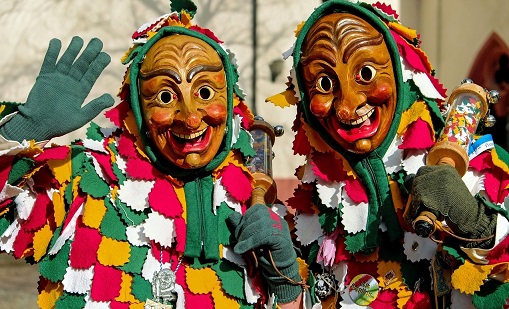
Not all of Germany celebrates the same way. The Rhineland version tends to be loud, musical, and heavily organized around clubs and street parades. Southwestern Fastnacht, especially in places like Rottweil, Villingen, and Elzach, has older, stranger roots. Participants wear carved wooden masks (Larven) and elaborate costumes tied to centuries-old local characters, and the tone is more ritual than party, sometimes even a little eerie by comparison. Bavarian Fasching, centered in Munich, leans toward masked balls and a more refined version of the season, though the Viktualienmarkt also hosts its own well-known street dance on Fasching Tuesday.
Northern and eastern Germany, especially Protestant regions, mostly stay out of it. A Hamburg resident is far less likely to own a costume than someone from Cologne, and large parts of northern Germany treat Karneval as a curiosity that happens somewhere else. This religious and regional divide is one of the clearest dividing lines in the country’s cultural map.
The Political Edge
Karneval has a sharper tradition than visitors often realize. Historically, the Rhineland festival grew partly as a way to poke fun at authority, including the Prussian rulers who governed the region in the nineteenth century. The first organized Cologne parades in the 1820s were as much about local identity as about partying, and the satirical floats today carry on that tradition. Politicians, from local mayors to heads of state, regularly become the targets of Rosenmontag floats, and Germans generally accept the mockery with good grace, or at least learn to fake it. It’s one of the few moments where public figures are openly laughed at in the street.
Practical Tips If You Want to Join In
Costumes aren’t optional if you want to blend in, but they don’t need to be elaborate. A hat, a wig, or a face paint design is enough, and Cologne in particular treats a thrown-together outfit as part of the spirit. Book accommodation months in advance, since hotels in Cologne, Düsseldorf, and Mainz fill up completely and prices climb sharply. Public transport runs on adjusted schedules and gets extremely crowded, so build in extra time. Carry cash, since street stalls often don’t take cards. And if someone offers you a Bützje, remember it’s a light cheek kiss and a traditional part of the day, not a romantic gesture.
If you’d rather experience a quieter version, smaller towns in the Rhineland often host local parades with far fewer crowds, and the atmosphere can feel warmer and more neighborly than the big-city spectacle.
What the Madness Is Really About
Germans are often described as rule-followers, and Karneval is the clearest evidence that the rules have a pressure valve. For a few days, class, age, and authority blur together, strangers hug, and the mayor hands over the keys. The point isn’t chaos for its own sake. It’s the idea that a society works better when there’s an agreed time to be ridiculous together. After a week of Karneval in Germany, the ordinary order of things feels a little more human, and so do the people who maintain it.
FAQ
When is Karneval in Germany? The main street celebrations run from the Thursday before Ash Wednesday (Weiberfastnacht) to the Tuesday night before it. The dates change every year because they depend on Easter, and in 2027 Rosenmontag falls on February 8.
What is the difference between Karneval, Fasching, and Fastnacht? They’re regional names for the same pre-Lenten festival. Karneval is used along the Rhine, Fasching in Bavaria and eastern Germany, and Fastnacht or Fasnet in the southwest.
What do you say at Karneval in Germany? It depends on the city. In Cologne the greeting is “Kölle Alaaf!”, while in Düsseldorf and Mainz it’s “Helau!” Mixing them up is a classic mistake that locals will happily point out.
Is Karneval celebrated across all of Germany? No. It’s strongest in Catholic regions, especially the Rhineland, the southwest, and parts of Bavaria, while much of northern and eastern Germany largely skips it.
Related articles:
How to Celebrate Carnival in Cologne
Fasching – Carnival in Germany
Lent in Germany: Traditions, History, and Rituals