

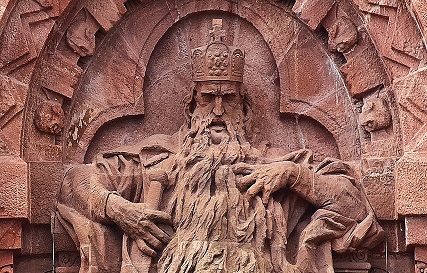
Frederick I – better known by his epithet “Barbarossa” (literally Red Beard) – stands as one of the towering figures of high-medieval Germany. King of the Germans from 1152, Holy Roman Emperor from 1155 until his death in 1190, he sought to restore the imperial dignity of the German monarchy, expand its authority in Italy, challenge papal power, and engage in crusading enterprise.
In so doing he left a complex legacy: triumphant in parts, frustrated in others; admired in later national myth, critiqued by modern historians. This article, written in the tone of an authoritative cultural-historical expert, explores his background, reign, major policies, crises, death, mythic afterlife and enduring cultural significance – with a focus on how Frederick Barbarossa matters for understanding medieval Germany, empire and identity.
Early Life and Ascension of Frederick I
Frederick was born around December 1122 (some sources say early 1123) in Haguenau (then Duchy of Swabia, part of the Kingdom of Germany). He was the son of Duke Frederick II of Swabia (of the Hohenstaufen dynasty) and Judith of Bavaria (of the Welf dynasty) – thereby linking the two powerful rival dynasties of the era.
This dynastic connection made Frederick politically acceptable to many of the German princes: his Hohenstaufen lineage gave imperial legitimacy; his Welf link offered a conciliatory dimension toward one of the major noble factions.
In 1147, Frederick succeeded his father as Duke of Swabia (as Frederick III). He gained early experience in princely politics, military campaigns and court gatherings (Hoftage). His selection as King of the Germans (King of the Romans) on 4 March 1152 at Frankfurt marked his rise. He was crowned at Aachen on 9 March 1152.
Just a few months later, in 1155, he was crowned Emperor by Pope Adrian IV, making him Holy Roman Emperor.
Imperial Vision
Frederick’s reign was defined by a clear set of ambitions:
- Restoring imperial authority: After the weakness of the German monarchy in previous decades, Frederick sought to reassert the crown’s power over the multitude of German princes and over Italy.
- Italian campaigns: The so-called “Italo-German” relationship was central; Frederick launched multiple expeditions into northern Italy to assert his rights and confront the growing independence of Italian city-states.
- Law and administration: Frederick encouraged the revival of Roman law and used legal frameworks to bolster imperial legitimacy rather than relying purely on personal military might.
- Crusading enterprise: Like many medieval rulers, Frederick saw participating in crusades as both an act of Christian duty and a means to prestige and power. His involvement in the Third Crusade (1189-90) exemplifies this.
Key Reigns and Conflicts
Germanity and Italy
One of the defining elements of Frederick’s reign was his repeated expeditions into Italy. In 1154-55 he marched down into the peninsula, confronted the Norman Kingdom of Sicily, reached Pavia and Rome, and in the process sought to enforce his imperial rights.
In 1158 Frederick convened the Diet of Roncaglia in Italy, where he attempted to assert imperial control over the northern Italian cities and re-establish the comitatus (imperial officers) in the region.
However, Frederick’s policy in Italy met formidable resistance: the Lombard League (Italian city-states allied with the Pope) challenged him. A decisive setback came with the Battle of Legnano in 1176 (though not in all sources) where the imperial forces were opposed by the city militias; this checked Frederick’s ambitions.
Conflict with Henry the Lion
Another major aspect was Frederick’s relationship with his cousin and powerful German duke Henry the Lion (of Saxony and Bavaria). Henry had grown immensely influential and independent, complicating Frederick’s efforts to assert central authority in Germany. Frederick ultimately stripped Henry of his duchies in 1180.
This action shows how Frederick balanced his imperial ambitions in Italy with the demands of securing his power within Germany itself.
Crusade and Death
In 1189 Frederick led a significant contingent in the Third Crusade, travelling overland from Regensburg down the Danube, through Hungary and Byzantium, into Asia Minor. His leadership and logistical planning were noted by contemporaries and later historians.
On 10 June 1190, Frederick drowned in the Saleph River (modern Göksu River near Silifke, Turkey) during the crusader journey. His death abruptly ended his ambition and the German crusader army lost momentum, many returning home soon afterward.
Domestic Policies and Economic Developments
While military and foreign policy often dominate narratives of Frederick’s reign, his domestic and economic policy also had substantial impact. Under his rule:
- The number of mints in Germany increased significantly, contributing to monetary and trade expansion.
- Frederick supported the revival of Roman civil law, employing a professional class of legal‐staff to administer his domains and assert imperial rights.
- He promoted stability (to a degree) among the German princes, though his model of dominance had limits; he relied often on negotiation, compacts and concessions rather than outright subjugation.
- Even though centralisation remained limited compared to later monarchies (France, England), Frederick’s reign marked a high point of imperial self-consciousness in Germany.
Legacy and Myth
Frederick’s influence extends far beyond his life. Several facets are worth noting:
The Legend
German folklore endowed Frederick with legendary status. One famous myth: he sleeps in the caves of the Kyffhäuser mountain and will awaken when Germany needs him.
His nickname “Barbarossa” – though used first in Italy, not in Germany – symbolized his red beard and became part of the medieval and later national memory.
National Appropriations
In the 19th and early 20th centuries, Frederick was used as a symbol of German national identity and imperial tradition. He was invoked by the Wilhelmine regime and other movements seeking a continuity of German greatness.
The monumental Kyffhäuser Monument (1890-96) stands as a physical manifestation: an 81-metre tower near the ruins of the medieval imperial castle, with a large sculpture of Frederick.
Historiographical Reassessment
Modern historians have reevaluated Frederick’s achievements more critically: acknowledging his ambition, skill and legacy of law, but also pointing out the limits of his success (for example, he never fully subdued the Italian city-states).
Scholars emphasize his pragmatic rule, consensus-building among German princes, and administrative sophistication rather than only martial glory.
Why Frederick Barbarossa Matters for German Culture and History
From the perspective of a cultural expert, there are several key reasons why Frederick remains important:
- Imperial Identity: Frederick embodied the idea of a German king who could claim Roman imperial legacy, bridging the German lands and Italy – thus representing the ambition of the medieval German monarchy.
- Law and Administration: His use of Roman law and professional administration matters for understanding how medieval German political culture evolved toward more structured governance.
- Myth and Memory: The legend of Barbarossa illustrates how historical figures can be transformed into cultural symbols, influencing nationalism, art, literature and popular memory.
- Continuity & Change: His reign marks a transitional phase: feudal fragmentation remains, but concepts of crown, law and administration develop; his failure in Italy foreshadows persistent structural limits of the Holy Roman Empire.
- Cultural Artefact: Monuments, legends, and his portrayal in medieval chronicles and modern media show how Frederick’s image has been adapted and re-interpreted across ages.
Key Themes in Frederick’s Reign
Let us summarize several themes to guide readers:
- Authority versus fragmentation: German lands remained highly fragmented (many princes, bishops, free cities), yet Frederick sought to enforce imperial authority, with mixed results.
- Germany and Italy: The dual monarchy (German lands + Italian kingdom) was always difficult; his Italian campaigns show both ambition and limitation.
- Church and Crown: Frederick engaged in sustained conflict and negotiation with the papacy. He aimed to assert crown rights but ultimately had to accommodate ecclesiastical power.
- Military and Crusading: His participation in the Third Crusade demonstrates the international dimension of his rule, and how German kingship connected to the broader Latin Christendom.
- Law and Institutions: His promotion of Roman law, administration and mints show development of state-like features in the emperor’s realm.
- Myth and Memory: Posthumous legend casts him as a king asleep beneath the mountain, a symbol of national and imperial hope.
Major Milestones and Chronology
- c. 1122/1123: Frederick born in Haguenau.
- 1147: Becomes Duke of Swabia.
- 4 March 1152: Elected King of the Germans.
- 9 March 1152: Crowned at Aachen.
- 18 June 1155: Crowned Holy Roman Emperor by Pope Adrian IV.
- 1154-55: First Italian expedition.
- 1158: Campaigns in Italy; Diet of Roncaglia.
- 1176: Defeat at Legnano (symbolic).
- 1180: Henry the Lion stripped of his lands.
- 1189-90: Third Crusade, Frederick sets out.
- 10 June 1190: Frederick drowns in the Saleph River; death ends his personal reign.
Critique & Historical Evaluation
While Frederick’s reign was impressive, historians note these caveats:
- He never fully achieved Italian domination, the growth of city-states resisted his efforts.
- The German monarchy remained heavily reliant on princely cooperation; the empire did not become a highly centralised state.
- His crusade ended prematurely with his death; the German contingent’s impact was limited.
- Later national myth sometimes exaggerated his achievements, risking anachronism.
Nonetheless, his role in stabilising the German monarchy for a time, promoting legal culture and shaping imperial self-understanding remains foundational.
Legacy in Memory and Culture
Frederick’s memory has lived on in many ways:
- The legend of him sleeping in the Kyffhäuser mountain waiting to return at Germany’s hour of need.
- His name attached to later historical projects (for example, the German invasion of the USSR in 1941 named Operation Barbarossa, though that legacy is obviously much darker).
- Inclusion in popular culture: novels, video games, documentaries.
- Towns, monuments and institutions in Germany trace their heritage to his reign and image.
Frederick Barbarossa remains a figure of enduring importance for German history and culture. He embodies the ambition of the medieval German monarchy to reclaim imperial dignity; he operated at the intersection of German, Italian and crusading worlds; he promoted institutions, law and administration; and he left not only a historical footprint but a mythic legacy that has shaped German self-understanding.
For anyone interested in medieval Europe, German state-formation, the tension between local and imperial power, or the cultural memory of empire, Frederick Barbarossa offers a rich case study. He teaches us about ambition and constraint, about rule and legend, and about how history and memory intertwine.
Related articles:
Henry the Lion – Discover Henry the Lion’s rise, rule, and rivalry with Frederick Barbarossa that reshaped medieval Germany’s power and identity.
Otto I and the Birth of the Holy Roman Empire – Explore how Otto I’s coronation in 962 marked the formal beginning of the Holy Roman Empire, establishing a powerful political and religious legacy in medieval Germany.
Medieval German Feudal Society – Learn how landholding, loyalty, and class defined the social structure of medieval Germany, shaping both everyday life and royal authority.
The Hanseatic League – Discover the rise of this powerful trade alliance of northern German cities that dominated commerce across the Baltic and North Seas during the late Middle Ages.