

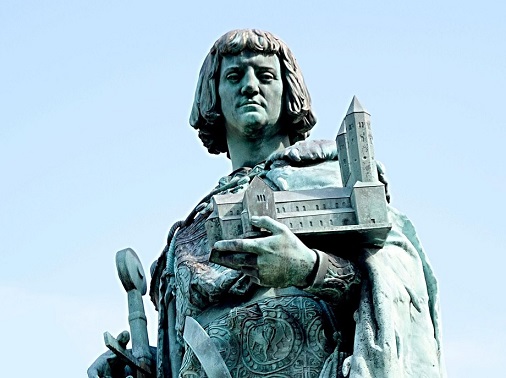
In the turbulent world of 12th-century Germany, one name stands out for its audacity, ambition, and near-royal power: Henry the Lion. Duke of Saxony and Bavaria, founder of Lübeck and Munich, patron of churches, and rival to emperors, Henry carved out a realm that rivaled the crown itself. His story captures the essence of medieval Germany’s central dilemma – the delicate balance between imperial authority and the independence of powerful regional princes.
Henry’s career illustrates both the potential and peril of medieval state-building. His alliance and later confrontation with Emperor Frederick Barbarossa defined one of the most dramatic chapters in the Holy Roman Empire’s history. To understand Henry the Lion is to understand the anatomy of German power: personal ambition, dynastic networks, faith, rebellion, and the enduring question of unity within diversity.
The World into Which Henry Was Born
Henry the Lion (Heinrich der Löwe) was born around 1129 into the Welf dynasty, one of the most influential noble houses in the German-speaking world. The Welfs were power brokers par excellence – a dynasty that combined political cunning with vast territorial resources. Henry inherited this legacy and expanded it with both skill and boldness.
Germany at the time was not a centralized nation-state but a vast constellation of duchies, counties, bishoprics, and free cities, nominally united under the Holy Roman Emperor. Real power lay in the hands of regional magnates like Henry. Whoever could command the loyalty of knights, clergy, and merchants held the keys to influence.
The Making of a Duke
Henry inherited the Duchy of Saxony in 1142, a sprawling region stretching from the North Sea to the Harz Mountains. Saxony had long been both a prize and a challenge for German rulers – a vast, restless land populated by proud nobles and frontier settlers. At a time when royal authority was weak, Henry understood that his power would rest on controlling the great cities, bishoprics, and trade routes that crisscrossed northern Germany.
He built alliances through marriage and diplomacy, most notably with the influential Ascanian and Wettin families, and through his relationship with the emperor. When he later gained the Duchy of Bavaria in 1156, his influence extended from the Baltic coast to the Alps – a territorial expanse that few rulers other than the emperor could match.
Henry’s power base was so strong that chroniclers sometimes referred to him as a “second king.” And indeed, for decades, he seemed almost equal to Emperor Frederick Barbarossa himself – until their friendship unraveled in one of the great political dramas of the Middle Ages.
The Alliance with Frederick Barbarossa
When Frederick Barbarossa was elected King of the Romans in 1152, Henry supported him enthusiastically. Their alliance seemed natural. Frederick came from the Hohenstaufen family, Henry from the Welfs – two dynasties that had long been rivals. A partnership between them promised peace at home and strength abroad.
Frederick needed Henry’s military power to consolidate his rule and to enforce imperial authority in rebellious Italian territories. Henry, for his part, needed the emperor’s recognition to confirm his rights in Saxony and regain Bavaria, which had been taken from his father years earlier.
In 1156, Frederick granted Henry the Duchy of Bavaria as a reward for his loyalty – a political triumph that cemented Henry’s dominance over southern Germany. The balance of power within the empire tilted noticeably. For a time, the Hohenstaufen emperor and the Welf duke ruled in tandem, their partnership symbolizing a rare moment of harmony between crown and aristocracy.
Building a Northern Empire: Henry’s Rule in Saxony
Henry’s ambitions went far beyond titles. He envisioned a powerful, prosperous Saxony anchored in trade, urban development, and Christian expansion. His reign transformed the landscape of northern Germany.
The Founding of Lübeck
Henry’s greatest legacy as a state-builder is the founding of Lübeck, around 1159. He recognized that control over the Baltic trade could transform his duchy into an economic powerhouse. Lübeck became a magnet for merchants from Flanders, Denmark, and Scandinavia, and later grew into the first great city of the Hanseatic League.
By encouraging settlement, trade privileges, and self-governance, Henry laid the foundation for a uniquely German form of urban autonomy. His vision made Saxony not just a military territory, but an economic engine driving northern Europe’s prosperity.
Christianization and Expansion Eastward
Henry also pursued the expansion of Christianity east of the Elbe River, into Slavic territories. This Drang nach Osten – or “push to the East” – combined missionary work with colonization. German settlers, craftsmen, and monks followed his campaigns, establishing new towns and monasteries.
This process had profound consequences: it permanently extended German cultural influence eastward, created enduring trade links, and helped integrate the Baltic world into the broader European economy. Henry’s policies thus connected faith, conquest, and commerce in a way that foreshadowed later European expansion.
The Lion and the Church
Despite his ambitious nature, Henry understood the value of religion as a political tool. He was a devout patron of the Church, founding cathedrals, abbeys, and monastic institutions that both legitimized his rule and enhanced his prestige.
Among his most famous projects was the Cathedral of St. Blasius in Brunswick (Braunschweig), which he turned into a family burial site and political center. He also commissioned the Brunswick Lion, a monumental bronze statue that remains one of the earliest free-standing sculptures north of the Alps. It was not merely art – it was propaganda in bronze, a declaration of ducal strength and sovereignty.
Henry’s church patronage served both heaven and earth. Monasteries stabilized frontier regions, educated clerics who served his administration, and strengthened his grip on distant lands. He was not a theologian but a shrewd ruler who understood that piety could be power.
The Seeds of Conflict
By the 1170s, Henry the Lion’s power had become so immense that it began to threaten imperial balance. His lands formed a continuous corridor from the Baltic to the Alps. He minted coins, commanded armies, and ruled with the self-assurance of an independent monarch.
Tensions between Henry and Emperor Frederick Barbarossa were inevitable. At first, these were subtle – disagreements over Italian campaigns, imperial taxation, and military service. But over time, personal pride and political competition widened the gap.
The decisive break came during Frederick’s Italian wars. The emperor sought Henry’s military support for his campaigns against the rebellious Lombard League. Henry refused, arguing that his own territories needed his attention. His decision humiliated the emperor and gave Frederick’s enemies a powerful symbol of defiance.
In a world where loyalty was currency, Henry’s refusal was tantamount to treason.
The Fall of a Duke
Frederick Barbarossa could not tolerate a rival who undermined his authority. In 1179, imperial princes gathered at Worms to accuse Henry of abusing power and ignoring imperial summons. He was formally tried and stripped of his duchies.
Henry’s fall was dramatic and deliberate. The emperor aimed to send a message that no duke – not even one as powerful as Henry the Lion – could defy imperial authority.
Henry resisted, retreating to his Saxon heartland, but his forces were overwhelmed. By 1181, he submitted to the emperor at Erfurt, humbly kneeling before Frederick in a gesture that symbolized the restoration of imperial dominance.
He was exiled to England, where his father-in-law, King Henry II, gave him refuge. There, the once-mighty German duke became a guest at the English court, witnessing a different kind of monarchy – one where royal authority was far stronger than in the fractured Holy Roman Empire.
Return and Late Years
In 1185, Henry was allowed to return to Germany under strict conditions. His power was diminished, but not entirely extinguished. Brunswick remained his center of influence, and he continued to shape Saxon politics through careful alliances and family networks.
When Frederick Barbarossa embarked on the Third Crusade in 1189, Henry saw an opportunity. He regained some of his territories during the emperor’s absence, demonstrating his enduring ambition. Yet he never again reached his former heights.
Henry died in 1195 and was buried in the cathedral he had founded in Brunswick beside his wife, Matilda of England. His tomb became both a personal monument and a political statement: the Lion might have been defeated, but his legacy endured.
The Legacy of Henry the Lion
Henry the Lion’s life offers a powerful lens through which to view the structure of medieval Germany. He was neither hero nor villain, but a ruler who embodied the strengths and weaknesses of a fragmented empire. His legacy can be seen in three key dimensions:
1. The Architect of Urban Germany
Henry’s promotion of Lübeck and other cities laid the groundwork for the Hanseatic League, one of the most influential trade networks in European history. By encouraging urban autonomy and trade privileges, he helped create the economic foundations of northern Germany’s future prosperity.
2. The Symbol of Noble Power
Henry’s story illustrates the limits of imperial authority in the Holy Roman Empire. His rise showed how ambitious nobles could build near-sovereign states; his fall revealed how emperors could reassert dominance only temporarily. The cycle of rivalry between emperor and princes would continue to define German politics for centuries.
3. The Patron of Culture and Faith
Henry’s architectural and religious patronage left an enduring mark on German art and spirituality. Brunswick’s cathedral, the bronze lion, and the towns he founded represent a fusion of faith, artistry, and political vision rarely equaled in his time.
Henry and Frederick: A Rivalry That Defined an Era
Few rivalries in medieval Europe were as consequential as that between Henry the Lion and Frederick Barbarossa. It was more than a clash of egos; it was a confrontation between two visions of empire.
Frederick represented the ideal of a unified Christendom under strong imperial authority. Henry embodied the autonomy of local power, the independence of the great princes who preferred to rule their own lands rather than serve a distant emperor.
In their struggle, one sees the central tension of medieval Germany – unity versus particularism, crown versus aristocracy. That tension would persist for centuries, shaping the destiny of the German lands until modern times.
Henry the Lion’s story reads like a medieval epic – part triumph, part tragedy, all power. He rose higher than almost any noble of his age, ruling two great duchies and reshaping the map of Germany. He defied an emperor, fell spectacularly, and yet secured a legacy that outlived both him and his rival.
Through cities like Lübeck, monuments like the Brunswick Lion, and the legends that bear his name, Henry’s influence endures. He personifies the restless energy of medieval Germany – its drive for independence, its genius for building, and its unending struggle between unity and freedom.
Related articles:
Frederick Barbarossa – Explore the life, reign and enduring legacy of Frederick Barbarossa – his ambition, Italian campaigns, crusade, myth and impact on German identity.
Otto I and the Birth of the Holy Roman Empire – Explore how Otto I’s coronation in 962 marked the formal beginning of the Holy Roman Empire, establishing a powerful political and religious legacy in medieval Germany.
Medieval German Feudal Society – Learn how landholding, loyalty, and class defined the social structure of medieval Germany, shaping both everyday life and royal authority.
The Hanseatic League – Discover the rise of this powerful trade alliance of northern German cities that dominated commerce across the Baltic and North Seas during the late Middle Ages.