

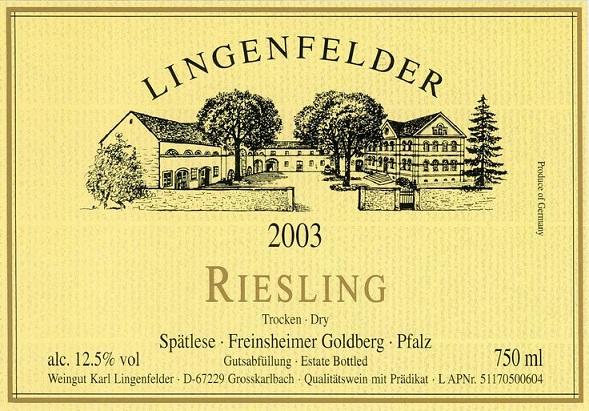
German wine labels have a reputation for being intimidating, and it’s partly deserved. A single bottle can carry a vineyard name, a village, a grape, a ripeness level, a sweetness term, a region, and a long number that looks like a lottery ticket. Even people who enjoy the wine often give up and just pick by the picture on the front.
It’s easier than it looks, once you know two ideas. First, the famous ripeness words (Kabinett, Spätlese, Auslese) describe how ripe the grapes were at harvest, not how sweet the wine is. Second, the sweetness is stated separately, in words like trocken (dry). Keep those two apart, and the rest falls into place.
A Sample Label, Decoded
Here’s a made-up label, with each piece explained.
Weingut Beispiel
2023 Riesling Kabinett feinherb
Mosel
Prädikatswein, 8.5% vol
A.P. Nr. 1 234 567 08 24
| On the label | What it tells you |
|---|---|
| Weingut Beispiel | The producer (Weingut means wine estate) |
| 2023 | The vintage, the year of the harvest |
| Riesling | The grape variety |
| Kabinett | The ripeness level at harvest, the lightest of the Prädikat levels |
| feinherb | Sweetness: off-dry, somewhere between dry and medium-sweet |
| Mosel | The wine region (Anbaugebiet) |
| Prädikatswein | The quality category |
| 8.5% vol | Alcohol, relatively low |
| A.P. Nr. | The official testing number (Amtliche Prüfungsnummer), which shows the wine passed official quality control |
So this is a light, slightly sweet Riesling from the Mosel, harvested at modest ripeness. If you like crisp and refreshing, you’d probably enjoy it.
The Quality Ladder
German wine law, in place since the 1970s, groups wines into categories, from the simplest to the most demanding:
- Deutscher Wein. Basic table wine.
- Landwein. Regional wine with a protected geographical indication.
- Qualitätswein. Quality wine from one of Germany’s 13 designated regions, which must be named on the label.
- Prädikatswein. The top tier, graded by the ripeness of the grapes at harvest, with no added sugar allowed.
The Six Prädikat Levels
Prädikatswein has six levels, ranked by the sugar content of the grape juice (the must weight, measured in degrees Oechsle) when the grapes were picked.
| Level | Meaning | Style |
|---|---|---|
| Kabinett | The lightest level, from fully ripe grapes | Light, high acidity, dry to medium-sweet, often low in alcohol |
| Spätlese | “Late harvest,” picked riper | Fuller, more concentrated |
| Auslese | “Select harvest,” with especially ripe bunches | Rich, sometimes with noble rot |
| Beerenauslese (BA) | Individually selected, very ripe berries | Always sweet, a dessert wine |
| Eiswein | Grapes harvested while frozen | Always sweet and intense |
| Trockenbeerenauslese (TBA) | Shriveled, extremely ripe, noble-rot berries | The sweetest and rarest |
The minimum must weight depends on the region and grape. For Riesling in the Mosel, for example, the minimum is around 70 degrees Oechsle for Kabinett and 76 for Spätlese. The key point is that a Kabinett, Spätlese, or Auslese can be made dry or sweet, depending on how the winemaker ferments it. A Spätlese trocken is a full-bodied dry wine, while a plain Spätlese is typically sweeter. Beerenauslese, Eiswein, and Trockenbeerenauslese are always sweet.
The Sweetness Words
Sweetness is stated in a separate term, which is the one to look for if you want to avoid surprises:
| Term | Meaning | Residual sugar |
|---|---|---|
| Trocken | Dry | Up to 4 g/L, or up to 9 g/L if the acidity is high enough to balance it |
| Halbtrocken | Off-dry | Up to 18 g/L, with the acidity condition |
| Feinherb | An unofficial term for off-dry, between halbtrocken and sweeter | Not legally defined |
| Lieblich | Medium-sweet | Roughly 18 to 45 g/L |
| Süß | Sweet | More than 45 g/L |
According to one industry overview, roughly half of German quality and Prädikat wine is now sold in a dry style, so a “trocken” bottle isn’t hard to find.
The VDP: A Second Ladder
You’ll also see an eagle logo on many top bottles. It belongs to the VDP, the Verband Deutscher Prädikatsweingüter, an association of around 200 leading estates founded in 1910. It’s not state law, but a producers’ quality classification modeled on Burgundy, with four tiers:
- VDP.Gutswein. Entry-level estate wine.
- VDP.Ortswein. Village wine.
- VDP.Erste Lage. First-class vineyards, comparable to premier cru.
- VDP.Grosse Lage. The best vineyards, comparable to grand cru.
When a dry wine comes from a Grosse Lage vineyard, it’s called a Grosses Gewächs, or GG for short. These are strictly regulated: yields are capped, the grapes are hand-harvested, and the wine is classified as dry. The bottle is often embossed with “GG.” If you’re after Germany’s best dry white wines, this is where to look.
The 13 Regions
Germany has 13 designated wine regions (Anbaugebiete): Ahr, Baden, Franken, Hessische Bergstraße, Mittelrhein, Mosel, Nahe, Pfalz, Rheingau, Rheinhessen, Saale-Unstrut, Sachsen, and Württemberg. Rheinhessen is the largest, at about 27,500 hectares, and the country has around 104,000 hectares under vine in total. A few useful associations:
- Mosel. Steep slopes along the river, and the home of light, low-alcohol Riesling.
- Rheingau. A classic Riesling region on the Rhine.
- Franken. Known for Silvaner and the flat, round-bellied Bocksbeutel bottle. See our guide to the Romantic Road for the area around Würzburg.
- Baden. In the southwest, with a warmer climate and many Pinot varieties, next to the Black Forest.
- Württemberg. The southwest’s red-wine country, where much of the production is drunk locally.
On the shores of Lake Constance, vineyards around Meersburg and Hagnau add to the picture.
How to Choose a Bottle
| If you want… | Look for |
|---|---|
| A crisp, dry white | Trocken on a Riesling, Weißburgunder, or Silvaner |
| Something light and low in alcohol | A Mosel Kabinett |
| A refreshing, slightly sweet wine | Feinherb or halbtrocken Riesling |
| A rich dessert wine | Auslese or higher, without “trocken” |
| A special occasion dry white | A VDP Grosses Gewächs |
| A simple everyday bottle | A Qualitätswein or VDP Gutswein |
Drinking Like a German
- Try a Weinschorle. Wine mixed with sparkling water is a popular summer drink in Germany, and a good use for a lighter white.
- Order by the glass. In wine regions, a “Schoppen” is a traditional serving, and in the Palatinate it’s often served in a special glass.
- Visit a wine festival. Many wine villages hold festivals in late summer and autumn.
- Try Federweißer in early autumn. This young, partly fermented wine is a seasonal specialty, usually paired with onion tart.
For more on German drinks, see our guides to German wine, Apfelwein, and German beer styles, or browse our German cuisine pages.
FAQ
What does Kabinett mean on a German wine?
It’s the lightest Prädikat level, indicating fully ripe grapes harvested at modest ripeness. It says nothing about sweetness, so a Kabinett can be dry or sweet.
What does Trocken mean?
Dry. By law, trocken wines contain no more than 4 g/L of residual sugar, or up to 9 g/L if the acidity balances it.
What is Feinherb?
An unofficial term for off-dry wine, with some residual sugar, usually between halbtrocken and medium-sweet in style.
What is a Grosses Gewächs?
A dry wine from a VDP Grosse Lage vineyard, often abbreviated GG and considered among Germany’s best dry white wines.