

Standing beneath a German Zeppelin in its hangar, passengers preparing for transatlantic flights in the 1930s confronted something that defied everyday experience – an 800-foot structure that somehow floated, that carried dozens of people across oceans at 80 miles per hour, that combined the lightness of balloons with the strength of buildings. Understanding how these magnificent machines actually worked requires appreciating both the engineering brilliance that made them possible and the fundamental physical principles that ultimately doomed them. The German Zeppelin represented perhaps the most audacious application of basic physics and engineering ingenuity in aviation history, creating flying machines whose very existence seemed to violate common sense about what objects that large could do.
The engineering challenges Count Ferdinand von Zeppelin and his successors faced were extraordinary. They needed to create structures light enough to float yet strong enough to withstand aerodynamic forces, large enough to carry useful payloads yet controllable enough to navigate precisely, and reliable enough for passenger service across unpredictable ocean weather. Solving these challenges required innovations in materials science, structural engineering, aerodynamics, propulsion systems, and operational procedures. The resulting Zeppelin designs represented technological achievement that remains impressive even by contemporary standards, though fatal limitations built into their fundamental architecture would ultimately prove insurmountable.
The Rigid Framework: Aluminum Skeleton in the Sky

What distinguished Zeppelins from earlier airships and contemporary blimps was their rigid internal framework – a complete structural skeleton that maintained the airship’s shape independently of gas pressure. This fundamental design decision enabled the enormous sizes that made Zeppelins practical but also created complex engineering challenges.
The framework consisted of longitudinal girders running the length of the airship and circular transverse rings spaced along these girders, creating a cylindrical structure reminiscent of a fish skeleton. This lattice framework used aluminum alloy – chosen for its superior strength-to-weight ratio compared to other available materials. The specific aluminum alloy, called duralumin, contained copper, manganese, and magnesium additions that significantly increased strength while maintaining aluminum’s light weight. This material choice was crucial; steel would have been prohibitively heavy, while pure aluminum lacked necessary strength.
The framework’s design balanced competing demands. It needed sufficient strength to resist aerodynamic forces during flight – imagine an 800-foot long structure experiencing wind forces at 80 miles per hour. It needed to flex enough to absorb stresses without breaking, yet maintain shape precisely enough to preserve aerodynamic efficiency. It needed to support the weight of engines, fuel, crew quarters, passenger accommodations, and payload while itself weighing as little as possible, since every pound of structure reduced lift available for useful load.
German engineers solved these challenges through sophisticated structural analysis and innovative construction techniques. The framework members were built up from smaller aluminum pieces riveted together, creating complex trusses that distributed loads efficiently. The longitudinal girders and transverse rings worked together as an integrated structure where loads could be shared across multiple members, providing redundancy that enhanced safety and allowed weight savings compared to simpler designs.
The framework’s outer covering deserves particular attention. This fabric skin – treated with compounds to improve weatherproofing and reduce weight – served primarily aerodynamic functions, creating smooth surfaces that reduced drag and protected the internal structure and gas cells from weather. The covering contributed virtually no structural strength; the rigid framework beneath carried all loads. This separation of structural and aerodynamic functions represented sophisticated engineering thinking that wouldn’t become common in aircraft design for decades.
The Gas Cells: Hydrogen’s Blessing and Curse
At the heart of Zeppelin operation lay the gas cell – enormous fabric bags filled with hydrogen that provided the lift making flight possible. Understanding these gas cells reveals both the engineering cleverness that made Zeppelins work and the fatal vulnerability that ultimately destroyed them.
A large Zeppelin like the Hindenburg contained 16 to 17 separate gas cells, each holding hundreds of thousands of cubic feet of hydrogen. These cells weren’t rigidly attached to the framework but rather hung from it like bags, free to change shape as the hydrogen expanded or contracted with temperature and altitude changes. This arrangement allowed the cells to accommodate gas volume changes without damaging either themselves or the framework.
The gas cells were constructed from goldbeater’s skin – the outer membrane of cattle intestines that had been processed to create an extremely thin, lightweight, yet relatively gas-tight material. Multiple layers of goldbeater’s skin were laminated together with rubber cement to create material that could contain hydrogen reasonably well while remaining light enough not to consume excessive lift capacity. Manufacturing these enormous gas cells required specialized skills, as any weak points or poor seams would allow hydrogen leakage that reduced lifting capacity and created fire hazards.
Hydrogen provided excellent lift – it’s the lightest element and provides about 92% of helium’s lifting power while being far cheaper and more readily available in the 1920s and 1930s. However, hydrogen’s extreme flammability represented the Zeppelin’s fundamental vulnerability. Any ignition source – static electricity sparks, mechanical friction, lightning, or enemy incendiary ammunition – could transform a Zeppelin into a towering inferno within seconds. The entire airship essentially flew as an enormous bomb waiting for ignition.
Gas management during flight represented continuous operational challenges. As Zeppelins climbed, atmospheric pressure decreased and hydrogen expanded, potentially bursting gas cells if unchecked. Automatic pressure relief valves released excess hydrogen to prevent this, but hydrogen released meant lift lost. As fuel was consumed during long flights, the airship became lighter and would rise unless ballast was dropped or gas was vented. Skillful gas and ballast management – conserving both hydrogen and ballast to maintain optimal buoyancy – distinguished expert crews from mediocre ones.
The framework’s internal volume wasn’t entirely filled with gas cells. Spaces between cells and between cells and the outer covering allowed hydrogen that leaked from cells to accumulate. Ventilation systems attempted to remove this accumulated hydrogen before it reached dangerous concentrations, but the system was imperfect. The Hindenburg disaster likely involved ignition of hydrogen-air mixture in these spaces between gas cells and outer covering – a design vulnerability that the elaborate safety systems couldn’t completely eliminate.
Propulsion and Control: Making Giants Steerable
Creating lift solved only part of the Zeppelin challenge. Making these enormous structures steerable and controllable required sophisticated propulsion and control systems that represented significant engineering achievements in their own right.

Zeppelins used multiple internal combustion engines mounted in gondolas attached to the framework’s exterior. These engines – typically modified aircraft engines or specially designed airship power plants – drove large propellers that provided thrust. The Hindenburg carried four 1,200-horsepower diesel engines, mounted in separate gondolas positioned along the airship’s sides. This distributed propulsion arrangement provided redundancy (the loss of one or even two engines didn’t prevent flight) and allowed differential thrust that aided maneuvering.
Diesel engines offered advantages for airship applications despite being heavier than gasoline engines of equivalent power. Diesel fuel was less flammable than gasoline, reducing fire risk in a hydrogen-filled environment. Diesel engines also provided better fuel efficiency, crucial for transoceanic flights where fuel weight significantly affected range and payload capacity. The engines’ weight disadvantage became acceptable given these safety and efficiency benefits.
Control surfaces at the Zeppelin’s stern provided directional and pitch control. Large vertical fins with movable rudders allowed steering left and right, while horizontal elevators controlled pitch (nose up or down). These control surfaces worked on the same aerodynamic principles as airplane controls but on a vastly larger scale. Moving these enormous control surfaces required substantial force, so they incorporated mechanical advantage systems and later hydraulic assistance to allow helmsmen to operate them.
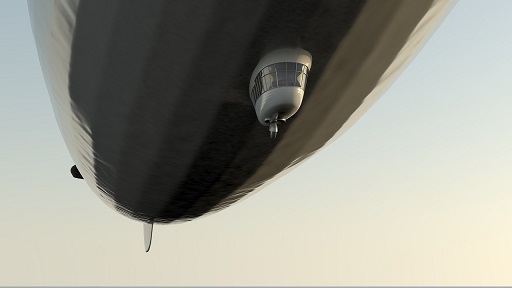
The control car – a gondola beneath the Zeppelin’s forward section – housed the navigation bridge where officers controlled the airship. From here, the captain, helmsmen, and navigators operated steering wheels and elevator controls, monitored instruments showing altitude, airspeed, heading, and engine status, and directed the crew managing ballast, gas, and engines. The control car provided visibility forward, downward, and to the sides, essential for navigation and landing operations.
Ballast management represented a crucial control aspect. Water ballast carried in tanks throughout the airship could be released to reduce weight and increase lift, while gas could be vented to reduce lift when descent was needed. Landing required precise coordination of ballast drops, gas venting, and engine power to bring the enormous airship gently to the mooring mast or ground crew. This operation demanded exceptional skill – small errors in a structure weighing many tons, with enormous momentum and wind sensitivity, could lead to crashes.
Passenger Accommodations: Luxury Inside the Framework
One of the Zeppelin’s most remarkable aspects was how engineers created comfortable, even luxurious passenger accommodations inside a structure that was fundamentally a giant gas-filled aluminum framework. The passenger quarters represented a triumph of lightweight construction and clever space utilization.
Passenger accommodations were housed in a separate structure built inside the main framework, positioned along the airship’s lower section where minimal gas cell interference occurred. This accommodation deck was essentially a building-within-a-building, with its own framework supporting cabins, lounges, dining rooms, and service spaces. Every structural element, wall panel, furnishing, and fixture was obsessively weight-optimized – furniture used aluminum tubing and lightweight fabrics, walls were thin but insulated panels, and even the grand piano aboard the Hindenburg was specially constructed from aluminum to save weight.
The cabins, though small by ocean liner standards, provided private sleeping accommodations with proper beds, wash basins, and even windows looking outward through the airship’s skin. Passengers could watch the world passing beneath them from the comfort of their cabins – an experience impossible in contemporary aircraft and unique to airship travel.
Common areas included dining rooms where passengers took meals served on fine china (specially lightweight versions), lounges with large slanted windows offering spectacular views, promenade decks allowing passengers to walk while watching the landscape below, and even a smoking room. The smoking room represented extraordinary engineering confidence – or hubris. Located inside a hydrogen-filled airship, it was pressurized with inert gas and featured an airlock entry to prevent hydrogen from entering. Passengers could smoke cigars and cigarettes inside a flying hydrogen bomb, separated from ignition by engineering systems whose failure would mean instant death.
Environmental control presented significant challenges. At altitude, outside temperatures could be well below freezing, while the large windows allowed heat loss. The engines generated waste heat that could be ducted to passenger areas, but the lightweight construction provided minimal insulation. Passengers sometimes needed warm clothing even in summer flying, though the dining room’s heat and the lounge’s sunlight through large windows created comfortable spaces.
The crew areas, separate from passenger accommodations, were far more utilitarian. Crew bunks were minimal, food storage and preparation areas were cramped, and working conditions in engine gondolas were noisy, vibration-filled, and sometimes dangerous. The contrast between passenger luxury and crew utility mirrored ocean liner divisions but was more extreme given the severe weight constraints that made any unnecessary comfort unaffordable in terms of payload capacity.
The Fatal Flaw: Why Zeppelins Couldn’t Survive

Understanding Zeppelin engineering reveals why, despite sophisticated design and genuine achievement, rigid airships ultimately couldn’t compete with airplanes and why the Hindenburg disaster effectively ended the era. The fatal flaws were built into the fundamental architecture.
Hydrogen’s flammability represented the most obvious vulnerability. No amount of safety systems could eliminate the fundamental fact that Zeppelins were flying bombs. A single ignition source could destroy the entire vessel in seconds. The Hindenburg disaster demonstrated this catastrophically, but many earlier Zeppelin losses – both civilian and military – involved fire. Helium would have solved this problem, but American helium monopoly and export restrictions made helium-filled passenger Zeppelins impossible for Germany.
Structural vulnerability to weather represented another insurmountable limitation. The enormous structures, while impressive engineering achievements, couldn’t withstand severe weather that airplanes could fly through or avoid entirely through superior speed. Several Zeppelins broke apart in storms, their frameworks unable to resist forces that overwhelmed the structural strength. This weather vulnerability meant Zeppelins couldn’t operate safely in all conditions, limiting their reliability and practical utility.
Speed limitations doomed Zeppelins competitively. Aerodynamic drag limited even the most powerful Zeppelins to 80-85 miles per hour maximum speed – fast for 1930s but increasingly uncompetitive as airplane performance improved. The fundamental physics of moving such enormous structures through air meant that achieving higher speeds would require disproportionately more power, making speed increases impractical.
Economic factors sealed the Zeppelin’s fate. These enormous machines required huge infrastructure – specialized construction facilities, enormous hangars, trained crews, ground handling teams – that made them economically uncompetitive with airplanes that needed only runways and standard facilities. As airplane range, capacity, and comfort improved through the 1930s and 1940s, Zeppelin advantages disappeared while their disadvantages remained.
Modern Perspective: Engineering Lessons from the Zeppelin Era
Examining Zeppelin engineering from a contemporary perspective reveals both remarkable achievements and instructive failures. These airships represented what could be accomplished with early 20th-century technology, sophisticated engineering thinking, and willingness to accept risks that contemporary standards would find unacceptable.
The structural engineering remains impressive – creating frameworks that large and light required sophisticated analysis and innovative construction techniques that influenced later aerospace engineering. The gas cell design, the control systems, the lightweight construction methods for passenger accommodations – all represented genuine innovation that solved difficult problems elegantly.
However, the Zeppelin story also teaches about technological dead ends. Not every engineering achievement leads to lasting success. The rigid airship, despite representing remarkable engineering, was ultimately an evolutionary dead end superseded by heavier-than-air craft. Enormous investment, sophisticated engineering, and genuine achievement couldn’t overcome fundamental limitations built into the airship concept.
The modern Zeppelin NT represents how airship engineering can succeed when realistic about capabilities and limitations. These contemporary airships are much smaller, use safe helium, incorporate modern materials and systems, and serve applications where airships offer genuine advantages – tourism, advertising, aerial observation – rather than attempting to compete in transportation where airplanes dominate completely.
The Engineering Marvel That Couldn’t Last
German Zeppelin engineering represented an extraordinary achievement – the creation of functional flying machines of unprecedented size using early 20th-century technology. The sophisticated solutions to structural, propulsion, control, and operational challenges demonstrated genuine engineering brilliance. For a brief period, these magnificent airships fulfilled their promise, carrying passengers across oceans in comfort and style that contemporary aircraft couldn’t match.
Yet the Zeppelin also demonstrated that engineering excellence alone cannot overcome fundamental flaws. Hydrogen’s flammability, structural vulnerability, speed limitations, and economic disadvantages were built into the rigid airship concept and couldn’t be engineered away with better design or more sophisticated systems. The Hindenburg disaster didn’t cause the airship era’s end – it merely provided the dramatic moment when fundamental vulnerabilities could no longer be ignored or rationalized.
Understanding how German Zeppelins worked reveals the remarkable capabilities of early aviation engineering while simultaneously explaining why these magnificent machines disappeared. They remain testament to human ambition, engineering ingenuity, and the ultimate truth that sometimes even the most sophisticated technology serves ideas whose time has passed – or perhaps never really arrived at all.
Related articles:
German Zeppelin: The Rise and Fall of Germany’s Giant Airships
The Death of the Hindenburg: The Catastrophe That Ended the Airship Era
Transportation Future
Zeppelin Airships
Zeppelins the Bombers
The Death of the Hindenburg