

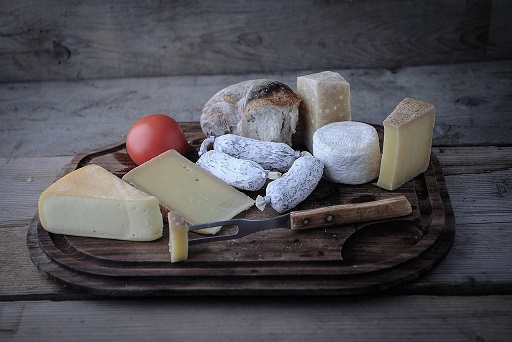
France gets the reputation, Switzerland gets the fondue, and Italy gets the Parmesan. Germany, meanwhile, quietly eats a record amount of cheese. According to the official statistics, the average German consumed 26.4 kilograms in 2025, a new high, up from 25.4 kilograms in 2024. The country produced about 2.7 million tonnes of cheese in 2024, considerably more than it eats, and it exports the rest.
Yet German cheese is rarely the star of a trip. That’s a shame, because the counter in a German supermarket or market stall is full of things worth knowing. Here’s a walk along it, from the freshest cheeses to the hardest, following the way German law and shop signs group them.
Fresh Cheese (Frischkäse): Start with Quark
Quark is the cheese most Germans eat without thinking of it as cheese. It’s a soft, creamy, slightly tangy fresh cheese, somewhere between yogurt and cream cheese, sold in tubs as Speisequark. It’s used everywhere: in breakfast spreads, in dips with herbs (Kräuterquark), over baked potatoes, in desserts, and as the base of German cheesecake. Our guide to Kaffee und Kuchen explains why Käsekuchen is a staple. Other fresh cheeses in the same group include Schichtkäse and double-cream and cream cheeses.
Sour Milk Cheese (Sauermilchkäse): The Strong Ones
This is the most distinctly German group, and the one that confuses visitors most.
Harzer Käse is a low-fat, firm, very pungent cheese made from soured milk, traditionally from the Harz mountains. Handkäse is the Hessian version, a small, translucent round that’s usually served marinated with onions, vinegar, oil, and caraway. The famous order, Handkäse mit Musik (“with music”), is said to get its name from the playful effects of the raw onions. Both belong to the same category as Korbkäse, and sour milk cheeses like these (or Quark) are the base of Kochkäse, a spreadable Hessian cooked cheese. You’ll find them in beer gardens and cider taverns, and they pair well with the apple wine described in our guide to Apfelwein.
Soft Cheese (Weichkäse): Camembert and the Smelly Ones
The soft cheese group includes Camembert and Brie, but the interesting German entries are the smear-ripened, washed-rind cheeses: Limburger and Romadur. They’re famous for a strong smell, a mild, creamy interior, and a loyal following. Limburger is traditionally eaten on dark bread with onions. Both are made in the Allgäu region today, even though the name Limburger refers to a historic area now in Belgium.
Semi-Hard Cheese (Schnittkäse): The Everyday Cheeses
This is the group that dominates production and plates. Semi-hard cut cheeses accounted for around 31 percent of German cheese production in 2024. The main members are:
- Gouda and Edamer. Dutch-style cheeses that are the everyday sandwich cheese. In Germany, Gouda is the most consumed single variety, at around 3.7 kilograms per person per year.
- Tilsiter. A tangy, slightly sharp cheese named after the town of Tilsit in former East Prussia, and now made in several regions, including Schleswig-Holstein. Sometimes it’s flavored with caraway or pepper.
- Butterkäse. A very mild, buttery, soft-textured cheese popular with children and anyone who likes it gentle.
Hard Cheese (Hartkäse): The Allgäu
If there’s a heartland of German hard cheese, it’s the Allgäu, the Alpine foothill region of southern Bavaria and Baden-Württemberg. Its two best-known cheeses both have EU protected status (PDO):
- Allgäuer Emmentaler. A large-holed, nutty cheese that goes back to 1821, when the Swiss cheesemaker Josef Aurel Stadler brought Swiss methods to the region. It earned its protected designation in 1997.
- Allgäuer Bergkäse. The “mountain cheese,” made from the milk of cows grazing on herb-rich Alpine meadows. It’s firmer, more aromatic, and the typical choice for a Käsespätzle. See our recipe for Swabian Käsespätzle and our guide to German dumplings.
Both are named in many regional recipes, along with Weißlacker, another Allgäu cheese. The region begins near Füssen, the end point of the Romantic Road.
Blue and Mold-Ripened Cheeses
Germany makes several blue cheeses, including Bavaria Blu, a creamy Bavarian blue cheese, and Cambozola, a hybrid of Camembert and Gorgonzola that’s a supermarket staple. In the official classification, mold-ripened blue cheeses (Edelpilzkäse) fall into the semi-soft category.
Goat and Sheep Cheese
Altenburger Ziegenkäse is a protected goat cheese produced only in a few districts of Thuringia and Saxony-Anhalt. Sheep and goat cheeses such as Hirtenkäse (a feta-style cheese) are also popular, particularly in salads and as a lighter option.
Cheese on the German Table
Cheese is built into the daily routine. At breakfast, there’s cheese on bread or rolls. At Abendbrot, the cold evening meal, it’s one of the main items, sliced thin with cold cuts. For how the day is organized, see our guide to German meal times and our overview of German bread culture. Cheese also appears in the hot kitchen: melted over Spätzle, baked into gratins, or blended into a dip like Obatzda, the Bavarian beer-garden spread made with Camembert, butter, and paprika.
How to Buy Cheese in Germany
- At the counter. At a supermarket deli or market stall, cheese is sold by weight. Say “Ich hätte gern 200 Gramm Bergkäse, bitte” (I’d like 200 grams of Bergkäse, please), and add am Stück (in one piece) or in Scheiben (sliced).
- Ask to taste. Counter staff usually don’t mind a small sample.
- Look for the protected label. The red-and-yellow PDO seal on a cheese like Allgäuer Bergkäse or Emmentaler indicates it was made in the designated region.
- If you’re pregnant, check the advice. German food-safety guidance for pregnancy typically suggests avoiding soft and smear-ripened cheeses such as Camembert, Limburger, and Handkäse, so ask your doctor or midwife.
- Visit the Allgäu. Many dairies and mountain huts in the Allgäu sell their own cheese directly.
- Combine it with wine or beer. Our guides to German wine labels and German beer styles can help you choose a drink.
For more dishes, browse our German cuisine pages.
FAQ
What is the most popular cheese in Germany?
Gouda is the most consumed single variety, at about 3.7 kilograms per person per year, followed by other semi-hard cheeses.
How much cheese do Germans eat?
About 26.4 kilograms per person in 2025, a record, up from 25.4 kilograms in 2024, according to official statistics.
What is Quark?
A soft, fresh cheese with a creamy, slightly sour taste, used in spreads, dips, cakes, and desserts.
What is Handkäse mit Musik?
A Hessian sour milk cheese marinated with onions, vinegar, oil, and caraway. The “Musik” refers to the effect of the onions.