German Culture

All about Germany

  • Home
  • Learn German
    • German Language Basics
    • German Grammar & Vocabulary
    • German Learning Tips
    • German Idioms & Expressions
    • German Quizzes & Exercises
  • Articles
    • Famous Germans
    • German Holidays
    • German Cuisine
    • How To In Germany
    • Daily Life in Germany
    • German Facts
    • German Traditions
  • Facts About Germany
  • German History
    • Early History of Germany
    • Middle Ages in German History
    • German Reformation Period
    • 19th Century and German Unification
  • German Recipes
    • German Baking Recipes
    • German Bread Recipes
    • German Christmas Recipes
    • Desserts
    • German Easter Recipes
    • Halloween Recipes
    • Main Dishes
    • German Salad Recipes
    • German Salads
    • Sauerkraut Recipes
  • Travel to Germany
  • Contact

January 7 in German History

January 7, 1742

Birth of the enlightenment philosopher, Christian Garve. Garve was a professor at the University of Leipzig. He was noted as a moral philosopher and the translator to German of Cicero’s De Officiis and the works of Edmund Burke and Adam Smith.

January 7, 1830

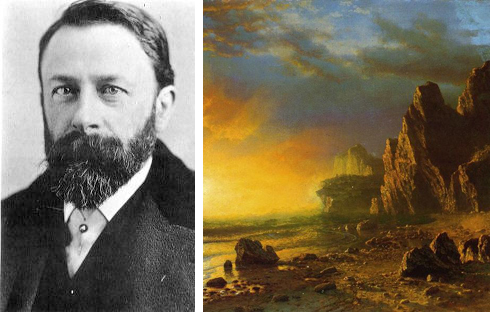
Birth of Albert Bierstadt (1830-1902) in Solingen, Germany. Bierstadt immigrated to the U.S.A. and became a very popular painter with grandiose scenes of the American West. He was a part of the “Hudson River School”.

January 7, 1890

Death of Maria Luise Augusta Katharina in Berlin, Germany. She was the Empress of the German Reich after 1871 as the wife of Wilhelm I. Her son became Emperor Friedrich III.

January 7, 1893

Death of Josef Stefan in Vienna, Austria. Stefan was a physicist at the University of Vienna. He concluded a law of physics through empirical studies, the Stefan-Boltzmann law. According to that law a blackbody has a radiant energy proportional to the fourth power of its temperature. The Boltzmann in the Stefan-Boltzmann law was another Austrian who proved the law theoretically.

January 7, 1918

Death of Julius Wellhausen in Gottingen, Germany. Wellhausen was a Biblical scholar who was a professor of Old Testament at the University of Greifswald. He is most known for his work on the Pentateuch.

January 7, 1956

uwe-ochsenknecht

Birth of the actor, Uwe Ochsenknecht. He played in Die Straße, Derrick, Tatort, Das Boot, Manner and Schtonk.

Back to Today in German History Calendar

You might also like:

  • The Enlightenment in the German States: Reform, and Revolution
    The Enlightenment in the German States
  • German Literature
    The Rich Tapestry of German Literature: From the…
  • German philosophy
    Exploring the Depths of German Philosophy: A Journey…
  • Georg Wilhelm Friedrich Hegel
    Georg Wilhelm Friedrich Hegel: Philosophy and Influence
  • The Franco-Prussian War - The Conflict That United Germany
    The Franco-Prussian War (1870–71)
  • Frederick the Great of Prussia: Warrior and Reformer
    Frederick the Great of Prussia
  • Käthe Paulus - German inventor
    Katharina Paulus: The German Inventor Who…
  • Traditional Three Kings’ Cake Recipe
    Three Kings’ Cake Recipe

Recent Posts

Are German stereotypes true?

German Stereotypes: What’s True and What’s Not

German work culture has many strength

German Work Culture: What Makes It So Different?

Why is German culture so efficient

Why Is German Culture So Efficient? The Secrets Behind It

Modern Germany is one of the most diverse countries in Europe.

What Do Germans Think of Foreigners? The Truth Explained

Foundation of German Culture

German Values and Beliefs: What Shapes Daily Life

German friendliness just looks different.

Are Germans Friendly or Rude? Breaking the Stereotype

Why Germans value rules so highly

Why Do Germans Love Rules? Ordnung Explained

Examples of German Directness

Why Are Germans So Direct? Understanding Blunt Communication

Copyright © 2026 · German Culture

Go to mobile version