German Culture

All about Germany

  • Home
  • Learn German
    • German Language Basics
    • German Grammar & Vocabulary
    • German Learning Tips
    • German Idioms & Expressions
    • German Quizzes & Exercises
  • Articles
    • Famous Germans
    • German Holidays
    • German Cuisine
    • How To In Germany
    • Daily Life in Germany
    • German Facts
    • German Traditions
  • Facts About Germany
  • German History
    • Early History of Germany
    • Middle Ages in German History
    • German Reformation Period
    • 19th Century and German Unification
  • German Recipes
    • German Baking Recipes
    • German Bread Recipes
    • German Christmas Recipes
    • Desserts
    • German Easter Recipes
    • Halloween Recipes
    • Main Dishes
    • German Salad Recipes
    • German Salads
    • Sauerkraut Recipes
  • Travel to Germany
  • Contact

Wieskirche – The Pilgrimage Church

The Pilgrimage Church of Wies

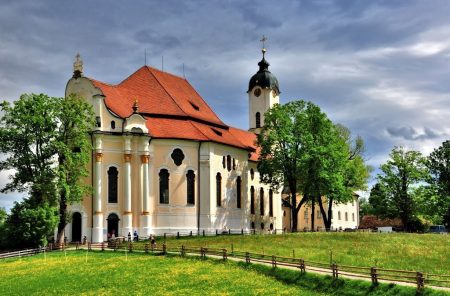
The Wieskirche, or Wies Church, is one of the most important places of pilgrimage in southern Germany.

It is situated between Steingaden and Wildsteig on the Romantic Road – or, to be more accurate, slightly off the road on a country lane to the small hamlet of Wies.

The Pilgrimage Church of Wies is an oval rococo church, designed in the late 1740s by brothers J. B. and Dominikus Zimmermann, the latter of whom lived nearby for the last eleven years of his life.

The Wieskirche is also one of the most famous works from the Rococo period of art and architecture and its position close to the Romantic Road, the religious attraction of Oberammergau and the Passion Play and the historic buildings of Neuschwanstein and Hohenschwangau ensure that it is popular with many coach tours and day-trips from surrounding villages and towns.

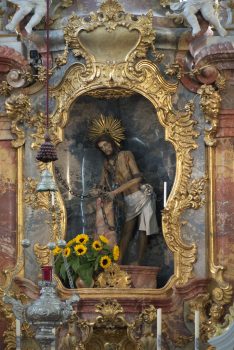
Scourged Saviour, Wieskirche

Like many pilgrimage churches in the area, the prominence of the Wieskirche came about through a religious “wonder”.

In this case, it was a fairly prosaic statue of the “Scourged Saviour” which had been taken from the inn of the monastery in Steingaden by a farmer’s wife in Wies. In 1738 they claimed that they had seen tears in the eyes of the statue at their evening prayers.

Eventually more and more visitors came to see the statue and to pray and a new building was needed to accommodate them (and, of course, to promote the religious wonder and the economic benefits to the area).

In the mid-18th century the current church was built by the Zimmermann brothers, who were local artists and architects whose work in this period can be found all over Europe. The style is the elaborate gilt, stucco and art mixed in with white that was the feature of this Rococo epoch and which can be found in other Bavarian and Tyrolean churches and historic buildings.

The church was renovated in the 1980s to safeguard the original decoration and to bring the design more in line with the concepts of the artists at the time. It is on the list of UNESCO World Heritage protected buildings.

The church is of course used for normal purposes – visitors should note that sightseeing is not permitted during church services – but the principal Pilgrimage festival, the Feast of Christ’s Tears, is held on the first Sunday after June 14.


You might also like:

  • Religion in Modern Germany: Faith in a Secular Age
    Religion in Modern Germany: Faith in a Secular Age
  • German Pilgrimages and the Jakobsweg
    German Pilgrimages and the Jakobsweg
  • What Germans Believe Today
    What Germans Believe Today: Faith, Values, and Identity
  • Rothenburg ob der Tauber
    20 Things to Do in Rothenburg ob der Tauber: A Step…
  • Why Germans Still Pay Church Tax
    Why Germans Still Pay Church Tax
  • How Germany Handles Its Past
    How Germany Handles Its Past: Memory and Identity
  • German Reformation and Early Modern Period
    German Reformation and Early Modern Period
  • Nuremberg Christkindlesmarkt: Germany's Famous Christmas Market
    Nuremberg Christkindlesmarkt: Germany's Famous…

Recent Posts

Rules for Tourists in Germany

What Not to Do in Germany: Mistakes Tourists Make

Are German stereotypes true?

German Stereotypes: What’s True and What’s Not

German work culture has many strength

German Work Culture: What Makes It So Different?

Why is German culture so efficient

Why Is German Culture So Efficient? The Secrets Behind It

Modern Germany is one of the most diverse countries in Europe.

What Do Germans Think of Foreigners? The Truth Explained

Foundation of German Culture

German Values and Beliefs: What Shapes Daily Life

German friendliness just looks different.

Are Germans Friendly or Rude? Breaking the Stereotype

Why Germans value rules so highly

Why Do Germans Love Rules? Ordnung Explained

Copyright © 2026 · German Culture

Go to mobile version