German Culture

All about Germany

  • Home
  • Learn German
    • German Language Basics
    • German Grammar & Vocabulary
    • German Learning Tips
    • German Idioms & Expressions
    • German Quizzes & Exercises
  • Articles
    • Famous Germans
    • German Holidays
    • German Cuisine
    • How To In Germany
    • Daily Life in Germany
    • German Facts
    • German Traditions
  • Facts About Germany
  • German History
    • Early History of Germany
    • Middle Ages in German History
    • German Reformation Period
    • 19th Century and German Unification
  • German Recipes
    • German Baking Recipes
    • German Bread Recipes
    • German Christmas Recipes
    • Desserts
    • German Easter Recipes
    • Halloween Recipes
    • Main Dishes
    • German Salad Recipes
    • German Salads
    • Sauerkraut Recipes
  • Travel to Germany
  • Contact

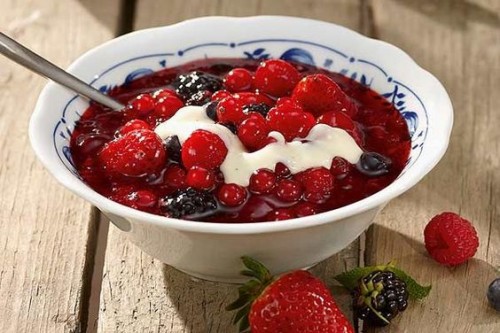
German Red Berry Pudding (Rote Grütze)

rote-grutze2

This refreshing summer dessert takes advantage of the cherry and berry season. Rote Grütze is a popular specialty from Northern Germany and has a lovely tart flavor. Serve with vanilla custard, cream or vanilla ice-cream.

Ingredients:

6 cups fresh or frozen, unsweetened berries (raspberries, strawberries, red currants, or a combination of these)
1/2 cup sugar
2 tbsp. cornstarch
1/4 cup cold water
1 tbsp. fresh lemon juice
1 tsp. vanilla extract

Preparation:

  1. For fresh berries: stem, wash and dry in a colander.  For frozen berries: thaw before using.
  2. For a smooth pudding, process berries in a blender, 2 cups at a time, until pureed.
  3. For a chunkier texture, process 4 cups, and chop the rest, blending with puree.
  4. Stir cornstarch in cold water until smooth.
  5. Combine berries and sugar in non-stick saucepan.  Bring to a boil over medium heat, stirring constantly.  Stir cornstarch mixture again, then add into the berry mixture gradually, while still stirring.
  6. Reduce heat and let simmer for 3 minutes, stirring constantly, until mixture starts to thicken.
  7. Remove from heat and stir in the lemon juice and vanilla.
  8. Pour into a serving bowl, or individual dessert bowls.
  9. Cover and chill in the refrigerator for 24 hours.
  10. This is traditionally garnished with a Vanilla Custard Sauce, but you may also use whipped cream, vanilla ice cream, or heavy cream.



You might also like:

  • Obstsalat mit Quark – Traditional Fruit Salad with Quark German Recipe
    Obstsalat mit Quark – Traditional Fruit Salad with Quark…
  • Christmas Tree Cupcakes
    Christmas Tree Cupcakes
  • Eierlikör - Traditional German Egg Liqueur Recipe
    Eierlikör - Traditional German Egg Liqueur Recipe
  • The Ultimate Guide to Spritzers: Refreshing, Effervescent, and Versatile
    The Ultimate Guide to Spritzers: Refreshing, Effervescent,…
  • Osterlamm Recipe – German Easter Lamb Cake
    Osterlamm Recipe – German Easter Lamb Cake
  • The Cozy Comfort of Kinderpunsch
    The Cozy Comfort of Kinderpunsch
  • Lachs mit Senfsauce – German Salmon with Mustard Sauce Recipe
    Lachs mit Senfsauce – German Salmon with Mustard Sauce…
  • Eierlikörtorte - Traditional German Egg Liqueur Cake Recipe
    Eierlikörtorte - Traditional German Egg Liqueur Cake Recipe

Recent Posts

"Kinder, Küche, Kirche" functions primarily as a historical artifact and cautionary phrase

“Kirche, Küche, Kinder”: Germany’s Three K’s

Women and German Military Traditions

Women in German Army: Historical Evolution

Hindenburg disaster

The Death of the Hindenburg: The Catastrophe That Ended the Airship Era

German wedding Tracht represents the most meaningful ways modern couples honor their cultural heritage.

German Wedding Tracht: History and Cultural Meaning

The History of Traditional German Clothing

The History of Traditional German Clothing

Krampus is the shadow to Saint Nicholas's light.

Krampus in Germany: Origins, Folklore, and Traditions

German Advent traditions, their history and customs.

Deep Guide to German Advent Traditions

How Lent Shaped German Culture

Lent in Germany: Traditions, History, and Rituals

Copyright © 2025 · German Culture

Go to mobile version