German Wedding Traditions: From Polterabend to Log Sawing
Picture this: it’s the night before a wedding, and instead of a quiet dinner or an early bedtime, the bride and groom are standing in someone’s driveway surrounded by broken plates, old sinks, and the occasional smashed toilet bowl. Neighbors have wandered over. Someone’s uncle is sweeping with far too much enthusiasm. This isn’t chaos – it’s tradition, and it’s one of the many reasons German weddings tend to surprise outsiders who expect something more buttoned-up.
Germany’s wedding customs blend centuries-old superstition with genuinely fun, community-driven rituals, and while some couples today pick and choose which ones to keep, plenty of these traditions are still going strong at weddings across the country – from small Bavarian villages to Berlin loft parties.
Polterabend: Breaking Things for Good Luck
The Polterabend, held a day or two before the wedding, is probably the most famous German wedding custom, and it’s exactly as loud as it sounds. “Poltern” roughly translates to “to make a racket,” and that’s the whole point.
Friends, family, and neighbors gather at the couple’s home – or sometimes a public spot – bringing old porcelain, ceramics, and ideally nothing made of glass, since glass is considered bad luck and, frankly, a much bigger cleanup job. Plates, cups, sinks, even old toilets have made appearances at particularly enthusiastic Polterabend parties. Guests smash everything on the ground in front of the couple, and the noise is meant to scare away evil spirits before the marriage.
Here’s the part that surprises people: the bride and groom don’t get to relax and watch. They’re handed brooms and dustpans and expected to clean up the entire mess together, right then and there. The symbolism is straightforward enough – if they can handle a pile of broken crockery as a team, they can handle whatever marriage throws at them. It’s messy, it’s a little absurd, and it’s genuinely one of the more charming customs still widely practiced, especially in smaller towns and among families with strong regional roots.
The Wedding Dress: Tradition Meets Modern Style
German wedding dress customs carry their own quiet superstitions, some of which have faded and some of which still hold on in certain families.
Traditionally, the bride’s dress was meant to be handmade or at least homemade in some part, a practice tied to older rural customs where a woman’s sewing skill was seen as part of her readiness for marriage. That expectation has mostly disappeared, and today’s German brides shop for dresses the same way brides do across much of Western Europe – bridal boutiques, custom designers, and increasingly, international online retailers.
One superstition that’s stuck around longer: the bride shouldn’t be seen in her full wedding outfit – dress, veil, and all – by the groom before the ceremony. This isn’t unique to Germany, but it’s taken fairly seriously in many families, sometimes with elaborate logistics to keep the groom out of the getting-ready room until the actual walk down the aisle.
Green is traditionally considered an unlucky color for a wedding dress in parts of Germany, tied to old folklore, though this is more of a regional or generational belief than a hard rule most modern couples worry about.
Sawing the Log: A Test of Teamwork
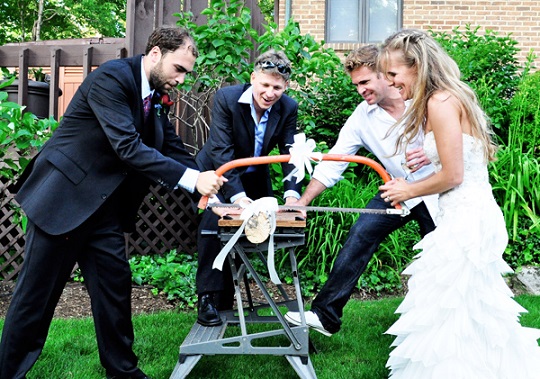
If there’s one tradition that photographs better than almost anything else at a German wedding, it’s Baumstamm sägen – literally, “sawing the tree trunk.”
Right after the ceremony, guests set up a large log on a sawhorse, hand the newlyweds a two-person crosscut saw, and the couple has to saw straight through it together, usually in their wedding attire, usually in front of a crowd cheering them on. It’s harder than it looks. The saw catches, the log wobbles, and there’s always a moment where it seems like it might take forever – which is sort of the point. Like the Polterabend cleanup, this is a hands-on demonstration that the couple can tackle a difficult, slightly awkward task as a team, right at the start of their marriage.
This one tends to show up more at weddings in southern Germany and rural areas, though it’s popular enough that plenty of couples request it specifically because it makes for great photos and gets guests laughing.
Kidnapping the Bride: A Playful Wedding-Day Chase
Another custom that catches visitors off guard is Brautentführung, or “kidnapping the bride.” At some point during the wedding reception – sometimes even earlier in the day – a group of friends will sneak the bride away from the venue, usually to a nearby bar or restaurant, without telling the groom where they’ve gone.
The groom’s job is to figure out where she’s been taken and track her down, sometimes visiting several bars in the process, often footing the bill for a round of drinks at each stop along the way as a “toll” for information. When he finally finds her, it’s treated as a triumphant reunion, complete with applause from whoever’s tagged along for the chase. Like several of these customs, it’s rooted in old-fashioned playfulness rather than anything sinister, and it’s become something of a bonding ritual for the groom’s friend group specifically.
Regional and Generational Differences
Not every German wedding includes every one of these customs, and the mix varies quite a bit depending on where you are and who’s getting married. Bavaria and other southern regions tend to hold onto older, more elaborate traditions – including specific folk costumes, brass band music, and more ritualized versions of the log sawing. Northern and urban weddings, particularly in cities like Hamburg or Berlin, often lean toward simplified or reinterpreted versions of these customs, sometimes skipping the Polterabend entirely in favor of a more low-key bachelor or bachelorette celebration influenced by international trends.
Younger couples increasingly treat these traditions as optional extras rather than obligations – something fun to include because it connects them to their grandparents’ generation, not because skipping it would cause a scandal. It’s common now to see a couple do the log sawing for the photos and the fun of it, while quietly deciding the Brautentführung isn’t really their scene.
A Few Practical Notes for Guests
If you’re attending a German wedding for the first time, a couple of things are worth knowing ahead of time. Bringing porcelain to smash at a Polterabend is a genuinely appreciated gesture – thrift stores and flea markets are the usual source, not your good dishware. Gift-wise, cash is common and welcomed, often placed in a decorated envelope or contributed toward a honeymoon fund rather than given as a physical present off a registry. And if you find yourself part of a bridal kidnapping crew, be ready to keep a straight face when the groom finally catches up.
Where These Traditions Are Headed
What’s interesting about German wedding customs right now is how selectively couples are reviving them. Rather than treating these rituals as outdated, plenty of younger Germans are bringing them back specifically because they stand out – a log-sawing photo says something a generic first dance doesn’t, and a driveway full of broken plates makes for a much better story than a quiet rehearsal dinner. Whether a couple leans into the full spread of customs or just picks their favorite, these traditions have a way of turning a wedding into something guests actually remember, long after the cake’s been eaten and the last plate’s been swept up.
FAQ
Do all German couples still do Polterabend? No – it’s still common, especially in smaller towns and among families with strong regional ties, but many urban and younger couples skip it or replace it with a low-key bachelor/bachelorette night instead.
What should guests bring to a Polterabend? Old porcelain, ceramics, or crockery – plates, cups, sinks – but never glass, which is considered bad luck. Flea markets and thrift stores are the usual source.
Why do German couples saw a log at their wedding? Baumstamm sägen symbolizes teamwork, showing that the couple can work through a difficult task together right at the start of their marriage. It’s also a popular photo moment.
Is bridal kidnapping still practiced in Germany? Yes, particularly among younger friend groups – Brautentführung remains a popular, lighthearted tradition where the groom has to track down the bride, often paying a “toll” of drinks along the way.