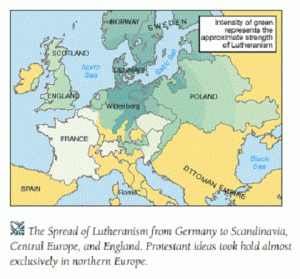
The Peace of Augsburg brought peace but did not settle the religious disagreements in Germany. For one thing, its signatories did not recognize Calvinism, a relatively stringent form of Protestantism that was gaining prominence around the time the Augsburg treaty was signed, in what has been called the Second Reformation. Adherents to both … [Read more...]
The Thirty Years’ War – Military Campaigns
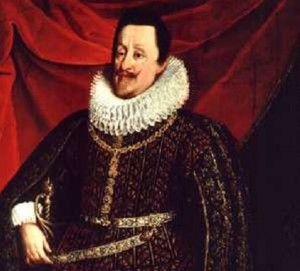
The Thirty Years' War resulted from a local rebellion, but the admixture of religion transformed it into a European conflict that lasted for more than a generation and devastated Germany. In 1618 Bohemian nobles opposed the decision of Emperor Matthias (r. 1608-19) to designate his Catholic cousin Ferdinand king of Bohemia. Instead, the nobles … [Read more...]
The Thirty Years’ War
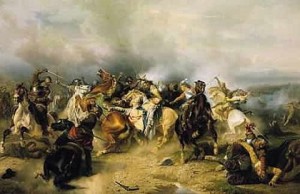
Germany enjoyed a time of relative quiet between the Peace of Augsburg, signed in 1555, and the outbreak of the Thirty Years' War in 1618. The empire functioned in a more regular way than previously, and its federal nature was more evident than in the past. The Reichstag met frequently to deal with public matters, and the emperors Ferdinand I (r. … [Read more...]
The Peace of Augsburg
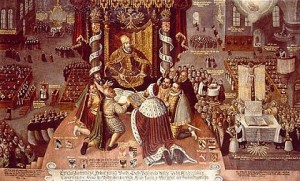
Imagine a country where the ruler’s religion dictated your own. No choice. No freedom of belief. Just the heavy hand of authority deciding how - and to whom - you should pray. Welcome to 16th-century Germany, a land torn by one of Europe’s fiercest struggles: the battle between Catholicism and Protestantism. And at the heart of this storm stood one … [Read more...]
Resistance to Lutheranism in Germany
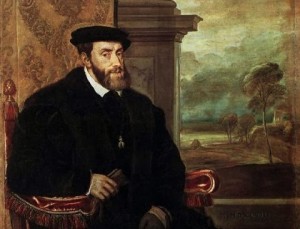
Although Lutheranism had powerful supporters, its survival was by no means certain. Its main opponent was the Habsburg emperor Charles V, who had inherited Spain, the Netherlands, southern Italy, Sicily, and the Austrian lands as patrimony and who hoped to restore the unity of the German Empire by keeping it Roman Catholic. Charles had been out … [Read more...]
The Protestant Reformation
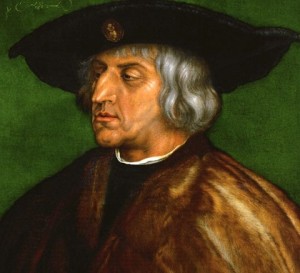
On the eve of the Protestant Reformation, the institutions of the Holy Roman Empire were widely thought to be in need of improvement. The Habsburg emperors Frederick III (r. 1440-93) and his son Maximilian I (r. 1493-1519) both cooperated with individual local rulers to enact changes. However, the imperial and local parties had different aims, the … [Read more...]
The Empire Under the Early Habsburgs – Medieval Germany
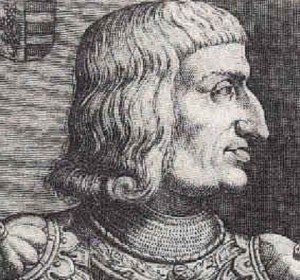
The Great Interregnum ended in 1273 with the election of Rudolf of Habsburg as king-emperor. After the interregnum period, Germany's emperors came from three powerful dynastic houses: Luxemburg (in Bohemia), Wittelsbach (in Bavaria), and Habsburg (in Austria). These families alternated on the imperial throne until the crown returned in the … [Read more...]
The Hohenstaufen Dynasty, 1138-1254 – Medieval Germany
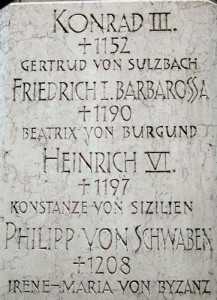
Following the death of Henry V (r. 1106-25), the last of the Salian kings, the dukes refused to elect his nephew because they feared that he might restore royal power. Instead, they elected a noble connected to the Saxon noble family Welf (often written as Guelf). This choice inflamed the Hohenstaufen family of Swabia, which also had a claim to the … [Read more...]
The Salian Dynasty, 1024-1125 – Medieval Germany
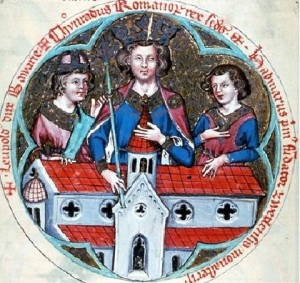
After the death of the last Saxon king in 1024, the crown passed to the Salians, a Frankish tribe. The four Salian kings--Conrad II, Henry III, Henry IV, and Henry V--who ruled Germany as kings from 1024 to 1125, established their monarchy as a major European power. Their main accomplishment was the development of a permanent administrative system … [Read more...]
The Saxon Dynasty, 919-1024 – Medieval Germany
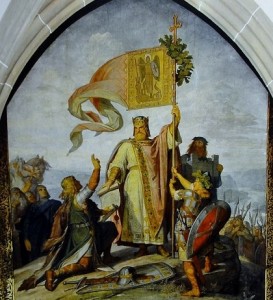
Because the dukes of the East Frankish Kingdom had wearied of being ruled by a foreign king, they elected a German to serve as their king once the Carolingian line expired. The election of Conrad I (r. 911-18), Duke of Franconia, as the first German king has been marked by some historians as the beginning of German history. Conrad's successor, … [Read more...]
- « Previous Page
- 1
- …
- 7
- 8
- 9
- 10
- 11
- …
- 13
- Next Page »