German Culture

All about Germany

  • Home
  • Learn German
    • German Language Basics
    • German Grammar & Vocabulary
    • German Learning Tips
    • German Idioms & Expressions
    • German Quizzes & Exercises
  • Articles
    • Famous Germans
    • German Holidays
    • German Cuisine
    • How To In Germany
    • Daily Life in Germany
    • German Facts
    • German Traditions
  • Facts About Germany
  • German History
    • Early History of Germany
    • Middle Ages in German History
    • German Reformation Period
    • 19th Century and German Unification
  • German Recipes
    • German Baking Recipes
    • German Bread Recipes
    • German Christmas Recipes
    • Desserts
    • German Easter Recipes
    • Halloween Recipes
    • Main Dishes
    • German Salad Recipes
    • German Salads
    • Sauerkraut Recipes
  • Travel to Germany
  • Contact

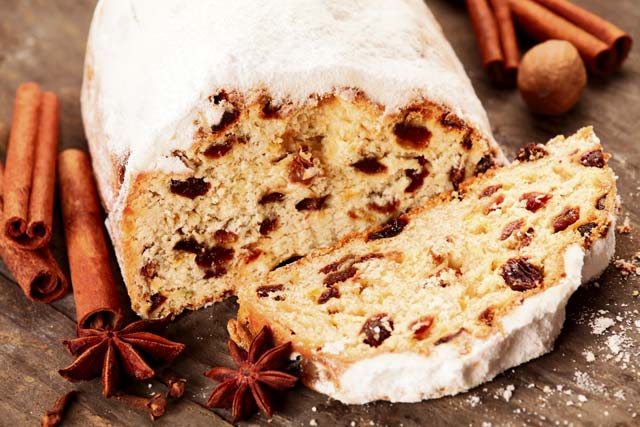
German Christmas Stollen

stollen3

Stollen is a fruit bread containing dried fruit and often covered with powdered sugar or icing sugar. The bread is usually made with chopped candied fruit and/or dried fruit, nuts and spices. Stollen is a traditional German bread usually eaten during the Christmas season, when it is called Weihnachtsstollen (after “Weihnachten”) or Christstollen (after Christ).

Ingredients:

500 g raisins
100 g currants
100 g candied lemon peel
100 g candied orange peel
250 g chopped almonds
3 packs vanilla sugar
6 tablespoons of rum
12 drops of bitter almond flavoring or 40 g bitter almond, finely ground
1 kg wheat flour
84 g fresh yeast
150 g sugar
250 ml milk
2 egg yolks
700 g butter
125 g icing sugar to decorate Stollen
15 g salt
1 lemon

Preparation:

1. Mix raisins, currants, candied peel, almonds, 2 packs vanilla sugar, zest and juice of a lemon and rum. Let mixture rest for 6 hours (or overnight).
2. Sieve flour into a bowl. Make a well in the center and pour the crumbled yeast, a tablespoon sugar and the lukewarm milk into the center and mix with a little bit of flour. Lay a tea towel over the bowl and let this rise for 15 minutes in a warm room.
3. Add the remaining sugar, salt, egg yolks, 400 g butter (butter in knobs). Knead into dough. In case you are using a food processor knead for 30 minutes on lowest level. Then let the dough rise for 30 minutes covered with a tea towel.
4. Roll dough, add fruit mixture. Knead dough quickly and let it rise for 30 minutes (while being covered). Knead again. Shape the dough in a roughly oval form, 3-4 cm thick, fold dough in half lengthwise and put it on baking tray. Let the dough rise for 15 min.
5. Preheat oven to 175° C. Bake for 80 minutes (without air circulation or foil). Position rack in lowest third of oven.
6. Immediately after baking: pierce stolen all over with a wooden needle and brush it on the top and underneath with 150 g brown melted butter and then cover the top with powdered sugar with a sieve. Let it cool down overnight.
7. Let it rest for 1 or 2 weeks tightly wrapped in foil and plastic bags in a cool place (but not in the fridge).


You might also like:

  • German Christmas recipes
    15 Best German Christmas Recipes
  • Früchtebrot – Traditional German Fruit Bread Recipe
    Früchtebrot (Fruit Bread) Recipe
  • Rosinenbrot - Traditional German Raisin Bread Recipe
    Rosinenbrot (Raisin Bread) Recipe
  • Osterbrot Recipe – Traditional German Easter Bread
    Osterbrot – Traditional German Easter Bread Recipe
  • Traditional Three Kings’ Cake Recipe
    Three Kings’ Cake Recipe
  • Marzipan Potatoes - Marzipan Kartoffeln
    Authentic Marzipan Kartoffeln (Marzipan Potatoes) Recipe
  • Lebkuchen German Gingerbread Recipe
    Lebkuchen - German Gingerbread Recipe
  • Marzipan-Eier Recipe – Traditional German Marzipan Easter Eggs
    Marzipan-Eier – Traditional German Marzipan Easter…

Recent Posts

Is Halloween popular in Germany, Austria, and Switzerland?

Halloween in Germany, Austria and Switzerland Compared

How much money do Germans spend on Halloween

Halloween in Germany: Statistics and Facts

Halloween in German: Spooky Words and Phrases

Halloween Costumes in Germany: Why Scary Beats Cute

German Pumpkin Recipes: Kürbissuppe and More

German Pumpkin Festivals: Ludwigsburg and Beyond

Reformationstag: What Germans Celebrate on October 31

Süßes oder Saures: Trick-or-Treating in Germany Explained

Copyright © 2026 · German Culture

Go to mobile version