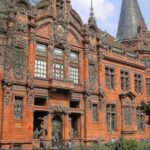
Death of Hermann von Reichenau in Reichenau, Germany. As a chronicler, he has become a primary source of information on his age.
September 24, 1521
Death of Paracelsus (Philippus Aureolus Theophrastus Bombastus von Hohenheim), a German-Swiss Renaissance physician, botanist, alchemist, astrologer, and general occultist, in Salzburg, Austria. He attended many universities seeking a great teacher, but in his words found mostly just “asses”. He took the name Paracelsus which means “beyond Celsus” in that he felt superior to the most famous Roman physician, Celsus. And indeed, he may have been correct. He became the most famous physician of his age with his wondrous cures and his university lectures. It seems Paracelsus had learned how to carry out cures with chemicals. He is also credited for giving zinc its name, calling it zincum, and is regarded as the first systematic botanist.
September 24, 1545
Death of Albert of Brandenburg in Mainz, Germany. He was the Archbishop of Mainz and an Elector in the Holy Roman Empire. He was criticized by Martin Luther for the sale of indulgences.
September 24, 1583
Birth of Albrecht Wallenstein, commanding general of the armies of the Holy Roman Empire during the Thirty Years’ War. Wallenstein was born in Hermanice, Bohema (now in the Czech Republic). The classic dramatist Friedrich Schiller wrote a three part play about the life of Wallenstein.
September 24, 1705
Birth of Graf Joseph Leopold von Daun in Vienna, Austria. Von Daun was the Austrian commander during the Seven Year’s War with Prussia (1756-1763). He undertook extensive reorganization of Austria’s military and upgraded its power substantially.
September 24, 1740
Immanuel Kant is officially registered as a student at the University of Königsberg by the rector as Emmanuel Kandt.
September 24, 1849
Death of Johann Strauß (the elder) in Vienna, Austria. This Johann Strauß was the father of the more famous “waltz king”. Like his son, he too was very popular in Vienna as a composer of waltzes, polkas, and marches. He tried to discourage his son, Johann the younger, from a career in music. He felt that banking would be a better career for him. Today Johann the elder is probably best known for his “Radetzky March”. His other sons, Josef and Eduard became conductors and Josef also composed waltzes.
September 24, 1861
Birth of Walter Simons in Elberfeld, Germany. Simons was president of the German Supreme Court from 1922-1929. He took the office of temporary president of the Weimar Republic at the death of Friedrich Ebert until the next president, Paul von Hindenburg was elected.
September 24, 1934
Birth of Manfred Wörner in Stuttgart, Germany. Wörner was the first German secretary-general of NATO, serving from 1988-1994). His major task was to start the redefinition of NATO after the end of the Soviet Union. Wörner was a member of the German CDU political party.
September 24, 1941
Death of Gottfied Feder in Murnau, Germany. Feder was the developer and leader of National Socialist economic ideology in the early days of the party. Hitler referred to his book Der deutsche Staat auf nationaler und sozialer Grundlage (1923) as “the catechism of the movement”. Feder was the chairman of the Nazi Party’s economic council and the state secretary of the German Ministry of Economics in the early years of the rule of the Nazi party. By 1936, however, he ceased to play any significant role.
September 24, 1945
Death of Hans Geiger in Potsdam, Germany. A nucelar physicist, he invented the Geiger counter. He studied at the University of Erlangen. He was later at the University of Manchester, England. In 1912 Geiger accepted a position at the Physikalisch-Technische Reichsanstalt in Berlin where he did research on atomic structure. He then became then a professor at the University of Kiel, the University of Tübingen and the Technische Hochschule in Berlin.
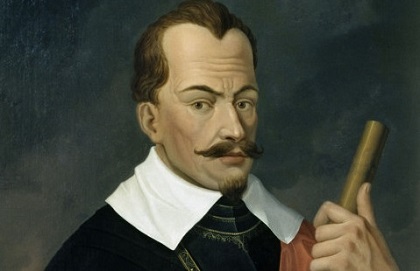 Birth of Albrecht Wallenstein, commanding general of the armies of the Holy Roman Empire during the Thirty Years’ War. Wallenstein was born in Hermanice, Bohema (now in the Czech Republic). The classic dramatist Friedrich Schiller wrote a three part play about the life of Wallenstein.
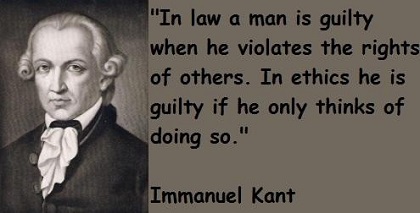 Immanuel Kant is officially registered as a student at the University of Königsberg by the rector as Emmanuel Kandt.
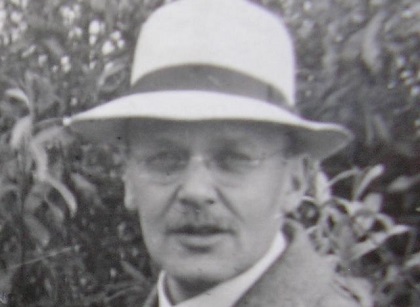 Death of Hans Geiger in Potsdam, Germany. A nucelar physicist, he invented the Geiger counter. He studied at the University of Erlangen. He was later at the University of Manchester, England. In 1912 Geiger accepted a position at the Physikalisch-Technische Reichsanstalt in Berlin where he did research on atomic structure. He then became then a professor at the University of Kiel, the University of Tübingen and the Technische Hochschule in Berlin.