German Culture

All about Germany

  • Home
  • Learn German
    • German Language Basics
    • German Grammar & Vocabulary
    • German Learning Tips
    • German Idioms & Expressions
    • German Quizzes & Exercises
  • Articles
    • Famous Germans
    • German Holidays
    • German Cuisine
    • How To In Germany
    • Daily Life in Germany
    • German Facts
    • German Traditions
  • Facts About Germany
  • German History
    • Early History of Germany
    • Middle Ages in German History
    • German Reformation Period
    • 19th Century and German Unification
  • German Recipes
    • German Baking Recipes
    • German Bread Recipes
    • German Christmas Recipes
    • Desserts
    • German Easter Recipes
    • Halloween Recipes
    • Main Dishes
    • German Salad Recipes
    • German Salads
    • Sauerkraut Recipes
  • Travel to Germany
  • Contact

Easter Bunny Cake

Ingredients:

2 cups all-purpose flour
1/2 cup shortening
1 1/2 cup sugar
1 cup milk
3 1/2 tsp baking powder
1 1/4 tsp vanilla
1 tsp salt
3 eggs

Frosting:

100 g cream cheese, softened
a pinch of salt
1 tbsp milk
2 1/2 cups confectioners’ sugar
1 tsp vanilla

Preparation:

  1. Preheat the oven to 180 degrees C.
  2. Grease and flour the cake pans (rub bottom of pan with butter or shortening, then sprinkle flour in the pan, tap the pan until flour spreads and covers the bottom).
  3. Sift the flour, sugar, baking powder, and salt into the electric mixer bowl.
  4. Add the shortening, milk, vanilla, and eggs.
  5. Mix on low speed for one minute. Scrape the sides of the bowl, then turn mixer to high speed. Beat for 3 minutes.
  6. Pour into pans and bake for 30 to 35 minutes, or until a wooden pick inserted in the cake center comes out clean (not sticky).
  7. Cool in pans for 10 minutes, then turn cake layers onto a wire rack (you might need help with this step).
  8. Make frosting: place the cream cheese, milk, vanilla, and salt in the electric mixer bowl. Mix on medium speed until well blended.
  9. Gradually add sugar, beating at medium to high speed until the frosting is smooth and will spread easily. If necessary, add more milk.
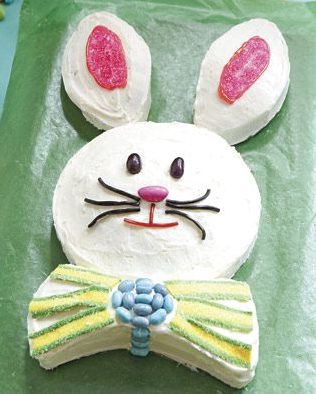
  10. Cut the cooled cake and arrange as shown in the photo. One layer is left intact, and the other is cut to form the bunny’s ears and bow tie. Spread the frosting between the head, ear, and bow tie pieces, then over top and sides. Add jelly beans for the bunny’s eyes, strips of licorice for whiskers. You could also cover the rabbit with coconut for a very special Easter dessert!


Related articles:
How Germany Celebrates Easter: Traditions That Are Older Than Christianity
9 ways to celebrate Easter like a German 

You might also like:

  • Christmas Tree Cupcakes
    Christmas Tree Cupcakes
  • Osterlamm Recipe – German Easter Lamb Cake
    Osterlamm Recipe – German Easter Lamb Cake
  • Rüblikuchen Recipe – Traditional German Carrot Cake
    Rüblikuchen Recipe – Traditional German Carrot Cake
  • Quarkhasen – Traditional German Easter Quark Bunnies Recipe
    Quarkhasen – Traditional German Easter Quark Bunnies Recipe
  • Rosinenbrot (Raisin Bread) Recipe
    Rosinenbrot (Raisin Bread) Recipe
  • Osternest-Kekse – Traditional German Easter Nest Cookies Recipe
    Osternest-Kekse – Traditional German Easter Nest Cookies…
  • Vanillekipferl – Traditional German Vanilla Crescent Cookies Recipe
    Vanillekipferl – Traditional German Vanilla Crescent Cookies…
  • Osterzopf – Traditional German Easter Braided Bread Recipe
    Osterzopf – Traditional German Easter Braided Bread Recipe

Recent Posts

Potatoes are one of the most beloved ingredients in German cuisine

Traditional German Potato Dishes

Traditional German potato dishes

Traditional German Potato Dishes You Should Know

Discover how potatoes in German culture shaped history

Potatoes in German Culture

The German Zeppelin represents far more than a transportation technology.

German Zeppelin: The Rise and Fall of Germany’s Giant Airships

Discover how the German Zeppelin worked

How the German Zeppelin Worked: Inside the Engineering of Airship Giants

Valentine’s Day in Germany: Love, History, and Traditions

Valentine’s Day in Germany: From American Import to Cultural Tradition

"Kinder, Küche, Kirche" functions primarily as a historical artifact and cautionary phrase

“Kirche, Küche, Kinder”: Germany’s Three K’s

Women and German Military Traditions

Women in German Army: Historical Evolution

Copyright © 2026 · German Culture

Go to mobile version