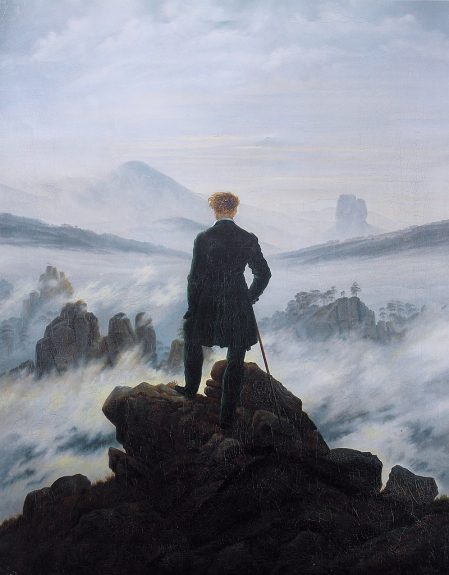
Wanderer above the Sea of Fog (Der Wanderer über dem Nebelmeer), also known as Wanderer above the Mist or Mountaineer in a Misty Landscape, is an oil painting c. 1818 by the German Romantic artist Caspar David Friedrich. It has been considered one of the masterpieces of Romanticism and one of its most representative works. It currently resides in the Kunsthalle Hamburg in Hamburg, Germany.
In the foreground, a young man stands upon a rocky precipice with his back to the viewer. He is wrapped in a dark green overcoat, and grips a walking stick in his right hand. His hair caught in a wind, the wanderer gazes out on a landscape covered in a thick sea of fog. In the middle ground, several other ridges, perhaps not unlike the ones the wanderer himself stands upon, jut out from the mass. Through the wreaths of fog, forests of trees can be perceived atop these escarpments. In the far distance, faded mountains rise in the left, gently leveling off into lowland plains in the east. Beyond here, the pervading fog stretches out indefinitely, eventually commingling with the horizon and becoming indistinguishable from the cloud-filled sky.
The painting is composed of various elements from the Elbe Sandstone Mountains in Saxony and Bohemia, sketched in the field but in accordance with his usual practice, rearranged by Friedrich himself in the studio for the painting. In the background to the right is the Zirkelstein. The mountain in the background to the left could be either the Rosenberg or the Kaltenberg. The group of rocks in front of it represent the Gamrig near Rathen. The rocks on which the traveler stands are a group on the Kaiserkrone.
Portrait of Caspar David Friedrich, Gerhard von Kügelgen c. 1810–20
Friedrich’s greatest accomplishment was his ability to turn landscapes into a medium of physiological and spiritual biography. Here, he includes his own portrait within his landscape as a lay figure seen from behind — a device intended to invite the viewer to look at the world through the lens of the artist’s own personal perception.
It would not be an exaggeration to take this picture as the essence of the Romantic approach to art. Here, Friedrich has adapted the generic conventions of landscape painting to the demands of creative self-expression. Unwilling to have the artist serve as a mere “photographer” as it were of nature, Friedrich always took as his task the private and personal encounter of an individual with nature.
Indeed, Friedrich was captivated by the idea of encountering nature in solitude in deepest ravines, on the edge of the sea, or as here on the pinnacle of a mountain, which was about as far away from urban civilization as a European man could get. Indeed in his later paintings, Friedrich will continue to stress that the very idea of “self-expression” had to be associated with physical and spiritual isolation. The Romantics believed that any artist who wanted to explore his own emotions, had necessarily to stand outside of the throng of money-making, political gimmickry, and urban noise in order to assert and maintain their positions.
 Wanderer above the Sea of Fog (Der Wanderer über dem Nebelmeer), also known as Wanderer above the Mist or Mountaineer in a Misty Landscape, is an oil painting c. 1818 by the German Romantic artist Caspar David Friedrich. It has been considered one of the masterpieces of Romanticism and one of its most representative works. It currently resides in the Kunsthalle Hamburg in Hamburg, Germany.