If you’ve ever tried to explain Halloween to a German speaker, you’ve probably hit a wall within the first minute. Is it “der Kürbis” or “die Kürbis”? Is a ghost a “Geist” or a “Gespenst”? And how do you ask someone what they’re dressing up as without sounding like a textbook? The good news is that Halloween vocabulary in German is friendly: many words are close to English, and the rest are fun to learn.
This guide covers the words and phrases you’ll actually use, with the article (der, die, or das) and plural for each noun, since in German those details matter.
First, the Name: Halloween and Süßes oder Saures
Halloween is used in German as it is in English, usually with no article. Germans say “an Halloween” or “zu Halloween” (“on Halloween”). You’ll also hear “Happy Halloween,” often in English, or “Schönes Halloween!”
Trick or treat is “Süßes oder Saures!”, literally “sweets or sour.” Children shout it at the door. Some say “Süßes, sonst gibt’s Saures” (“sweets, or else you get sour”). For the full story of how it works in practice, see our guide to trick-or-treating in Germany.
Creatures and Characters
German
English
Plural
der Geist
ghost, spirit
die Geister
das Gespenst
ghost, specter
die Gespenster
die Hexe
witch
die Hexen
der Zauberer
wizard
die Zauberer
der Vampir
vampire
die Vampire
der Werwolf
werewolf
die Werwölfe
der Zombie
zombie
die Zombies
die Mumie
mummy
die Mumien
das Skelett
skeleton
die Skelette
das Monster
monster
die Monster
A quick note on ghosts: “Geist” is the more general word and also means “spirit” or “mind,” while “Gespenst” is specifically a ghost that haunts, like the ones in old castle stories.
Things You’ll See on Halloween
German
English
Plural
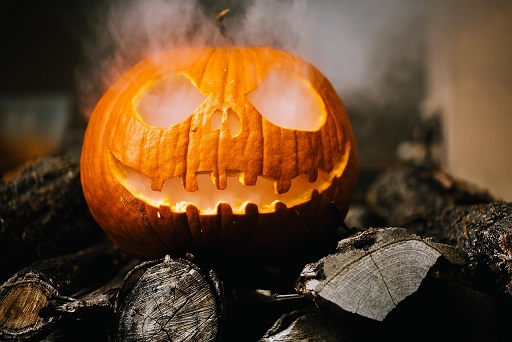
der Kürbis
pumpkin
die Kürbisse
die Fledermaus
bat
die Fledermäuse
die Spinne
spider
die Spinnen
das Spinnennetz
cobweb
die Spinnennetze
der Friedhof
cemetery
die Friedhöfe
der Sarg
coffin
die Särge
der Totenkopf
skull (the symbol)
die Totenköpfe
der Besen
broom
die Besen
der Kessel
cauldron
die Kessel
die Kerze
candle
die Kerzen
das Spukhaus
haunted house
die Spukhäuser
die Geisterbahn
ghost train (fairground ride)
die Geisterbahnen
If you want the broader autumn picture, a pumpkin soup is a good test of your new vocabulary, so see our German pumpkin recipes.
Costumes and Candy
German
English
Plural
das Kostüm
costume
die Kostüme
die Verkleidung
disguise, costume
die Verkleidungen
die Maske
mask
die Masken
der Hexenhut
witch’s hat
die Hexenhüte
die Süßigkeiten
sweets, candy
(plural only)
das Bonbon
hard candy
die Bonbons
die Schokolade
chocolate
(usually singular)
The verb for dressing up is sich verkleiden. “Ich verkleide mich als Vampir” means “I’m dressing up as a vampire.” If you want to see what Germans actually wear, check our article on Halloween costumes in Germany.
Adjectives and Verbs for Spooky Moments
Adjectives:
gruselig means creepy or scary, and it’s the word you’ll hear most often.
schaurig is eerie or dreadful, a bit more literary.
unheimlich means uncanny, spooky, or sinister.
Verbs:
spuken means to haunt. “Es spukt hier” means “It’s haunted here.”
erschrecken means to scare. “Du hast mich erschreckt!” means “You scared me!”
schnitzen means to carve. “Wir schnitzen einen Kürbis” means “We’re carving a pumpkin.”
gruseln means to give someone the creeps. “Es gruselt mich” means “It gives me the creeps.”
You can also say “Buh!” for “Boo!”, which needs no translation.
Useful Phrases
Als was gehst du an Halloween? What are you going as for Halloween?
Ich gehe als Hexe. I’m going as a witch.
Ich verkleide mich als Skelett. I’m dressing up as a skeleton.
Gehst du auf eine Halloween-Party? Are you going to a Halloween party?
Süßes oder Saures! Trick or treat!
Hier spukt es. It’s haunted here.
Das ist ja gruselig! That’s so creepy!
Hast du Süßigkeiten für uns? Do you have sweets for us?
Danke und schöne Halloween-Nacht! Thanks, and have a good Halloween night!
A Mini Dialogue to Practice
Anna: Als was gehst du heute Abend? Ben: Ich gehe als Vampir. Und du? Anna: Ich verkleide mich als Hexe. Ich habe sogar einen Besen! Ben: Super! Das wird gruselig.
Pronunciation Tips
Kürbis (KUER-biss): the “ü” is made with rounded lips, like the “u” in French “tu.”
Süßes (ZUE-ses): the “ß” sounds like a sharp “ss.”
Gespenst (geh-SHPENST): “sp” at the start of a stem sounds like “shp.”
Hexe (HEK-seh): the “x” is pronounced “ks,” and the final “e” is a soft “eh.”
Remembering the Genders
German nouns are tricky, but a few patterns help:
Nouns ending in -e are often feminine: die Hexe, die Mumie, die Kerze, die Maske.
Nouns ending in -ling, -er, -ismus often take der: der Zauberer.
Diminutives ending in -chen or -lein are always das.
Many foreign-loan words for monsters take der: der Vampir, der Zombie.
Don’t worry about perfection. Learning each noun with its article from the start is the habit that pays off most.
How do you say Halloween in German? Halloween is used in German as it is in English. Germans say “an Halloween” or “zu Halloween,” and often “Happy Halloween” or “Schönes Halloween.”
What is “trick or treat” in German? “Süßes oder Saures!”, which literally means “sweets or sour.”
What is the German word for pumpkin? Der Kürbis (plural: die Kürbisse).
What’s the difference between Geist and Gespenst? Both can mean “ghost.” Geist is more general and also means “spirit” or “mind,” while Gespenst usually refers to a haunting specter.