German Culture

All about Germany

  • Home
  • Learn German
    • German Language Basics
    • German Grammar & Vocabulary
    • German Learning Tips
    • German Idioms & Expressions
    • German Quizzes & Exercises
  • Articles
    • Famous Germans
    • German Holidays
    • German Cuisine
    • How To In Germany
    • Daily Life in Germany
    • German Facts
    • German Traditions
  • Facts About Germany
  • German History
    • Early History of Germany
    • Middle Ages in German History
    • German Reformation Period
    • 19th Century and German Unification
  • German Recipes
    • German Baking Recipes
    • German Bread Recipes
    • German Christmas Recipes
    • Desserts
    • German Easter Recipes
    • Halloween Recipes
    • Main Dishes
    • German Salad Recipes
    • German Salads
    • Sauerkraut Recipes
  • Travel to Germany
  • Contact

Pichelsteiner

Pichelsteiner is a German stew that contains several kinds of meat and vegetables.
The creation of this dish has been traced to Auguste Winkler (née Kiesling). Originally from Kirchberg im Wald, she worked as an innkeeper in Grattersdorf, where she is also buried. The name is likely to have derived from the nearby Büchelstein mountain, where the annual Büchelsteiner Fest has been celebrated since 1839. As early as the 40th anniversary in 1879, the Open-air-cooking festival was considered a tradition, and because the letter ü is pronounced like i in the local dialect, the dish’s name developed.

In Regen, a town in the Bavarian Forest, the citizens have met annually since 1874 on Kirchweih Monday to eat Pichelsteiner together, a tradition that is still alive today. They also claim the name’s etymology. In their opinion it derives from the pot in which the stew is cooked, which was called a pichel in the past, but this version is highly questioned by Bavarian researcher Max Peinkofer.

The dish was first mentioned in a cookbook in 1894.

Ingredients:

  • 200 g boneless lamb shoulder
  • 200 g boneless beef chuck
  • 200 g boneless pork from belly
  • 4 teaspoons butter or lard
  • 1 quart vegetable broth
  • 3 large carrots
  • 1-1/2 cups green or savoy cabbage
  • 1 cup celeriac
  • 1 cup leeks
  • 1 cup celery
  • 1 cup parsnips
  • 1 cup kohlrabi
  • 1/2 cup chopped onions
  • salt and black pepper
  • 3-4 tbs parsley
  • 3 medium cut potatoes, optional
  • 1/2 cup crème fraiche, optional

Preparation:

  1. Peel and cut the vegetable into finger-thick chunks. Cut all the meat into 2 cm thick cubes. In a big skillet brown the meat on all sides; scrape the brown parts from pan; set aside.
  2. Saute the onions until brown and set aside. Saute the vegetables and set aside.
  3. Now put all ingredients in a big pot, in layers one by one, sprinkling each layer with salt and pepper. First the meat, then the onions, then the vegetables, then the potatoes, if used.
  4. Pour the vegetable broth over the top. Bring to a boil over high heat, then reduce the heat to its lowest level and cover the pot tightly. Let the stew simmer for 1 1/2 hours without stirring.
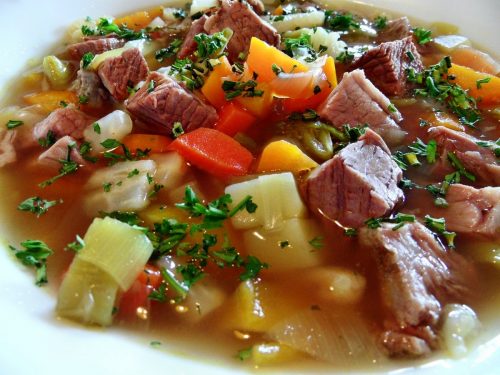
  5. Serve directly out of the pot.


You might also like:

  • Hase in Rotweinsauce Recipe – German Rabbit in Red Wine Sauce
    Hase in Rotweinsauce – Traditional German Rabbit in…
  • Frühlingsgemüse Recipe – German Spring Vegetable Side Dish
    Frühlingsgemüse – Traditional German Spring…
  • Traditional Sauerbraten Recipe
    Traditional Sauerbraten Recipe: A German Classic…
  • Oster Lammbraten Recipe – Traditional German Easter Roast Lamb
    Oster Lammbraten – Traditional German Roast Lamb…
  • Gründonnerstag Easter green soup
    Why Germans Eat Green Food on Maundy Thursday…
  • Mettbrötchen: Germany’s Raw Pork Sandwich Explained
    Mettbrötchen: Germany’s Raw Pork Sandwich Explained
  • Osterbraten – Traditional German Easter Roast Recipe
    Osterbraten – Traditional German Easter Roast Recipe
  • Rotkohl Recipe – Traditional German Braised Red Cabbage
    Rotkohl – Traditional German Braised Red Cabbage Recipe

Recent Posts

Germany vs UK Culture: Key Differences

German Beer Culture: More Than Just Oktoberfest

German Breakfast Culture: What Germans Really Eat

Strange German Laws

Strange German Laws

Germany's bread culture

Why Do Germans Eat So Much Bread? Bread Culture Explained

Oktoberfest History Explained

Oktoberfest Explained: History, Culture and Myths

German Wedding Traditions: From Polterabend to Log Sawing

German Greeting Customs: Handshakes

Copyright © 2026 · German Culture

Go to mobile version