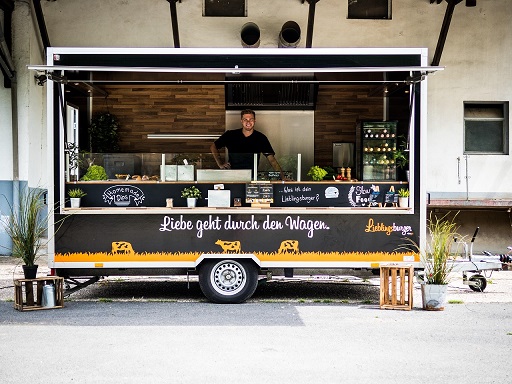
Ask ten Germans for their favorite street food and you’ll get an argument, probably with a defense of a specific stand in a specific town. That’s the first thing to understand about the Imbiss, the humble snack stand at the heart of German eating on the go: it’s local, it’s opinionated, and everyone has a loyalty.
The second thing is that two of the country’s most famous fast foods have unusually interesting birth certificates. One was supposedly created by a Turkish guest worker at a Berlin railway station. The other came from a woman who swapped with British soldiers for ketchup and curry powder. Here’s the field guide, starting with the big two.
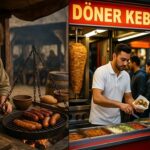
Döner Kebab: Invented in Berlin (Sort Of)
Start with a claim that will annoy someone: the Döner as Germans eat it, a pile of sliced spit-roasted meat stuffed into flatbread with salad and sauce, is a German invention. The meat itself isn’t. Turks have been cooking meat on a vertical spit for a long time, and Iskender Efendi of Bursa is often named as the pioneer of that technique. Meat in bread existed in Turkey in the mid-1960s, too, but never became anywhere near as popular as it did in Germany.
The man usually credited with the German version is Kadir Nurman, a Turkish guest worker who is said to have sold his first Döner from a stall opposite Berlin’s Bahnhof Zoo in 1972. The Association of Turkish Döner Producers in Europe (ATDID) officially names him the inventor, and gave him a lifetime achievement award in 2011. But there are rivals. The Berlin restaurateur Mehmet Aygün says he got there first in 1971, and a Swabian, Nevzat Salim, claims he sold one in Reutlingen in 1969. The association’s own spokesperson concedes that Döner turned up in some Turkish restaurants in Germany before 1972. Nobody has settled it, and nobody ever will.
What isn’t disputed is the scale. According to the ATDID, Germany eats around 550 tonnes of Döner meat every day, and roughly the same amount is produced for export. Estimates of how many Döner shops and Turkish restaurants the country has range from about 16,000 to 18,500, depending on who is counting. Berlin is widely called the Döner capital.
How to order it. Walk up, say “Einmal Döner, bitte,” and prepare for rapid-fire questions:
- “Mit allem?” With everything (salad, onions, cabbage)?
- “Scharf oder mild?” Spicy or mild?
- “Knoblauchsoße, Kräutersoße oder scharf?” Garlic sauce, herb sauce, or chili sauce?
- “Hier oder zum Mitnehmen?” Eat here or take away?
If bread isn’t your thing, try a Dürüm (the same filling in a rolled flatbread) or a Dönerteller (a plate with rice or fries).
Currywurst: A Sausage, Ketchup, and a Legend
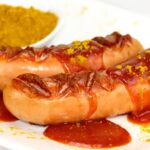
Currywurst is simpler to explain and almost as contested. It’s a sliced, fried pork sausage covered in a warm sauce of ketchup and curry powder, usually dusted with more curry on top, and served with fries or a bread roll.
According to the German Currywurst Museum in Berlin, which closed in 2018 but whose story is still widely told, it was created on 4 September 1949 by Herta Heuwer at a snack stand on the corner of Kantstraße and Kaiser-Friedrich-Straße in Charlottenburg. She is said to have obtained ketchup and curry powder from British soldiers in postwar Berlin and mixed them into a sauce for grilled sausage. Hamburg has its own rival claim, and the dispute remains good-natured.
Whatever its origin, it became a postwar working-class classic. In Berlin you may be asked whether you want it mit oder ohne Darm, with or without casing, which tells you how seriously the question is taken. Order it “mit Pommes” or “mit Brötchen,” and expect a tiny wooden fork.
Bratwurst: Not One Sausage, but a Regional Argument
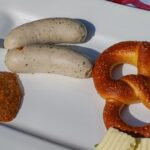
If you say “Bratwurst” in Germany, you’ve started a conversation, because the answer depends on where you are. The best-known are the Nuremberg version, tiny and thin, traditionally served three at a time in a bun (Drei im Weckla), and the Thuringian version, longer and spiced with marjoram and caraway, grilled over charcoal and served in a roll with mustard. Both are protected by EU geographical indications. For a recipe, see our Bratwurst guide, and for the beer-tent version, read about Oktoberfest traditions.
The Rest of the Lineup
- Fischbrötchen (north coast). A bread roll with pickled herring, matjes, fried fish, or shrimp, sold at harbor stands from Hamburg to the Baltic. A taste of the sea, with onions.
- Reibekuchen (Rhineland). Crispy fried potato pancakes, also called Kartoffelpuffer elsewhere, served with applesauce. A fixture of Christmas markets across the country.
- Pommes rot-weiß (Ruhr region). Fries with ketchup and mayonnaise, “red and white.” A staple at the corner kiosks described in our guide to Späti, Kiosk, and Büdchen culture.
- Leberkässemmel (Bavaria). A thick slice of baked, finely ground meat loaf in a roll, usually with sweet or hot mustard. It contains neither liver nor cheese, despite the name.
- Brezn (south). A soft pretzel, often with butter or cheese. See our pretzel recipe.
- Gebrannte Mandeln and Langos (markets and fairs). Sugar-roasted almonds and Hungarian-style fried dough with garlic sauce and cheese, both market and fairground classics.
Where to Eat and How It Works
You’ll find an Imbiss near most train stations, shopping streets, and markets, and eating standing up at a high counter is completely normal. Many stands are cash-only or prefer cash, so bring coins. Market halls offer a more relaxed alternative: Berlin’s Markthalle Neun in Kreuzberg, for example, is known for its street-food events. Late at night, a Döner stand may be the only food open. Stands that serve hot food are generally treated like restaurants, so many open on Sundays, when regular shops (and corner kiosks, as our Späti guide explains) are closed, though hours vary.
A Few Local Rules
- Don’t ask for ketchup on Bratwurst in Thuringia. Mustard is the rule.
- Say “bitte” and “danke.” Simple politeness goes a long way at a busy counter.
- Know your own spice level. “Scharf” in a Döner shop can be genuinely hot.
- Dispose of your tray and napkins in the bins provided, and don’t leave litter.
- Check bottle deposits if you buy drinks. See our guide to Pfand.
For more regional specialties, explore German cuisine, or see how the same pastry gets a different name in every region in our guide to German food words by region.
FAQ
Who invented the Döner kebab in Germany?
Kadir Nurman is officially credited by the Association of Turkish Döner Producers in Europe, who says he sold the first one at Berlin’s Bahnhof Zoo in 1972. Others, including Mehmet Aygün, dispute this.
Who invented Currywurst?
According to the Currywurst Museum, Herta Heuwer created it in Berlin on 4 September 1949. Hamburg has a rival claim.
What is the most popular street food in Germany?
Döner kebab, followed closely by Currywurst and Bratwurst, though regional favorites vary.
Is German street food cheap?
Typically cheaper than a restaurant meal, though prices vary by city and have risen in recent years, so check the menu board.