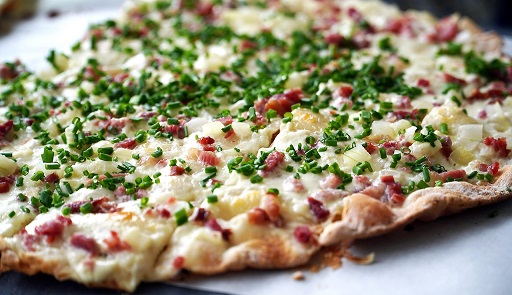
Few traditional German recipes manage to be both rustic and elegant quite like Flammkuchen. Originating from the borderlands of Germany and France, this crisp, thin flatbread – often called “German pizza” – combines the heartiness of country cooking with the sophistication of European cuisine.
At first glance, Flammkuchen seems simple: a paper-thin crust topped with crème fraîche, onions, and bacon, baked in a blazing hot oven until the edges are blistered and golden. Yet that simplicity hides its perfection. Every bite balances smoky, salty, and creamy flavors with a crisp, airy crunch.
Flammkuchen is more than a dish – it’s an experience. Traditionally baked in wood-fired ovens by bakers testing their oven’s heat, it has since become a regional treasure across southwestern Germany, especially in Alsace, the Palatinate (Pfalz), and Baden. Whether served at wine festivals, cozy taverns, or family dinners, this dish embodies German gemütlichkeit – that unique blend of warmth, comfort, and conviviality.
In this guide, we’ll explore the fascinating history of Flammkuchen, its authentic ingredients, and how to make it perfectly at home.
The Origins of Flammkuchen
The history of Flammkuchen (also known as Tarte Flambée in French) dates back to the 19th century in the wine-producing regions along the Rhine. Before thermometers were common, bakers needed a way to gauge the temperature of their wood-fired ovens. To test whether the heat was right for baking bread, they would stretch out leftover dough, spread it with sour cream or crème fraîche, top it with onions and bacon, and place it in the flames.
If the dough baked to a crisp golden brown within a few minutes, the oven was ready. These test bakes, known as “cakes of flame” (Flammkuchen in German), became so popular among the bakers and their families that they evolved into a beloved regional specialty.
Over time, Flammkuchen spread across Alsace, Baden, and Saarland, each region developing its own version. In Alsace, it became known as Tarte Flambée – a staple in wine taverns, served with a glass of Riesling. In the Palatinate and Swabia, it’s enjoyed with new wine (Federweißer) during autumn festivals.
Though reminiscent of Italian pizza, Flammkuchen is distinctly Germanic in character: leaner, lighter, and simpler, reflecting the rural resourcefulness of the Rhine valley’s culinary traditions.
Making Flammkuchen at home requires only a handful of ingredients, but success depends on balance – a paper-thin crust, creamy topping, and just enough smoky bacon and onions to create harmony, not heaviness.
Ingredients (makes 2 large Flammkuchen or 4 smaller ones):
For the Dough:
250 g (2 cups) all-purpose flour
125 ml (½ cup) water (lukewarm)
2 tbsp vegetable oil or olive oil
½ tsp salt
(Traditional dough contains no yeast, giving Flammkuchen its signature crispness.)
For the Topping:
200 g (¾ cup) crème fraîche or sour cream
100 g (½ cup) fromage blanc or quark (optional, for tanginess)
1 medium onion, thinly sliced into rings
100 g (3.5 oz) smoked bacon or speck, cut into thin strips
Salt and freshly ground black pepper
A pinch of nutmeg (optional)
Optional Additions and Variations:
1 leek (thinly sliced, for a milder flavor)
50 g (½ cup) grated cheese (for a richer version)
Fresh chives or thyme for garnish
Special Tools:
Rolling pin
Baking sheet or pizza stone
Parchment paper
Ingredient Notes: Crème fraîche is the traditional topping base, offering just the right combination of creaminess and tang. If unavailable, mix equal parts sour cream and heavy cream. The bacon should be high-quality and smoky; in Germany, Schinkenspeck (cured pork belly) is often used for its deep flavor.
How to Make Flammkuchen (Step-by-Step Recipe)
Step 1: Prepare the Dough
In a large bowl, combine flour and salt. Add water and oil, then knead until a smooth, elastic dough forms (about 5 minutes). If the dough feels dry, add a teaspoon of water at a time; if sticky, dust lightly with flour.
Form into a ball, cover with a clean towel, and let it rest at room temperature for 20-30 minutes. This allows the gluten to relax, making it easier to roll out thinly later.
Step 2: Prepare the Topping
In a bowl, stir together crème fraîche (and fromage blanc if using) until smooth. Season lightly with salt, pepper, and nutmeg. Set aside.
Peel the onion and slice into thin rings or half-moons. Cut the bacon or speck into small strips.
Step 3: Shape the Dough
Preheat your oven to 250°C (480°F) – as hot as it will go. Place a pizza stone or baking sheet inside to preheat.
Divide the dough into two portions and roll each one out very thinly on a floured surface, aiming for a rustic oval or rectangular shape. The thinner the dough, the crispier the result.
Transfer the rolled-out dough onto a sheet of parchment paper.
Step 4: Assemble the Flammkuchen
Spread a thin, even layer of the crème fraîche mixture over the dough, leaving a small border around the edges. Scatter the onion slices and bacon strips evenly on top.
For an authentic touch, keep the toppings light – Flammkuchen should remain delicate and crisp, not overloaded.
Step 5: Bake to Perfection
Slide the Flammkuchen (with the parchment) onto the preheated baking sheet or pizza stone. Bake for 8-10 minutes, until the crust is golden brown and the bacon is crisp.
Keep an eye on it – traditional Flammkuchen bakes very quickly in a hot oven. The edges should be slightly charred in places, true to its “flame cake” name.
Repeat with the remaining dough and toppings.
Step 6: Serve and Enjoy
Slice the Flammkuchen into pieces and serve immediately, preferably with a glass of chilled Riesling or Federweißer.
Pro Tip: For the most authentic experience, bake your Flammkuchen on a pizza stone or steel – it mimics the intense heat of a wood-fired oven, giving you that perfectly crisp base.
How to Serve Flammkuchen
Flammkuchen is the ultimate social dish – perfect for sharing among friends over wine, laughter, and conversation. In Germany, it’s often served as an appetizer or light main course in wine taverns and garden restaurants.
Traditional Serving Ideas:
Classic style: Simply topped with crème fraîche, onions, and bacon – the original and most loved version.
Alsatian style: Add a sprinkle of fresh thyme and black pepper before serving.
Vegetarian version: Replace bacon with thinly sliced zucchini, mushrooms, or leeks for a lighter option.
Sweet version (Dessert Flammkuchen): Spread crème fraîche mixed with a little sugar and top with apple slices, cinnamon, and a drizzle of honey – a favorite at autumn fairs.
Beverage Pairings: Flammkuchen pairs wonderfully with dry white wines from the Rhine or Mosel regions, such as Riesling or Silvaner. It’s also delicious with Federweißer (young wine), beer, or sparkling water for a refreshing contrast. For side dishes, consider a crisp green salad or a simple German potato salad to complement the rich toppings.
Though the traditional version remains iconic, regional and modern variations of Flammkuchen have flourished across Germany.
Elsässer Flammkuchen (Alsace): The most famous version – thin crust, crème fraîche, onions, and bacon.
Badischer Flammkuchen (Baden): Often includes leeks or cheese for extra richness.
Saarländischer Flammkuchen: Sometimes made with a yeast dough for a softer base.
Vegetarisch (Vegetarian): Topped with tomatoes, spinach, or goat cheese.
Gourmet versions: Modern chefs experiment with smoked salmon, figs, or truffle oil for creative twists.
Despite these innovations, traditional Flammkuchen remains rooted in simplicity – proof that the best flavors often come from humble beginnings.
Common Mistakes to Avoid
Rolling the dough too thick: Authentic Flammkuchen should be paper-thin for a crisp texture.
Using too much topping: Keep it light; excess moisture from onions or cream will make the crust soggy.
Low oven temperature: The key to success is a very hot oven. Bake at maximum heat for quick, even crisping.
Skipping the rest time: Resting the dough helps it stretch without tearing.
Flammkuchen is more than a meal – it’s a symbol of shared tradition, cozy evenings, and the joy of simple food done beautifully. Born from the ovens of German bakers, this “flame cake” has evolved from a humble test bake to a culinary favorite cherished across generations.
Its charm lies in its honesty: no fancy ingredients, no elaborate steps – just thin dough, creamy topping, and a quick bake in high heat. Yet the result is extraordinary – smoky, creamy, crisp, and utterly satisfying.
Whether you enjoy it in the vineyards of Alsace or your own kitchen, Flammkuchen brings a taste of Germany’s warm hospitality to your table. So roll out the dough, fire up your oven, and discover why this rustic flatbread has been loved for over a century.