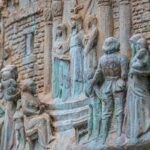
Feast Day of St. Primin (ca. 690 – 753) Primin was a West Goth who was appointed a traveling bishop in 720. He founded several monasteries during his lifetime. Among the monasteries he is said to have founded are Murbach, Neuweiler, Gegenbach, Schwarzach, Hornbach and Amorbach. The city of Pirmasens, Germany is named for him. He is entombed in Hornbach, Germany. His designation as a saint precedes the practice of canonization by the Pope. His feast day is on November 3. He is revered in Chur, Freiburg im Breisgau and Speyer.
November 3, 1801
Birth of Karl Baedeker in Essen, Germany. Karl Baedeker founded the publishing company which publishes the archetypal guidebooks for Germany. The name Baedeker has become synonymous with “guidebook”. Baedeker founded his company in 1827 and bought and published his first guidebook in 1829. The company was moved from Koblenz to Leipzig in 1872, to Hamburg in 1948 and to Freiburg in 1956.
November 3, 1853
Johann Jakob Bausch, an immigrant from Germany, opens an optical shop in Rochester, New York. Later he would join with Heinrich Lomb, another German immigrant and develop Bausch and Lomb into one of the leading optical companies in the United States.
November 3, 1914
Death of Georg Trakl in Cracow, Ausrtria-Hungary (now in Poland) (born in Salzburg, Austria). Trakl was an Expressionist poet, troubled with addiction to drugs. His poetry is characterized by topics of decline and death. The titles of a few of his poems are Verfall, Ein Winterabend, Verklfärter Herbst, Trübsinn and Grodek. Trakl died of an overdose of cocaine.
November 3, 1918
An armistice is signed between British, Italian and French representatives and Austria-Hungarian representatives.
November 3, 1942
Death of Carl Sternheim in Brussels, Belgium (born in Leipzig, Germany). Sternheim was a satiric dramatist. He is generally categorized as an Expressionist, but he insisted that he was a Realist. Among Sternheim’s dramas are Die Hose (1911), Der Snob (1914) and Das Fossil (1925)
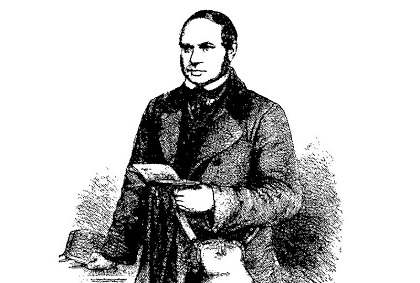 Birth of Karl Baedeker in Essen, Germany. Karl Baedeker founded the publishing company which publishes the archetypal guidebooks for Germany. The name Baedeker has become synonymous with “guidebook”. Baedeker founded his company in 1827 and bought and published his first guidebook in 1829. The company was moved from Koblenz to Leipzig in 1872, to Hamburg in 1948 and to Freiburg in 1956.
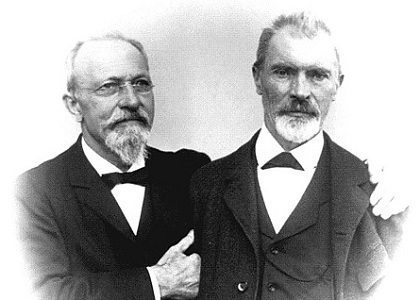 Johann Jakob Bausch, an immigrant from Germany, opens an optical shop in Rochester, New York. Later he would join with Heinrich Lomb, another German immigrant and develop Bausch and Lomb into one of the leading optical companies in the United States.
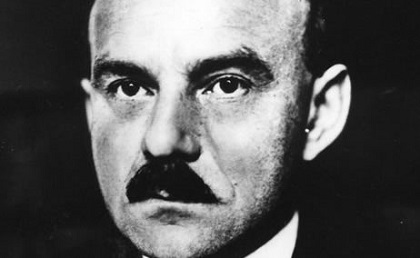 Death of Carl Sternheim in Brussels, Belgium (born in Leipzig, Germany). Sternheim was a satiric dramatist. He is generally categorized as an Expressionist, but he insisted that he was a Realist. Among Sternheim’s dramas are Die Hose (1911), Der Snob (1914) and Das Fossil (1925)