Martinsgans: Why Germans Eat Roast Goose on 11 November
Walk past a German country inn in early November and you’ll probably see a chalkboard with the same word on it: Martinsgans. Underneath, in slightly smaller letters, is a menu: roast goose with red cabbage, potato dumplings, and gravy, usually available “while stocks last.” On Wednesday, 11 November 2026, many of those inns will be fully booked, and a lot of German families will be carving a goose at home too.
The dish is tied to St. Martin’s Day, the same date as the children’s lantern processions, but it has a much older and more complicated backstory. Nobody is entirely sure why Germans eat goose on this particular day, and historians have at least three competing explanations. All of them are good stories.
What Is Martinsgans?
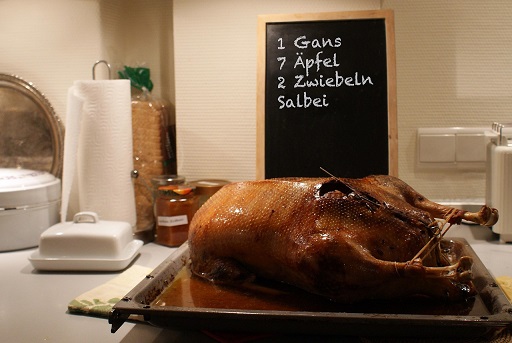
Martinsgans, literally “St. Martin’s goose,” is a roast goose eaten on or around 11 November in honor of St. Martin of Tours, the fourth-century bishop who is also remembered for the legend of cutting his cloak in half to share with a beggar. The goose is traditionally served with red cabbage (Rotkohl) and potato dumplings (Klöße), often with an apple and chestnut stuffing.
You can read more about the saint and the lantern parades in our guide to St. Martin’s Day.
Three Explanations for the Goose
1. The legend. According to the story, the people of Tours wanted Martin to become their bishop, but he didn’t feel worthy and hid in a goose pen. The geese cackled so loudly that they gave away his hiding place, and he was made bishop anyway. As punishment, the geese ended up on the dinner table. It’s a charming tale, but it was likely invented later to explain a custom that already existed.
2. The end of the farming year. In the Middle Ages, 11 November was the day when the farming year ended and tenants paid their annual dues to their landlords. Payment was often made in kind, including geese, which were popular with the nobility. This payment was known as the Martinsschoß, and some sources consider it the most likely origin of the name Martinsgans. It also made sense to eat a goose that evening, since the day was already a festival with music and dancing.
3. The last feast before the fast. In some church traditions, St. Martin’s Day marked the start of a forty-day fast leading up to Christmas, so people ate well beforehand. In autumn, geese were also at their fattest after being fed in the barn, and slaughtering them before winter saved the cost of feeding them through the cold months. Researchers today can’t say for certain which explanation is the right one, and the true answer may be a mix of all three.
From Martinsgans to Christmas Goose
The same goose has a second life at Christmas. The tradition of eating roast goose at Christmas is often traced back to the Martinsgans: when the pre-Christmas fast ended on Christmas Eve, a goose was served again. The custom spread over time, and goose is still a popular festive dish on 25 or 26 December in many households. Because geese were expensive before modern farming, many families turned to cheaper alternatives, such as roast pork, carp, or the potato-salad-and-sausage dinner now common on Christmas Eve. For how this fits into the holiday calendar, see our guide to Christmas in Germany 2026.
Martin’s Day Around the Region
Goose isn’t only a German custom. In Austria, the dish is called Martinigansl and is served in restaurants in early to mid-November. In the Czech Republic, geese are roasted on 11 November, and the first bottles of young wine are traditionally opened at 11:11. The date also connects to Karneval, whose new season opens at 11:11 a.m. on 11 November. One explanation is that the old pre-Christmas fast made people want to party once more before it began.
In Protestant regions, the day also gained a second meaning: the memory of Martin Luther’s baptism on 11 November 1483. His name, Martin, was chosen because it was St. Martin’s Day. Read more in our article on Martin Luther and the 95 Theses.
How to Eat Martinsgans in 2026
In a restaurant. Many offer special goose menus throughout November, not just on the 11th, but tables fill up quickly, so book now.
From a farm or butcher. A fresh goose from a farm is often considered the best option. Butchers and farms usually need advance orders, so order this week. If you buy frozen, thaw it completely in the fridge for several days.
Check the origin. Look for pasture-raised geese from known farms, as many geese on the market are imported.
Make it at home. A whole goose serves about six to eight people.
A Classic Martinsgans Recipe
Serves 6 to 8 | Prep: 30 minutes | Roast: about 3 hours
Ingredients:
1 goose, about 4 kg, fully thawed if frozen
Salt and black pepper
2 to 3 sprigs of mugwort (Beifuß) or fresh marjoram
3 tart apples, cut in wedges
200 g cooked chestnuts
1 onion, quartered
125 ml water for the roasting pan
To serve: red cabbage, potato dumplings, and gravy from the pan juices
Method:
Prepare the goose. Remove the giblets, neck, and excess fat from inside the cavity (save the fat). Rinse the goose, pat it very dry, and rub it inside and out with salt and pepper. Prick the skin all over with a fork or skewer, taking care not to pierce the meat, so the fat can drain.
Stuff it. Fill the cavity loosely with the apple wedges, chestnuts, onion, and herbs, and close the opening with skewers or toothpicks.
Roast, breast down. Set the goose breast-side down on a rack in a roasting pan. Pour the water into the pan and roast at 175 °C in a preheated oven for 1.5 hours.
Turn and baste. Turn the goose breast-side up and continue roasting for another 1.5 hours, basting with the pan juices several times. This follows a widely used German recipe with a total roasting time of 3 to 3¼ hours for a 4 kg goose, or roughly 45 minutes per kilogram as a rule of thumb. Pour off excess fat from the pan occasionally.
Crisp the skin. For the last 10 to 15 minutes, raise the oven to about 220 °C so the skin turns golden and crisp.
Check and rest. The thickest part of the thigh should reach at least 75 °C, and many cooks take it to around 85 °C for tender meat. Let the goose rest, covered loosely, for 15 to 20 minutes before carving.
Make the gravy. Skim the fat from the pan juices, add a splash of water or stock, simmer, and season.
Serve with: red cabbage and potato dumplings. Keep the rendered goose fat: Gänseschmalz is prized in German kitchens for roasting potatoes or spreading on bread.
FAQ
Why do Germans eat goose on 11 November? There are three common explanations: the legend of St. Martin hiding from the bishop’s office among geese, the medieval tradition of paying farm rent in geese on that date, and a last feast before the pre-Christmas fast.
When is Martinstag in 2026? Wednesday, 11 November 2026.
What do you serve with Martinsgans? Traditionally red cabbage (Rotkohl) and potato dumplings (Klöße), often with an apple and chestnut stuffing and gravy.
Is Martinsgans the same as Christmas goose? They’re closely related. The Christmas goose is often traced back to the Martinsgans tradition, and in many families goose is eaten at both times.