Death of Duns Scotus (original name: Johannes) in Cologne, Germany (born in Scotland). Duns Scotus was a Franciscan who was educated in England and had taught at the University of Paris prior to his final academic appointment at Cologne in 1307. He had become a very controversial scholar through one of his conclusions, that Mary had been born without sin (considered heresy by many). By the 16th Century Scotus was held in an esteem rivaling that of Thomas Aquinas.
November 8, 1773
Death of Friedrich Freiherr von Seydlitz in Kalkar, Germany. Von Seydlitz was the commander who built the Prussian cavalry of Friedrich II into the best in Europe.
November 8, 1848
Birth of Gottlob Frege in Wismar, Germany. Frege studied mathematics, physics, chemistry and philosophy at the University of Göttingen. He later became a professor of mathematics at the University of Jena. Thinking on the boundary between philosophy and mathematics, Frege developed the beginnings of modern mathematical logic. His work remained without interest or understanding for many years until taken up by Bertrand Russell (1902). Some of his definitions (e.g., of the predecessor relation and of the concept of natural number) and methods (e.g., for deriving the axioms of number theory) constituted a significant advance.
November 8, 1865
Friedrich Wilhelm, the elector of Brandenburg (Holy Roman Empire) grants asylum to all Huguenots expelled from France by Louis XIV.
November 8, 1884
Birth of Hermann Rorschach in Zürich, Switzerland. The developer of the “Rorschach Test”, he earned his M.D. from the University of Zürich. He was a practicing psychologist in Zürich.
November 8, 1895
Wilhelm Röntgen announced the discovery of X-rays. He then went on to invent a machine which could take X-ray pictures. The first objects he X-rayed were the interiors of some metal objects and then the bones of his wife’s hand. Röntgen was a professor at the University of Würzburg.
November 8, 1916
Birth of Peter Weiss in Berlin, Germany. Weiss was a noted dramatist and novelist. Of Jewish background, he was forced from Germany as a young man and settled in Sweden. Noted works by Weiss include, Die Verfolgung und Ermordung Jean Paul Marats, dargestellt durch die Schauspielgruppe des Hospizes zu Charenton unter Anleitung des Herrn de Sade, Die Ermittlung, Abschied and Fluchtpunkt.
November 8, 1918
King Ludwig III of Bavaria was forced to abdicate and a Bavarian socialist republic was proclaimed.
November 8, 1923
Hitler attempts to take over Munich (Putsch).
November 8, 1935
Death of Elisabeth Förster-Nietzsche in Weimar, Germany. She was the sister of the philosopher, Friedrich Nietzsche.
November 8, 1942
On this day the first Allied Forces land on the beaches of French North Africa in Operation Torch (WWII).
November 8, 1999
The German Gerichtshof (supreme court) sentences Egon Krenz, former East German political leader, to prison for his role in the killing of East Germans seeking to flee the country.
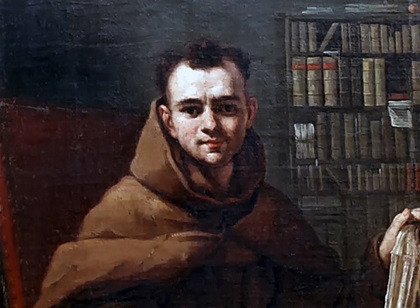 Death of Duns Scotus (original name: Johannes) in Cologne, Germany (born in Scotland). Duns Scotus was a Franciscan who was educated in England and had taught at the University of Paris prior to his final academic appointment at Cologne in 1307. He had become a very controversial scholar through one of his conclusions, that Mary had been born without sin (considered heresy by many). By the 16th Century Scotus was held in an esteem rivaling that of Thomas Aquinas.
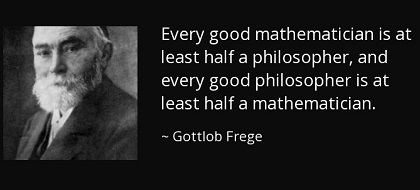 Birth of Gottlob Frege in Wismar, Germany. Frege studied mathematics, physics, chemistry and philosophy at the University of Göttingen. He later became a professor of mathematics at the University of Jena. Thinking on the boundary between philosophy and mathematics, Frege developed the beginnings of modern mathematical logic. His work remained without interest or understanding for many years until taken up by Bertrand Russell (1902). Some of his definitions (e.g., of the predecessor relation and of the concept of natural number) and methods (e.g., for deriving the axioms of number theory) constituted a significant advance.
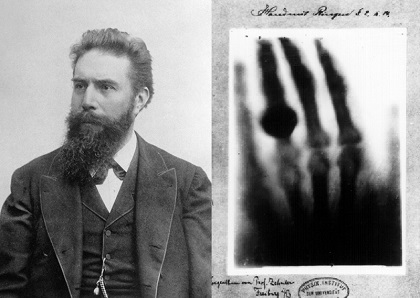 Wilhelm Röntgen announced the discovery of X-rays. He then went on to invent a machine which could take X-ray pictures. The first objects he X-rayed were the interiors of some metal objects and then the bones of his wife’s hand. Röntgen was a professor at the University of Würzburg.
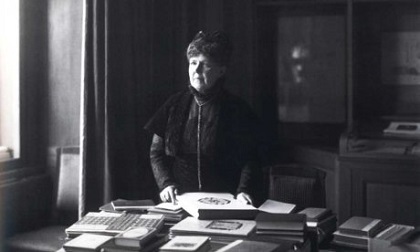 Death of Elisabeth Förster-Nietzsche in Weimar, Germany. She was the sister of the philosopher, Friedrich Nietzsche.