Dietrich Bonhoeffer: Pastor, Theologian, Resistance Martyr
In the summer of 1939, Dietrich Bonhoeffer was safe. He was in New York, a respected young German theologian with friends and a standing invitation to stay. War in Europe was only weeks away. He could have waited it out. Instead, after a few weeks he booked a passage home, explaining to his American colleagues that he would have no right to help rebuild church life in Germany after the war if he did not share the trials of his people now.
Almost six years later, about two weeks before American troops reached the area, he was hanged at the Flossenbürg concentration camp. He was 39 years old. Today he is one of the most widely read Christian thinkers of the 20th century, and in Germany, he is remembered above all as a man who tried to act on what he believed.
A Family of Intellectuals
Dietrich Bonhoeffer was born on 4 February 1906 in Breslau, then part of Germany and now the Polish city of Wrocław. He was the sixth of eight children and had a twin sister, Sabine. His father, Karl Bonhoeffer, was a renowned professor of psychiatry and neurology, and the family belonged to Berlin’s educated upper middle class. His older brother Walter was killed in the First World War in 1918, an event that deeply marked the family.
Dietrich began studying theology at 17 and completed his doctorate in 1927, at 21. In 1930, he spent a year at Union Theological Seminary in New York, where he studied under Reinhold Niebuhr and, by his own later account, was deeply affected by the worship of a Black congregation in Harlem. He returned to Berlin in 1931 as a university lecturer.
Against the Nazi Church
The Nazi seizure of power in January 1933 ended the path of a promising academic. Bonhoeffer was among the first to speak out against the regime’s treatment of Jews. In 1933, he wrote an essay, The Church Before the Jewish Question, arguing that Christians have a duty to resist unlawful actions by the state.
When the pro-Nazi “German Christians” introduced the so-called Aryan Paragraph into the Protestant church, requiring pastors of Jewish ancestry to be removed, Bonhoeffer joined Martin Niemöller’s Pastors’ Emergency League in protest. From this resistance grew the Confessing Church (Bekennende Kirche), founded in 1934, which split from the official Protestant church and insisted that Christian faith could not be bent to a political ideology. If you want to understand the Protestant background, see our guides to Martin Luther and Reformationstag.
From 1935, Bonhoeffer ran an illegal seminary for Confessing Church pastors, first in Zingst and then in Finkenwalde, until the Gestapo closed it in 1937. Out of this experience came his best-known book, Nachfolge (The Cost of Discipleship, 1937), which attacks what he called “cheap grace” and argues that real faith demands a costly commitment. He was later banned from speaking and publishing.
From Pastor to Conspirator
As the regime hardened, Bonhoeffer’s resistance moved from the church into politics. His brother-in-law Hans von Dohnányi, who was part of the military resistance, told him of plans for a coup as early as 1938. After the outbreak of war in 1939 and his decision to return from America, Bonhoeffer was recruited in 1940 into the Abwehr, the military intelligence service, which sheltered several opponents of Hitler.
The post was a cover. He used it to travel abroad and make contact with church leaders and Allied sources, and it allowed him to help some Jews escape to Switzerland. He also became deeply entangled in the conspiracy against Hitler. For a committed Christian who had once leaned toward pacifism, this was a hard decision, and historians still discuss how he wrestled with the question of whether violence against a tyrant could ever be justified.
Arrest and Prison
On 5 April 1943, Bonhoeffer was arrested, after incriminating documents were found in connection with Dohnányi. He was held first at Tegel military prison in Berlin until October 1944, and later moved to the Gestapo prison on Prinz-Albrecht-Straße and then to the concentration camps at Buchenwald, Schönberg, and Flossenbürg.
At Tegel he wrote some of his most significant work, which was published after the war as Widerstand und Ergebung (Letters and Papers from Prison). In these fragments, written to his friend Eberhard Bethge and others, he explored what Christianity might mean in a world no longer religious, and developed the idea that the church is only the church when it exists for others. Shortly before his arrest, he had become engaged to Maria von Wedemeyer, and the couple wrote to each other through the years of his imprisonment.
“Von guten Mächten”
One of Bonhoeffer’s last texts has become a household favorite in Germany. At the end of 1944, he wrote the poem Von guten Mächten wunderbar geborgen, a New Year’s greeting that expresses trust in God even in extreme adversity. Set to music by Siegfried Fietz and others, it’s sung in church services around New Year. In a 2021 survey by the Protestant Church in Germany (EKD), around 10,000 people voted it their favorite church song.
Execution at Flossenbürg
In February 1945, Bonhoeffer was transferred to Buchenwald and then to Flossenbürg in April. On 8 April, an SS summary court sentenced him to death, along with Admiral Wilhelm Canaris and Hans Oster, and in the early hours of 9 April 1945, he was hanged. Two weeks later, American troops liberated the area. His brother Klaus Bonhoeffer and his brother-in-law Hans von Dohnányi were both executed in April 1945 as well, as was his other brother-in-law Rüdiger Schleicher.
Legacy
After the war, Bonhoeffer was rehabilitated, and his writings were widely published. His influence has been vast, in Germany and abroad, especially among Christians struggling with the relationship between faith and politics.
Writings.The Cost of Discipleship, Life Together, Ethics, and Letters and Papers from Prison are widely read.
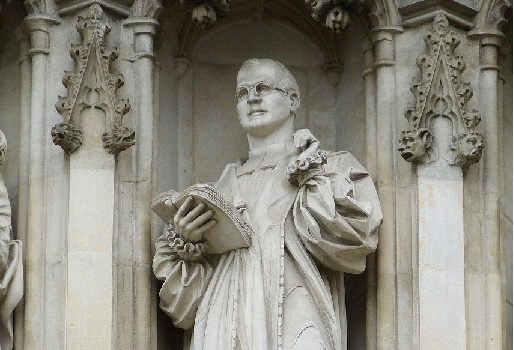
Memorials. He’s commemorated at the Flossenbürg memorial site and, in the UK, with a statue among the twentieth-century martyrs above the west door of Westminster Abbey.
Germany’s commemoration culture. He belongs, with Sophie Scholl and the participants of the 20 July plot, to the wider story of German resistance, remembered on days such as Volkstrauertag.
It’s worth remembering that Bonhoeffer’s story is more complicated than the image of a lone hero. He was part of a large family and a wide network, he took years to move from church opposition to political conspiracy, and interpreters still debate which aspects of his life to emphasize. For the broader context, read our overview of Germany under Hitler and the Nazis.
FAQ
Who was Dietrich Bonhoeffer? A German Lutheran pastor and theologian, a founder of the Confessing Church, and a member of the resistance against Hitler. He was executed at Flossenbürg on 9 April 1945.
Why did Bonhoeffer return to Germany in 1939? He felt he couldn’t help rebuild German church life after the war without sharing his people’s hardships during it.
What is “Von guten Mächten”? A poem Bonhoeffer wrote at the end of 1944 in prison, now one of the best-loved hymns in Germany, often sung at New Year.
How did Bonhoeffer die? He was sentenced by an SS summary court and hanged at Flossenbürg concentration camp on 9 April 1945, about two weeks before the camp’s liberation.