In the pantheon of the world’s greatest unsolved mysteries, few capture the imagination quite like the Amber Room – that legendary chamber whose walls literally glowed with the warm, honeyed light of six tons of amber panels, gold leaf, and precious mirrors. Often called the “Eighth Wonder of the World,” this masterpiece of baroque artistry vanished during World War II, spawning eight decades of speculation, treasure hunts, conspiracy theories, and obsessive searches that continue to this day. The story of the Amber Room is more than a tale of stolen art; it’s a narrative that encompasses the rise and fall of empires, the devastation of war, the persistence of cultural memory, and humanity’s enduring desire to recover lost beauty.
The mystery of the Amber Room resonates because it represents something beyond material value – though estimates suggest it would be worth over $500 million today. This lost treasure embodies the fragility of cultural heritage in times of conflict, the pain of irreplaceable loss, and the hope that even the most thoroughly vanished wonders might somehow, someday, be recovered. From its creation in the opulent courts of 18th-century Prussia to its disappearance amid the chaos of Nazi plunder, to the painstaking recreation that now stands in its place, the Amber Room’s story offers a compelling lens through which to examine questions of art, power, memory, and obsession.
This comprehensive exploration will guide you through the room’s spectacular origins, its journey from Prussia to Russia, the circumstances of its wartime disappearance, the decades of searching that followed, and the remarkable reconstruction that allows modern visitors to experience at least an echo of its vanished magnificence. Along the way, we’ll examine why this particular lost treasure has maintained such a powerful hold on the global imagination and what its story reveals about our relationship with cultural heritage.
The Creation: Baroque Splendor in Amber and Gold
The Amber Room’s story begins in the early 18th century, during the height of baroque extravagance, when European monarchs competed to create increasingly spectacular displays of wealth, power, and artistic refinement. The room was originally commissioned by Frederick I of Prussia, the first King in Prussia, who sought to transform his Berlin palace into a residence worthy of his newly elevated royal status.
The mastermind behind this ambitious project was Andreas Schlüter, the renowned baroque sculptor and architect who served as the Prussian court’s artistic director. Schlüter envisioned something unprecedented: an entire room whose walls would be covered not with painted panels or tapestries but with elaborately carved amber – that mysterious, fossilized tree resin that had been prized since ancient times for its warm beauty and supposed mystical properties.
Amber, sometimes called “Baltic gold,” had been harvested from the shores of the Baltic Sea for millennia. The region around Prussia – particularly the Samland Peninsula – was the world’s richest source of this remarkable substance. Ancient peoples attributed magical properties to amber, believing it could ward off evil spirits, cure diseases, and bring good fortune. By the baroque period, amber had become associated with luxury and refinement, used for jewelry, religious objects, and decorative arts, but never before had anyone attempted to use it on such an architectural scale.
The technical challenges were enormous. Amber is notoriously difficult to work with – brittle, unpredictable, and requiring specialized knowledge to carve and mount. Schlüter brought in amber craftsmen from Danzig (modern Gdańsk), particularly the Danish amber master Gottfried Wolfram, who possessed the rare skills necessary for this unprecedented project. These artisans spent years selecting amber pieces, cutting them into panels, and backing them with gold leaf to enhance their luminosity.
The original Amber Room, completed around 1712, was installed in the Charlottenburg Palace in Berlin. The room featured amber panels carved with baroque motifs – cherubs, floral designs, monograms, and allegorical figures – all glowing with that distinctive warm light that made amber so prized. Mirrors strategically placed multiplied the visual effect, while the gold leaf backing caused the amber to seem almost to glow from within. Contemporary accounts described visitors’ awe at entering a space that appeared to be made of captured sunlight itself.
However, Frederick I died in 1713, shortly after the room’s completion, and his son Frederick William I had little interest in such extravagant displays. The thrifty “Soldier King” preferred military might to artistic magnificence, and the Amber Room languished, admired but not particularly cherished by its owner.
The Journey to Russia: A Diplomatic Gift
The Amber Room’s destiny changed dramatically in 1716 when Tsar Peter the Great of Russia visited Prussia. Peter, who was transforming Russia into a European power and building his magnificent new capital of St. Petersburg, greatly admired the Amber Room. Recognizing an opportunity to cement a crucial alliance against their mutual rival Sweden, Frederick William I made an extraordinary diplomatic gesture: he gifted the entire Amber Room to the Russian Tsar.
This gift was more than mere generosity – it represented a calculated political alliance. In exchange, Peter provided Frederick William with 55 of his finest soldiers, including some exceptionally tall grenadiers for the Prussian king’s prized regiment of giant soldiers. From a purely economic standpoint, this might seem an unequal exchange, but diplomatic symbolism often transcends material value, and the gift helped establish the Prussian-Russian alliance that would influence European politics for decades.
The Amber Room was carefully dismantled and transported to Russia, where it was initially installed in the Winter Palace in St. Petersburg. However, its true glory would be realized at the Catherine Palace in Tsarskoye Selo (literally “Tsar’s Village”), about 15 miles south of St. Petersburg. Empress Elizabeth, daughter of Peter the Great, ordered the room moved to Catherine Palace in 1755, commissioning the Italian architect Bartolomeo Rastrelli to reinstall and expand it.
Rastrelli transformed the Amber Room into something even more spectacular than its original incarnation. The room at Catherine Palace was larger – approximately 180 square feet – requiring additional amber panels to be created by Russian craftsmen. These artisans, working under the guidance of amber master Martelli, created new sections that matched and complemented the original Prussian work. The expanded room incorporated additional mirrors, venetian glass, and gilt carvings, while amber mosaics depicted allegorical scenes and elaborate floral patterns.
Over the following decades, successive Russian rulers continued enhancing the Amber Room. Catherine the Great, who gave the palace its name, added amber furniture and decorative objects. The room became not just a display of wealth but a symbol of Russia’s cultural sophistication and imperial grandeur – a chamber where the tsars could receive important guests and demonstrate Russia’s place among Europe’s great powers.
By the early 20th century, the Amber Room had achieved legendary status. Visitors described it as one of the world’s great artistic wonders, a space where the interplay of amber, gold, and mirrors created an almost otherworldly atmosphere. The warm glow of the amber panels, enhanced by candlelight or the filtered daylight from the room’s windows, created effects that photographs could never adequately capture.
The Disappearance: World War II and Nazi Plunder
The Amber Room’s tragic disappearance is inextricably linked to World War II and the systematic Nazi plunder of Eastern European cultural treasures. When Germany invaded the Soviet Union in June 1941 as part of Operation Barbarossa, Soviet authorities attempted to evacuate and protect valuable artworks from the advancing German forces.
The Amber Room presented unique challenges for evacuation. Its amber panels were extremely fragile, having become increasingly brittle with age. When Soviet curators attempted to remove the panels, pieces began cracking and crumbling. Faced with the impossibility of safe transport and the rapid German advance, they made the fateful decision to try concealing the room instead, covering the amber panels with wallpaper in hopes the Germans wouldn’t discover what lay beneath.
This desperate strategy failed. In September 1941, as German forces captured Tsarskoye Selo, Nazi art experts – specifically trained to identify and seize valuable cultural property – immediately recognized what the crude wallpaper disguised. The Germans systematically dismantled the Amber Room over 36 hours, carefully removing the panels and packing them into 27 crates.
The dismantled Amber Room was transported to Königsberg (modern Kaliningrad), the capital of East Prussia, on direct orders from Hitler and his deputy for cultural affairs, Alfred Rosenberg. The Nazis viewed the Amber Room not merely as valuable loot but as Germanic cultural property that rightfully belonged to Germany, since it had been created by Prussian craftsmen. This twisted reasoning justified the theft as “repatriation” rather than plunder.
In Königsberg, the Amber Room was reassembled and displayed in the royal castle’s museum, where it remained on public exhibition until 1944. The castle’s director, Dr. Alfred Rohde, oversaw its installation and supposedly took great pride in having this treasure under his care. For nearly three years, German visitors could view the legendary room, even as the war turned increasingly against Germany.
As Allied bombing intensified and Soviet forces advanced toward East Prussia in late 1944, the Amber Room’s trail becomes murky and contested. According to some accounts, museum staff disassembled the room and packed it into crates as British bombs began falling on Königsberg. What happened next remains one of history’s greatest mysteries.
The last confirmed sighting of the Amber Room was in early 1945, as Soviet forces closed in on Königsberg. The castle was severely damaged during the Soviet assault in April 1945 and further devastated by fire. When Soviet troops finally entered the smoldering ruins, they found no trace of the Amber Room. It had vanished completely, along with Dr. Rohde, who died under mysterious circumstances shortly after the war’s end, taking his knowledge of the room’s fate to his grave.
The Search: Decades of Investigation and Theory
The disappearance of the Amber Room launched what would become one of the longest and most intensive treasure hunts in history. For over seven decades, investigators, treasure hunters, historians, and amateur sleuths have pursued countless leads, excavated numerous sites, and developed elaborate theories about the room’s fate.
Soviet authorities began searching for the Amber Room almost immediately after the war ended. Stalin personally ordered its recovery, viewing the room’s return as both a matter of cultural restoration and national pride. Soviet investigators interrogated German prisoners, museum officials, and anyone who might have knowledge of the room’s whereabouts. They explored the ruins of Königsberg castle, examined German archives, and followed numerous leads throughout former East Prussia and beyond.
The official Soviet investigation concluded that the Amber Room had likely been destroyed in the Königsberg castle fire, but this conclusion satisfied few people. The room’s disappearance seemed too convenient, too complete. How could six tons of amber and its elaborate mounting simply vanish without trace? Surely such a spectacular treasure must have survived somewhere, hidden away and waiting to be rediscovered.
This hope fueled decades of speculation and search efforts. Theories about the Amber Room’s location multiplied, each new hypothesis launching fresh searches. Perhaps it was hidden in underground bunkers beneath Königsberg? Maybe it was loaded onto a ship that sank in the Baltic Sea? Could it have been transported to Germany proper and concealed in salt mines, castle vaults, or secret Nazi hideouts in Bavaria or Austria?
Treasure hunters explored countless sites. In the 1960s and 1970s, amateur searchers excavated around Königsberg’s ruins, sometimes with official approval but often clandestinely. Every rumor of Nazi treasure hoards or secret bunkers prompted speculation that the Amber Room might be among the hidden valuables. The 1997 discovery of gold and art treasures hidden in an Bremen bank vault by a German soldier briefly reignited hopes, though the Amber Room wasn’t among the recovered items.
Some investigators pursued theories involving Nazi attempts to transport the Amber Room to Germany for safekeeping. Historical research revealed that several trains and ships left Königsberg carrying looted art in early 1945, before Soviet forces captured the city. Could the Amber Room have been among these transported treasures? Did it reach Germany only to be hidden in one of the numerous secret storage facilities the Nazis established for stolen art?
The discovery of individual amber pieces from the original room has both encouraged and frustrated searchers. In 1997, German authorities recovered an amber mosaic panel that conclusively came from the original Amber Room – it had been in possession of a German family since the war. This proof that at least some pieces survived the war’s chaos reinvigorated search efforts, suggesting that other portions might also have endured.
Throughout these decades, numerous people claimed to know the Amber Room’s location or to have information about its fate. Some were sincere but mistaken; others were deliberate fraudsters seeking attention or financial gain. The mystery attracted cranks and charlatans alongside serious researchers, making it increasingly difficult to separate credible leads from fantasy.
The search for the Amber Room has taken investigators across Europe and even beyond. Theories have pointed to locations in Germany, Poland, Austria, and elsewhere. Each new historical document discovery or witness account has prompted fresh excavations. Ground-penetrating radar, deep-sea diving expeditions, and sophisticated archival research have all been employed in the quest to locate the vanished treasure.
Despite these extensive efforts, no conclusive evidence of the Amber Room’s survival has emerged. The most likely scenarios remain frustratingly mundane: destruction in the Königsberg fire, disposal during the chaotic final days of the war, or gradual dispersion as looters broke the panels into smaller pieces for easier concealment or sale. The romantic vision of an intact Amber Room waiting in some forgotten bunker grows increasingly implausible with each passing year.
Theories and Speculation: Where Could It Be?
The absence of conclusive evidence hasn’t stopped speculation about the Amber Room’s possible survival and location. Several major theories have developed over the decades, each with adherents who argue passionately for their plausibility.
The Königsberg Fire Theory suggests the room was destroyed when the royal castle burned during and after the Soviet assault in 1945. This remains the official position of many historians and was the Soviet government’s conclusion. Amber is highly flammable, and the intense fires that consumed the castle could plausibly have destroyed the panels entirely, leaving no recognizable remains. However, skeptics note that six tons of amber would leave some trace, and that the mounting hardware and gold backing should have survived even if the amber burned.
The Underground Bunker Theory proposes that German officials hid the Amber Room in one of numerous underground facilities around Königsberg before the Soviet capture. East Prussia featured extensive tunnel systems, bunkers, and underground storage chambers. Proponents of this theory believe the room might still rest in an undiscovered or unexplored underground location, preserved in stable conditions. Regular announcements of “new evidence” pointing to specific bunker sites continue generating media attention and sometimes prompting excavations, though none have yet produced results.
The Baltic Sea Theory suggests the Amber Room was loaded onto a ship attempting to evacuate German property from Königsberg, and that this vessel sank during the war’s final chaotic weeks. The Baltic Sea witnessed numerous ship sinkings as German vessels fled westward ahead of Soviet advances. Several treasure hunting expeditions have searched for wrecks that might contain the Amber Room, using historical shipping records and sonar technology. The dramatic 2020 discovery of the Karlsruhe cruiser briefly renewed speculation, though the Amber Room wasn’t found aboard.
The Bavaria/Austria Hiding Theory proposes that the Amber Room reached western Germany or Austria and was concealed in salt mines, castle vaults, or mountain hideouts where the Nazis stored other stolen art. This theory gains plausibility from historical precedent – the Nazis did successfully transport massive amounts of looted art to secure facilities in these regions. However, Allied forces discovered and inventoried most of these storage sites after the war, and the Amber Room wasn’t among the recovered treasures.
The Private Collection Theory speculates that someone disassembled the Amber Room and sold it piecemeal, or that it remains hidden in a private collection. The 1997 recovery of a genuine amber panel from the room lends some credence to this possibility. Perhaps other pieces similarly survived in private hands, their owners either unaware of their significance or unwilling to reveal their possession of stolen property. This theory suggests the Amber Room may effectively be scattered and lost forever, existing only as fragments rather than a coherent whole.
Some more exotic theories involve transportation to South America, concealment in abandoned mines, or even deliberate destruction by the Nazis to prevent Soviet recovery. While these scenarios make for exciting speculation, most serious researchers view them as implausible given available historical evidence.
The Reconstruction: Recreating Lost Glory
Faced with the likelihood that the original Amber Room would never be recovered, Russian authorities made a momentous decision in 1979: they would recreate it. This reconstruction project would become one of the most ambitious art restoration undertakings in history, a 24-year effort requiring extraordinary craftsmanship, historical research, and determination.
The Soviet government commissioned a team of amber craftsmen, art historians, and restorers to meticulously recreate the Amber Room based on historical photographs, written descriptions, and fragments of amber from the original room. This was no simple reproduction – it was an attempt to resurrect a lost masterpiece using the same materials and techniques employed in the 18th century.
Russian amber craftsmen, many from the Kaliningrad region (formerly Königsberg, ironically), spent decades relearning lost techniques for working with amber on this scale. They studied historical documents, examined amber work in museums, and developed the specialized skills necessary to carve, mount, and polish amber panels to baroque standards. Each panel required countless hours of painstaking work, selecting amber pieces with appropriate color and clarity, cutting them to precise specifications, and fitting them into elaborate designs.
The reconstruction faced numerous challenges. Amber of suitable quality and quantity had to be sourced – much of it coming from the same Baltic regions that supplied the original craftsmen. The amber pieces needed to be aged artificially to match the warm, deep tones of the original room’s centuries-old panels. Historical photographs provided crucial visual references, but couldn’t capture all the details necessary for perfect reproduction.
Financial difficulties repeatedly threatened the project, particularly during the economic chaos following the Soviet Union’s collapse in 1991. For years, work proceeded slowly, dependent on limited funding and the dedication of craftsmen who sometimes worked for months without regular pay. The project’s completion seemed uncertain until Germany provided significant financial support in the late 1990s – a gesture of reconciliation acknowledging German responsibility for the original room’s loss.
This German financial contribution, totaling approximately 3.5 million euros, proved crucial to completing the reconstruction. It represented more than monetary support; it symbolized German recognition of the cultural tragedy that Nazi plunder represented and a commitment to helping heal this historical wound.
In 2003, on the 300th anniversary of St. Petersburg’s founding, the reconstructed Amber Room was officially opened to the public at Catherine Palace. The unveiling represented an extraordinary triumph of craftsmanship, scholarship, and determination. After 24 years of work and an estimated $11 million in costs, visitors could once again experience the glory that had been lost for nearly six decades.
The recreated Amber Room authentically reproduces the original’s splendor. Six tons of amber cover approximately 590 square feet of wall space, backed with gold leaf and accented with mirrors and venetian glass. The baroque designs – floral patterns, allegorical figures, monograms – mirror the original panels as closely as historical documentation allowed. When properly lit, the room glows with that distinctive warm luminosity that made the original legendary.
Today, the reconstructed Amber Room ranks among Russia’s most popular tourist attractions, with hundreds of thousands of visitors annually experiencing its beauty. While art historians and those who knew the original room note subtle differences between the reconstruction and what was lost, most visitors find the recreated chamber breathtaking – a testament to both the original creators’ genius and the modern craftsmen’s dedication.
A Mystery That May Never Be Solved
More than eight decades after the Amber Room vanished, the mystery remains unsolved. Despite extensive searches, sophisticated technology, and countless theories, the fate of those six tons of amber and gold remains unknown. The room may have burned in Königsberg’s flames, may rest in some undiscovered bunker, may have been scattered across private collections, or may have been destroyed deliberately. We may never know with certainty.
Yet perhaps the enduring mystery itself has become part of the room’s legacy. The search for the Amber Room has inspired books, documentaries, academic research, and countless personal quests. It has brought together historians, treasure hunters, scientists, and dreamers in shared pursuit of a lost wonder. The mystery has kept memory of the original room alive far more effectively than if it had simply survived the war and remained in place, admired but familiar.
The reconstructed Amber Room at Catherine Palace ensures that this baroque masterpiece can be experienced by new generations, even if the original remains lost. Modern visitors can still glimpse what made this chamber so extraordinary, can still experience that distinctive amber glow that captivated 18th-century aristocrats and 20th-century treasure hunters alike.
The Amber Room’s story ultimately transcends questions about its current location. It speaks to fundamental aspects of human experience: our creation of beauty, our capacity for destruction, our refusal to forget what we’ve lost, and our determination to preserve and restore cultural heritage even when original works cannot be recovered. Whether the original room ever resurfaces or remains forever missing, its legacy endures – in memory, in reproduction, and in the enduring fascination it continues to inspire.
In a world where so much feels disposable and temporary, the Amber Room reminds us that some things are genuinely irreplaceable, that cultural heritage matters profoundly, and that the desire to protect and recover beautiful things remains a powerful human impulse. The search may continue for decades more, driven by hope that somewhere, somehow, this vanished wonder might yet be found – six tons of Baltic gold waiting in darkness to return to light.
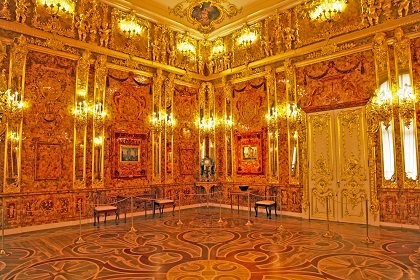
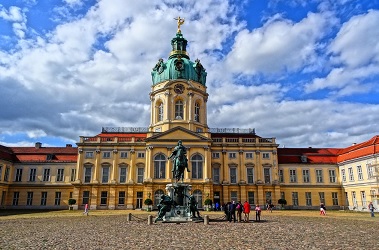 The original Amber Room, completed around 1712, was installed in the Charlottenburg Palace in Berlin. The room featured amber panels carved with baroque motifs – cherubs, floral designs, monograms, and allegorical figures – all glowing with that distinctive warm light that made amber so prized. Mirrors strategically placed multiplied the visual effect, while the gold leaf backing caused the amber to seem almost to glow from within. Contemporary accounts described visitors’ awe at entering a space that appeared to be made of captured sunlight itself.
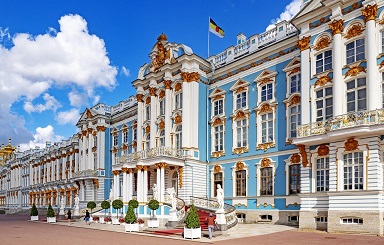 The Amber Room was carefully dismantled and transported to Russia, where it was initially installed in the Winter Palace in St. Petersburg. However, its true glory would be realized at the Catherine Palace in Tsarskoye Selo (literally “Tsar’s Village”), about 15 miles south of St. Petersburg. Empress Elizabeth, daughter of Peter the Great, ordered the room moved to Catherine Palace in 1755, commissioning the Italian architect Bartolomeo Rastrelli to reinstall and expand it.