Reformationstag: What Germans Celebrate on October 31
In Lutherstadt Wittenberg, the small town where the Reformation began, October 31 starts with church bells and festive services at the Schlosskirche and the Stadtkirche. By midday, a historic market fills the center, with stalls, music, and visitors drawn from across the country. Meanwhile, a few hundred kilometers away in Munich or Stuttgart, it’s an ordinary working day, and the same date is better known for costumes and pumpkins.
That split is the whole story of Reformationstag, or Reformation Day. It’s one of the most important dates in German history, and a public holiday in nine states, yet many Germans outside those states barely notice it. If you’ve ever wondered why shops are closed on Halloween in Hamburg or Leipzig, this is why.
What Reformationstag Commemorates
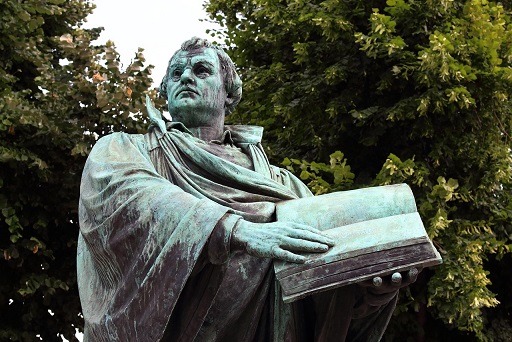
Reformationstag remembers October 31, 1517, the day the theologian and professor Martin Luther is said to have made public his 95 Theses, a set of statements challenging church practices of his time, especially the sale of indulgences. The theses spread quickly and set off the movement that split Western Christianity into Protestant and Catholic churches. You can read more in our article on Martin Luther and the 95 Theses.
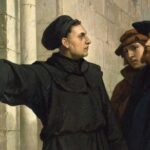
One detail that surprises many people: the famous image of Luther hammering the theses to the church door is a legend that historians cannot confirm. What is clear is the timing. The following day was All Saints’ Day, when crowds of believers traveled to Wittenberg to view a display of relics, so Luther’s challenge reached a large audience at exactly the right moment.
How It Became a Holiday
The date wasn’t always a day off. According to Protestant church sources, October 31 became a binding commemoration for Protestants in 1667, when the Elector of Saxony ordered it to be observed, tying it to the legendary posting of the theses in Wittenberg.
The modern holiday has a more patchwork history:
Since German reunification, Reformationstag has been a public holiday in the five eastern states of Brandenburg, Mecklenburg-Vorpommern, Saxony, Saxony-Anhalt, and Thuringia.
In 2017, the 500th anniversary of the Reformation, it was a one-time nationwide public holiday.
From 2018, four northern states added it permanently: Bremen, Hamburg, Lower Saxony, and Schleswig-Holstein.
That makes nine of Germany’s sixteen states. The remaining seven treat October 31 as an ordinary day, and the holiday has little place in the largely Catholic south and west, where Allerheiligen on November 1 is the religious date that matters.
What Happens on Reformationstag
For most people in the holiday states, Reformationstag feels like a quiet Sunday. Schools and public offices are closed, and most shops follow Sunday rules, so don’t expect to buy groceries. Anyone required to work on a public holiday is entitled to a compensatory day of rest.
For Protestant communities, the day has a more traditional shape.
Church services. Festive services mark the day, often including Luther’s famous hymn “Ein feste Burg ist unser Gott” (“A Mighty Fortress Is Our God”), which is closely associated with the Reformation.
The Luther Rose. You’ll see this symbol everywhere: a black cross on a red heart, set inside a white rose on a blue field and ringed in gold. It was Luther’s personal seal and has become the emblem of Lutheran churches.
Reformationsbrötchen. In Thuringia, Saxony, and Saxony-Anhalt, bakers make Reformation rolls, a yeast pastry with raisins and almonds shaped like the Luther Rose. Some congregations bake them together and share them after services.
Festivals in Wittenberg. The town hosts a Reformationsfest, with a historic market, concerts, and events. Medieval-style festivals are held in other German cities too. One past edition drew more than 30,000 visitors to Wittenberg, and church leaders stressed that the day is not meant as a celebration against anyone else, a message that has become common in ecumenical-minded Germany.
Reformationstag, Halloween, and All Saints’ Day
October 31 is crowded with meaning in Germany, and the three observances sit side by side in an uneasy balance.
Reformationstag (31 Oct) is a Protestant commemoration and a public holiday in nine states.
Halloween (31 Oct) is a recent, commercial import, celebrated mainly in cities and at parties, and not a holiday anywhere.
Allerheiligen (1 Nov) is the Catholic All Saints’ Day, a public holiday in Baden-Württemberg, Bavaria, North Rhine-Westphalia, Rhineland-Palatinate, and Saarland.
The overlap isn’t accidental. Halloween’s name comes from “All Hallows’ Eve,” the evening before All Saints’ Day, which is the same evening Luther is remembered for. In Protestant regions, where the date carries historical weight, some congregations offer children’s events or lantern gatherings as an alternative to Halloween parties. See our guide to Halloween in Germany for how the imported holiday found its place, or our article on whether Halloween is a public holiday.
Reformationstag in 2026 and Beyond
In 2026, October 31 falls on a Saturday, the 509th anniversary of the theses. Because it lands on a weekend, there’s no extra day off in the holiday states, but most shops there will still be closed. In 2027, October 31 is a Sunday, and in 2028 it’s a Tuesday.
Tips for Visitors
Plan ahead in the nine states. Buy food and supplies the day before, since most shops will be closed.
Visit Wittenberg for the full experience. Check the town’s official program for the Reformationsfest, services, and the historic market.
Look for Luther Roses and Reformation rolls. They’re easy ways to see the tradition up close, especially in Thuringia, Saxony, and Saxony-Anhalt.
Be respectful. For many Protestants it’s a day of religious meaning, and in some towns quiet reflection is the mood.
FAQ
What is Reformationstag in Germany? It’s Reformation Day, observed on October 31 to commemorate Martin Luther’s 95 Theses of 1517 and the start of the Protestant Reformation.
Which German states have Reformationstag as a public holiday? Brandenburg, Bremen, Hamburg, Lower Saxony, Mecklenburg-Vorpommern, Saxony, Saxony-Anhalt, Schleswig-Holstein, and Thuringia.
Did Martin Luther really nail the 95 Theses to a church door? The popular image is a legend that historians cannot confirm, though Luther’s theses certainly began circulating in 1517 and sparked the Reformation.
What are Reformationsbrötchen? Yeast rolls with raisins and almonds shaped like the Luther Rose, traditionally baked around Reformation Day in Thuringia, Saxony, and Saxony-Anhalt.