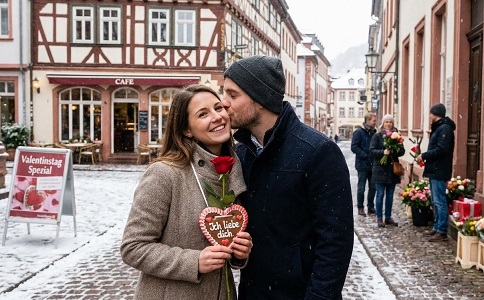
Valentine’s Day in Germany: From American Import to Cultural Tradition
When florists across Germany arrange elaborate bouquets of red roses on February 14th, when restaurants set romantic tables adorned with candles and hearts, when couples exchange chocolates and declarations of love, they participate in a tradition that would have been virtually unknown to their grandparents. Valentine’s Day in Germany represents one of the most successful examples of cultural transmission in post-war Europe – an initially American celebration that has been adopted, adapted, and thoroughly integrated into German romantic culture over just seven decades.
Unlike many German festivals with centuries-old roots in regional folk traditions, Christian liturgical calendars, or historical events, Valentine’s Day arrived in Germany as a consciously imported celebration, brought by American soldiers, promoted by commercial interests, and initially met with skepticism and resistance. Today, Germans spend hundreds of millions of euros annually on Valentine’s Day gifts, restaurants create special romantic menus, and the day occupies a established place in the German cultural calendar. Yet this adoption hasn’t been straightforward or uncontested – Valentine’s Day in Germany carries traces of its foreign origins, reveals tensions between authentic tradition and commercial creation, and continues generating debates about consumerism, romance, and cultural identity.
The Absent Tradition: Pre-War Germany and Romantic Celebrations
Before exploring Valentine’s Day’s arrival in Germany, it’s essential to understand what romantic celebration traditions existed beforehand – and what conspicuous absences left space for an imported holiday to fill.
Pre-20th century Germany possessed rich traditions around courtship, love, and marriage, but these were typically embedded in broader community festivals, seasonal celebrations, or life-cycle rituals rather than constituting a dedicated “day of love.” Rural communities had customs involving young people’s courtship – May Day celebrations where young men might leave flowers for desired partners, harvest festivals that brought young people together, and various regional traditions around engagement and marriage.
The Middle Ages knew of Saint Valentine – actually several different Christian martyrs whose legends became conflated – but Germanic territories didn’t develop significant liturgical or folk traditions specifically around his February 14th feast day. Unlike some Catholic regions where saint’s days generated elaborate local celebrations, Valentine’s Day remained relatively obscure in German religious calendars. The connection between Saint Valentine and romantic love that developed in medieval England and France through courtly love traditions never fully penetrated Germanic cultural spheres.
Post-War Arrival: American Soldiers and Cultural Transmission
Valentine’s Day arrived in Germany through the most direct possible route – American occupation forces who brought their cultural practices along with military presence. Understanding this transmission requires examining the broader context of American cultural influence in post-war Germany and the specific mechanisms through which Valentine’s Day traditions were introduced and gradually adopted.
When American troops arrived in Germany during and after World War II, they brought entire cultural worlds with them. Military bases became American cultural islands, complete with American products, entertainment, and holiday celebrations. American soldiers observed Valentine’s Day just as they would have at home – sending cards, buying flowers and chocolates, and celebrating with romantic dinners. These celebrations initially remained contained within American military communities, but proximity inevitably created contact and curiosity among Germans.
The broader context of American cultural influence in post-war West Germany facilitated Valentine’s Day’s acceptance. American movies, music, consumer products, and lifestyle aspirations flooded West Germany during the 1950s and 1960s. Valentine’s Day arrived as part of this larger American cultural package. For many Germans, particularly younger generations, American culture represented modernity, prosperity, and liberation from Nazi Germany’s oppressive traditions. Adopting American cultural practices, including Valentine’s Day, signaled participation in this desirable modern world.
The 1950s-1970s: Commercial Promotion and Gradual Adoption
The decades following Valentine’s Day’s initial introduction saw sustained commercial promotion meeting gradual cultural adoption, though progress remained uneven and the holiday faced significant skepticism and resistance.
Florists led Valentine’s Day promotion in Germany, recognizing the holiday’s potential to boost February sales. The Association of German Florists (Fachverband Deutscher Floristen) actively promoted Valentine’s Day from the 1950s onward, creating advertising campaigns that explained the tradition to German consumers and encouraged flower-giving as appropriate romantic expression. Red roses – already symbolically associated with love across European cultures – became the canonical Valentine’s Day gift, with florists emphasizing that gifting roses on February 14th demonstrated proper romantic devotion.
Confectionery companies similarly promoted Valentine’s Day as an occasion for giving chocolates. German chocolate manufacturers developed special Valentine’s products—heart-shaped boxes, romantic packaging, and marketing campaigns linking chocolate-giving to love expression. These companies borrowed directly from American Valentine’s marketing while adapting it for German tastes and sensibilities.
The greeting card industry, seeing the enormous success of Valentine’s cards in Anglo-American markets, attempted to establish similar practices in Germany. However, this proved more challenging than flower and chocolate sales. Germans had less tradition of sending greeting cards generally, and the practice of exchanging Valentine’s cards never achieved the ubiquity in Germany that it had in America or Britain. Valentine’s cards remained available but represented a smaller part of German Valentine’s Day observance than in their countries of origin.
Media coverage played important roles in normalizing Valentine’s Day. Magazines featured articles explaining Valentine’s Day traditions, offering romantic gift ideas, and publishing stories about couples celebrating the day. Radio programs discussed the holiday, while television increasingly included Valentine’s Day content in entertainment programming and advertising. This media attention created cultural familiarity – even Germans who didn’t personally celebrate Valentine’s Day knew about it and understood its basic customs.
The 1980s-Present: Mainstream Acceptance and German Adaptation
By the 1980s, Valentine’s Day had achieved sufficient cultural penetration in West Germany to be considered an established, if still somewhat controversial, part of the romantic calendar. The following decades saw the holiday’s further normalization and Germans’ adaptation of the tradition to local sensibilities and practices.
One significant development was Valentine’s Day’s expansion beyond young romantic couples to encompass broader relationship expressions. While American Valentine’s Day similarly evolved, Germans particularly embraced giving Valentine’s gifts to friends (particularly female friends exchanging tokens), family members, and even colleagues. This expansion diluted the holiday’s exclusively romantic character, making it more culturally comfortable for Germans who found overt romantic display somewhat embarrassing or overly sentimental.
The rise of internet culture and social media from the 2000s onward transformed Valentine’s Day observance in Germany as elsewhere. Online flower and gift ordering made Valentine’s shopping more convenient. Social media created platforms for public romantic declarations and for sharing Valentine’s celebration photos. Digital greeting cards and romantic messages partially replaced or supplemented physical cards. Young Germans particularly embraced these digital Valentine’s Day practices, integrating the holiday into their broader social media performances of relationship status and romantic identity.
The holiday also inspired counter-movements and alternative celebrations. “Anti-Valentine’s Day” events appeared, particularly in university towns and urban areas, where single people gathered to celebrate friendship and reject what they viewed as Valentine’s Day’s commercialized couple-centrism. Some feminist groups criticized Valentine’s Day for reinforcing traditional gender roles (men as gift-givers, women as recipients) and heteronormative relationship models. These critiques coexisted with mainstream celebration, creating diverse Valentine’s Day landscape where the holiday could be embraced, rejected, or ironically performed.
Contemporary Debates: Authenticity, Commercialism, and Meaning
Contemporary German discussions about Valentine’s Day reflect broader tensions about cultural authenticity, commercial manipulation, gender roles, and what constitutes meaningful romantic expression. These debates reveal that even after seven decades, Valentine’s Day remains somewhat contested in German culture.
The authenticity question persists. Critics argue that Valentine’s Day lacks genuine cultural roots in Germany, representing imposed commercialism rather than organic tradition. They contrast it unfavorably with “authentic” German festivals that emerged from centuries of folk practice or historical experience. Defenders counter that all traditions were once innovations, that cultural borrowing has always occurred, and that Valentine’s Day’s adoption demonstrates its meeting genuine cultural needs around romantic expression. This debate touches fundamental questions about what makes traditions “real” and whether cultural practices require ancient origins to be meaningful.
Gender dynamics generate particular scrutiny. Traditional Valentine’s Day practices typically positioned men as active gift-givers and women as passive recipients, reinforcing conventional gender roles in romantic relationships. Contemporary young Germans increasingly embrace more egalitarian Valentine’s practices – mutual gift-giving, couples splitting restaurant costs, women initiating romantic gestures – that challenge these traditional patterns.
The relationship status implications also generate discussion. Valentine’s Day’s couple-centrism can make single people feel excluded, pressured, or inadequate. The holiday creates social expectations about relationship status demonstration – couples are expected to celebrate, creating pressure on relationships and making single status more visible. Some Germans reject Valentine’s Day participation specifically because of these exclusionary dynamics, viewing the holiday as unfairly privileging coupled people over singles.
Valentine’s Day Customs: How Germans Celebrate Today
Contemporary German Valentine’s Day celebration combines adopted American practices, European influences, and distinctive German adaptations, creating recognizable but culturally specific observance patterns.
Flower-giving remains the most common Valentine’s Day practice in Germany, with red roses maintaining symbolic primacy. German florists report their busiest day of the year on February 14th, with many taking pre-orders weeks in advance to manage demand. Beyond roses, Germans give mixed bouquets, potted plants, and increasingly elaborate floral arrangements. The flower industry’s early promotional role means floral gifts feel more culturally established and less overtly commercial than some other Valentine’s practices.
Chocolate and confectionery gifts remain popular, though perhaps less dominant than in Anglo-American contexts. German chocolate manufacturers produce Valentine’s-specific products, but the practice of giving elaborate chocolate boxes is less universal than flower-giving. Germans might include chocolates as part of broader gift packages rather than as standalone Valentine’s gifts.
Restaurant dining on Valentine’s Day has become standard middle-class practice. Restaurants offer special Valentine’s menus ranging from modestly priced three-course dinners to elaborate tasting menus at upscale establishments. Making reservations well in advance is necessary at popular venues. This restaurant tradition creates semi-public romantic performance – couples demonstrate relationship status and romantic investment through public dining, while restaurants provide appropriate romantic atmosphere through candlelight, music, and special decorations.
Experience gifts have gained popularity, particularly among younger Germans. Rather than material presents, couples might exchange concert tickets, spa day vouchers, weekend getaway reservations, or adventure activity bookings. This shift toward experiences over objects reflects broader generational changes in consumption patterns and desires for memorable shared experiences rather than accumulated possessions.
Jewelry, perfume, and lingerie occupy important niches in Valentine’s gift-giving, though these tend toward special occasions or established relationships rather than new romances. German advertising for these products intensifies around Valentine’s Day, positioning them as appropriate demonstrations of serious romantic commitment.
Personal gestures – handwritten love letters, homemade gifts, carefully planned surprises – coexist with commercial Valentine’s practices. Many Germans combine purchased and personal elements, perhaps giving flowers alongside heartfelt letters or planning special home-cooked meals rather than restaurant dinners. This combination addresses concerns about excessive commercialism while maintaining Valentine’s Day observance.
Digital Valentine’s expressions have proliferated, particularly among younger Germans. Social media posts declaring love, sharing couple photos with Valentine’s hashtags, and digital love letters via messaging apps supplement or replace traditional practices. These digital expressions create public romantic declarations that previous German generations might have found excessively demonstrative but that digital natives embrace as normal relationship performance.
A Borrowed Tradition Made German
Valentine’s Day in Germany stands as a fascinating case study in cultural transmission, adaptation, and the creation of modern traditions. What arrived as an American military import, promoted by commercial interests and initially met with skepticism, has become an established part of German romantic culture over just seven decades – a remarkably short timeframe for cultural adoption.
Valentine’s Day’s German adoption also illuminates post-war cultural dynamics. The holiday’s success reflects American cultural influence’s breadth and depth in West Germany, the appeal of American-style romantic individualism to Germans emerging from Nazi collectivism, and the power of commercial infrastructure in creating and sustaining cultural practices. That this American import succeeded while many other attempted cultural transplants failed suggests that Valentine’s Day met genuine needs around romantic expression that existing German traditions didn’t adequately address.
Contemporary Valentine’s Day in Germany combines recognizably American elements – the February 14th date, the emphasis on romantic gifts, the commercial character – with distinctively German adaptations. Germans have made the tradition their own through selective adoption, cultural reinterpretation, and integration into broader German romantic culture. Valentine’s Day in Germany is simultaneously borrowed and authentic, commercial and meaningful, recent and increasingly traditional.
As younger Germans continue reshaping the holiday to reflect contemporary values around gender equality, environmental sustainability, and relationship diversity, Valentine’s Day demonstrates that even borrowed traditions remain living practices capable of evolution. Whether celebrated enthusiastically, rejected deliberately, or observed with ironic awareness, Valentine’s Day has undeniably secured its place in Germany’s cultural calendar – a testament to both commercial promotion’s power and genuine human desires for occasions that celebrate love, connection, and romantic expression.