German Culture

All about Germany

  • Home
  • Learn German
    • German Language Basics
    • German Grammar & Vocabulary
    • German Learning Tips
    • German Idioms & Expressions
    • German Quizzes & Exercises
  • Articles
    • Famous Germans
    • German Holidays
    • German Cuisine
    • How To In Germany
    • Daily Life in Germany
    • German Facts
    • German Traditions
  • Facts About Germany
  • German History
    • Early History of Germany
    • Middle Ages in German History
    • German Reformation Period
    • 19th Century and German Unification
  • German Recipes
    • German Baking Recipes
    • German Bread Recipes
    • German Christmas Recipes
    • Desserts
    • German Easter Recipes
    • Halloween Recipes
    • Main Dishes
    • German Salad Recipes
    • German Salads
    • Sauerkraut Recipes
  • Travel to Germany
  • Contact

Leberknödelsuppe – German Liver Dumpling Soup

Leberknödelsuppe is a traditional German dish, particularly popular in Bavaria. It is a liver dumpling soup made of beef liver, bread, eggs, and parsley cooked in beef broth. In the Palatinate, Leberknödel are often served with Sauerkraut and mashed potatoes.

Ingredients:

2 stale bread rolls
3/4 cup lukewarm milk
2 eggs, beaten
1 onion, finely chopped
400 g trimmed and finely ground beef liver
1 tbsp chopped parsley
1 tbsp chopped carrots
1 pinch dried marjoram
1⁄2 tsp of lemon zest
1 tsp salt
1 pinch fresh ground black pepper
about 1 tbsp dry breadcrumbs
750 ml beef broth

Preparation:

  1. In a large bowl, pour the milk over bread rolls and soak for 10 minutes.
  2. Beat the eggs, then pour over the soaked rolls.
  3. Add the onion, liver, parsley, marjoram, lemon zest, salt, pepper and breadcrumbs.
  4. Mix together well and knead until it forms pliable dough. (You may need to add some plain bread crumbs).
  5. Form walnut-sized dumplings.
  6. If your mixture is too wet or loose, then add another bread roll.
  7. Bring the broth and carrots to a simmer in a large pot. Heat should be about medium or just a little lower. Don’t put the dumplings into boiling water because it will make them fall apart. Add dumplings one by one and let simmer. Dumplings will fall to the bottom of the pot and then float. Simmer for another 30 minutes once dumplings float to top. Avoid stirring the pot, it will break up the dumplings.
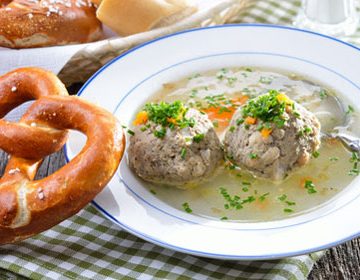
  8. Serve dumplings hot in bowl with broth.


You might also like:

  • Authentic Königsberger Klopse Recipe: A Taste of German Tradition
    Authentic Königsberger Klopse Recipe: A Taste of German…
  • Traditional German Beef Rouladen Recipe
    Traditional German Beef Rouladen Recipe
  • German Blutwurst Recipe: A Traditional Delight
    German Blutwurst Recipe: A Traditional Delight
  • Kartoffelsalat – Traditional German Potato Salad Recipe
    Kartoffelsalat – Traditional German Potato Salad Recipe
  • Rindfleischsalat – Traditional German Beef Salad Recipe
    Rindfleischsalat – Traditional German Beef Salad Recipe
  • Kartoffelsalat – Traditional German Recipe
    Kartoffelsalat – Traditional German Recipe
  • Schwäbischer Kartoffelsalat – Traditional German Recipe
    Schwäbischer Kartoffelsalat – Traditional German Recipe
  • Eiersalat – Traditional German Egg Salad Recipe
    Eiersalat – Traditional German Egg Salad Recipe

Recent Posts

Potatoes are one of the most beloved ingredients in German cuisine

Traditional German Potato Dishes

Traditional German potato dishes

Traditional German Potato Dishes You Should Know

Discover how potatoes in German culture shaped history

Potatoes in German Culture

The German Zeppelin represents far more than a transportation technology.

German Zeppelin: The Rise and Fall of Germany’s Giant Airships

Discover how the German Zeppelin worked

How the German Zeppelin Worked: Inside the Engineering of Airship Giants

Valentine’s Day in Germany: Love, History, and Traditions

Valentine’s Day in Germany: From American Import to Cultural Tradition

"Kinder, Küche, Kirche" functions primarily as a historical artifact and cautionary phrase

“Kirche, Küche, Kinder”: Germany’s Three K’s

Women and German Military Traditions

Women in German Army: Historical Evolution

Copyright © 2026 · German Culture

Go to mobile version