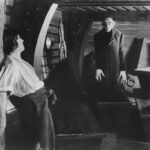
A shadow creeps up a staircase on the wall of a dark room. Its fingers are long and clawed, and it moves in a slow, impossible way. If that image feels familiar, it’s because it comes from a German film made more than a century ago, and nearly every vampire movie since has borrowed from it.
Germany might not be the first country people think of for horror, but it practically invented the visual language of the genre. A cluster of silent films from the early 1920s laid down the monsters, moods, and lighting tricks that Hollywood has been reusing ever since. If you’re building a Halloween watchlist, German horror films are the place to start.
The Silent Era: Where Modern Horror Began
The history of German horror cinema is a curve with a huge peak at the start. In the years after World War I, German filmmakers working in the Expressionist style produced a series of films that remain astonishingly influential.
Der Student von Prag (The Student of Prague, 1913). Directed by Stellan Rye, this early film about a man who sells his reflection is often cited as one of the first German horror features.
Das Cabinet des Dr. Caligari (The Cabinet of Dr. Caligari, 1920). Directed by Robert Wiene, it’s known for its twisted, painted sets and sharply angled shadows. It’s also considered an early example of the unreliable narrator, a trick still used in modern horror twists. In 2005 it was inscribed in UNESCO’s Memory of the World Register, a remarkable honor for a horror film.
Der Golem, wie er in die Welt kam (The Golem: How He Came into the World, 1920). Directed by Paul Wegener and Carl Boese, this film about a clay giant brought to life is a prequel to an earlier Golem film from 1915 that is now lost.
Nosferatu: Eine Symphonie des Grauens (Nosferatu: A Symphony of Horror, 1922). F. W. Murnau’s unauthorized take on Bram Stoker’s Dracula gave cinema its most unforgettable vampire, Count Orlok, with his bald head, rat-like teeth, and long fingers. The film survived a court order to destroy all copies, which is a good story for a film about the undead.
A Long Silence
After 1933, the Nazi regime changed German cinema, and horror, like many genres, largely disappeared from serious filmmaking. In postwar West Germany, there were very few horror films, and in East Germany, horror was treated as a Western genre and generally avoided. Some exploitation-style films appeared in the 1970s, but for decades the country’s horror reputation rested almost entirely on those early silent classics.
Herzog’s Nosferatu (1979)
The bridge between the silent era and the modern one was Werner Herzog‘s Nosferatu the Vampyre (Nosferatu: Phantom der Nacht, 1979). It’s less a remake than a tribute, with Klaus Kinski playing the vampire as a lonely, melancholy figure, more like a plague than a monster. Part of it is set in the town of Wismar on the Baltic coast.
It’s a film full of striking details. Herzog reportedly imported around 11,000 rats for filming and had them dyed gray, and the movie won an award from the international film critics’ association at the Cannes Film Festival. A more recent English-language remake directed by Robert Eggers followed in 2024, proving the story’s staying power.
Modern German Horror
From the 2000s onward, German horror gradually returned, mostly in smaller, genre-focused productions.
Antikörper (Antibodies, 2005). A serial-killer thriller by Christian Alvart with a dark, American-influenced style.
Rammbock (Siege of the Dead, 2010). Directed by Marvin Kren, this compact zombie film is set in a Berlin apartment block in the Bergmannkiez district. It’s often described as a German cousin of 28 Days Later.
Wir sind die Nacht (We Are the Night, 2010). A vampire thriller set in contemporary Berlin, about a group of female vampires.
Dark (2017 to 2020). Netflix’s first German original series isn’t horror in a strict sense, but its eerie, time-twisting mystery set in a small town has a growing international following.
In recent years critics have also noted a wave of festival-oriented “new German horror,” often labeled elevated horror, that mixes the genre with social and political themes.
Why Horror Is a Halloween Tradition for Many Germans
Horror is popular in Germany even though Halloween is a relatively recent holiday. A Statista survey found that roughly 38 percent of Germans regularly watch horror films or series, and viewing tends to climb around Halloween. For many people, a horror movie night at home is the easiest way to celebrate, with no costume required. For the wider cultural picture, see our guide to Halloween in Germany.
A Halloween Watchlist
If you want a short viewing plan, try this order:
Nosferatu (1922) for the original and the look that shaped everything after it.
The Cabinet of Dr. Caligari (1920) for its distinctive set design and early twist ending.
Nosferatu the Vampyre (1979) to see how Herzog reinterpreted the story.
Rammbock (2010) for a fast, modern horror-thriller.
Dark (2017 to 2020) if you’d rather have mystery than gore.
Tips for watching: silent films work best at night with the lights low and the sound turned up on the score. Many restored versions use new musical accompaniment, and the quality differs from edition to edition, so look for a restored release if you can.
What was the first German horror film? Early features like Der Student von Prag (1913) are often cited, and the major silent classics of 1920 to 1922 established the genre.
Why are German films so important to horror history? German Expressionist cinema pioneered the dramatic lighting, distorted sets, and psychological themes that shaped later horror, especially through Caligari and Nosferatu.
Is Nosferatu based on Dracula? Yes. It was an unauthorized adaptation of Bram Stoker’s Dracula with the names changed, and a court ordered copies destroyed, though the film survived.
Which German horror film should I watch first? For history, start with Nosferatu (1922). For something modern and fast-paced, try Rammbock (2010).