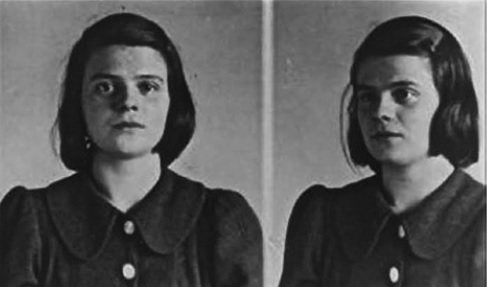
Sophie Scholl: The White Rose Student Who Defied the Nazis
On the morning of 18 February 1943, a few minutes before eleven o’clock, two students walked through the main building of the University of Munich carrying a suitcase full of paper. They placed stacks of leaflets outside the lecture halls, and when they had a few left over, one of them let the pages drift down into the central atrium. It was a small, quiet act, and it took no more than a minute. Within four days, both of them would be dead.
Sophie Scholl was 21 years old. Her brother Hans, with whom she was caught that morning, was 24. Their act of resistance has made her one of the best-known figures in German history and a symbol of conscience under dictatorship. This is who she was, what the White Rose did, and why Germans still remember her.
A Childhood in Württemberg
Sophie Scholl was born on 9 May 1921 in Forchtenberg, a small town in Württemberg, the fourth of five children of Robert Scholl, a liberal mayor, and Magdalena Scholl. As a teenager she did what many young Germans did in the 1930s: in 1934, she joined the League of German Girls (BDM), the girls’ branch of the Hitler Youth, and rose to the rank of group leader.
The turning point came in 1937, when the Gestapo took action against members of a banned youth movement, including her brother Hans, and Sophie herself was questioned. From that moment, she increasingly distanced herself from National Socialism. After school she trained as a kindergarten teacher, then did the compulsory labor and war auxiliary service the regime required of young people. In May 1942, she began studying biology and philosophy at the University of Munich, where her brother Hans was already studying medicine.
The White Rose
In Munich, Hans and his friends, medical students including Alexander Schmorell, Willi Graf, and Christoph Probst, had formed a small circle that rejected the regime. They were influenced by the Catholic publisher Carl Muth and by the university professor Kurt Huber. In the summer of 1942, they began writing and distributing leaflets under the name the White Rose (Die Weiße Rose), calling on Germans to resist the Nazi regime and its war.
The first four leaflets appeared in June and July 1942 in small numbers, mailed to people the group hoped to reach. After a break during which several members were sent to the Eastern Front as medics, the group resumed in early 1943. Sophie became involved in producing the fifth leaflet in January 1943. The sixth leaflet, drafted by Professor Huber and appearing after the German defeat at Stalingrad, called on students to rise up and build a “new spiritual Europe.” Their tone was moral and intellectual, not military: the leaflets argued that ordinary people were responsible for what was done in their name.
18 February 1943
By February 1943, the Gestapo knew that the authors of the leaflets were likely to be found among Munich’s students. On the morning of 18 February, Hans and Sophie placed about 1,500 copies of the sixth leaflet outside lecture halls in the university’s main building and let the remaining sheets fall into the atrium. A caretaker saw them, held them until officials arrived, and they were arrested by the Gestapo. Christoph Probst was arrested soon afterward.
After three days of interrogation, the three were tried on 22 February before the People’s Court (Volksgerichtshof) in Munich’s Palace of Justice. The presiding judge, Roland Freisler, was brought in from Berlin for the occasion. The trial was brief, and the defendants had little chance to speak. All three were convicted of high treason and sentenced to death. They were executed by guillotine the same day at Munich-Stadelheim prison. A local pastor, Karl Alt, later buried the siblings at the cemetery at Perlacher Forst, in a section sealed off by the Gestapo.
Other members of the group were arrested and later executed, including Alexander Schmorell and Kurt Huber in July 1943 and Willi Graf in October 1943.
How the Leaflets Outlived Them
The regime tried to silence the group, but its words traveled. A copy of the leaflet was smuggled out of Germany by Helmuth von Moltke, a member of another resistance circle, and reached Britain. In 1943, Allied aircraft dropped copies of the White Rose text over German cities. The author Thomas Mann told German listeners about the group in a BBC broadcast on 27 June 1943.
After the war, Sophie’s older sister Inge Scholl published a short book, Die weiße Rose (1952), which shaped how Germany and the world remembered the siblings.
Her Legacy in Germany Today
Sophie Scholl is one of the most commemorated people in modern German history, and she has come to stand for a particular idea: that ordinary people, even very young ones, can refuse to go along with injustice.
Memorials in Munich. In front of the university’s main entrance, the Geschwister-Scholl-Platz is named after the siblings, with a ground memorial of cast leaflets. Inside the building, a permanent exhibition called the DenkStätte Weiße Rose documents the group’s story. The atrium where the leaflets were dropped is still there.
Her grave. The Scholls and Probst are buried at the Friedhof am Perlacher Forst in Munich.
Stadelheim. A memorial room in the prison church recalls those executed there.
Schools and streets. Many German schools, streets, and public squares are named after the Scholls.
Film. The story has been filmed several times, including Die weiße Rose (1982) and Sophie Scholl: The Final Days (2005), which was nominated for an Academy Award for best foreign-language film.
Germany observes remembrance days for the victims of Nazi persecution, including Volkstrauertag in November and the anniversary of the pogrom on 9 November. The White Rose belongs to a wider story of resistance in Nazi Germany, which you can read about in our overview of Germany under Hitler and the Nazis.
A Note on How She Is Remembered
Like all historical figures, Sophie Scholl has sometimes been simplified. She wasn’t always a resister: she grew up inside the Nazi youth system and changed over several years. Her story is also not the story of the entire German resistance, which included many other people, among them military officers, church members, workers, and others, who acted at different times and for different reasons. Historians often point to this complexity as a reason her story matters: it shows a person arriving at conviction rather than being born with it.
Visiting Sites Connected to Sophie Scholl
LMU main building, Munich. See the atrium and the DenkStätte Weiße Rose exhibition. Check current opening hours before you go.
Geschwister-Scholl-Platz. The ground memorial of leaflets is outside the main entrance.
Friedhof am Perlacher Forst. The grave of Hans and Sophie Scholl and Christoph Probst.
Forchtenberg. Her birthplace in Baden-Württemberg also commemorates her.
Be respectful. These are places of remembrance, so keep noise and photography considerate.
FAQ
Who was Sophie Scholl? A German student and member of the White Rose resistance group, executed by the Nazi regime on 22 February 1943 at the age of 21.
What was the White Rose? A small group of students and a professor in Munich who wrote and distributed leaflets in 1942 and 1943 calling on Germans to resist the Nazi regime.
How did Sophie Scholl die? She was sentenced to death for high treason by the People’s Court and executed by guillotine at Munich-Stadelheim prison on the same day as her trial, 22 February 1943.
Where can I learn more in Munich? The DenkStätte Weiße Rose exhibition at the University of Munich’s main building is the central site.