Stollen is one of those foods people have strong opinions about without knowing much about it. Some swear it’s the best thing to come out of a German oven all year. Others remember a dry, heavy loaf studded with suspicious candied fruit.
Both reactions say something about how Stollen is made, kept, and eaten. So let’s go through the five most common beliefs about the Christmas cake, starting with the one that matters most this year: on Saturday, 5 December 2026, Dresden will parade a Stollen weighing more than three tonnes through its old town.
Myth: “Stollen is just fruitcake in a different shape”
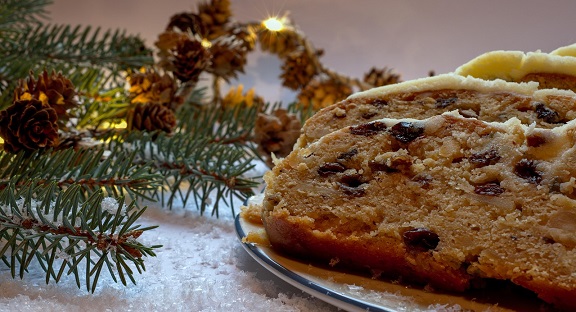
Not quite. Stollen is a rich, yeast-based loaf made with butter, raisins, candied citrus peel, almonds, and warm spices, baked and then brushed with melted butter and dusted heavily with powdered sugar. The coating protects it and keeps it moist.
The oldest written mention comes from 1329 in Naumburg on the Saale, where a Stollen is recorded as a Christmas gift for Bishop Heinrich. That makes it Germany’s longest-documented Christmas pastry, and the European Commission notes that its history is “adorned with as many colorful fancies as facts,” with one version describing a baking competition held by a bishop that year.
Early Stollen looked nothing like today’s. Because Advent was a fasting period, the first versions were lean: yeast dough made with flour, water, and oil, without butter, and the oil was often turnip oil. The taste, as one historical account puts it, was rather bland. A papal “butter letter” from around 1491 (some sources say 1490) finally allowed the use of butter, and the richer cake we know today followed. A popular story says that the loaf’s shape evokes the infant Jesus wrapped in swaddling cloth, which is why it’s also called Christstollen, though that explanation is a tradition rather than a documented fact.
Myth: “‘Dresden Stollen’ is just a nice name”
It’s actually a legal one. Since 2010, the names Dresdner Christstollen, Dresdner Stollen, and Dresdner Weihnachtsstollen have been registered as a Protected Geographical Indication (PGI) under EU law, by Regulation (EU) No. 1098/2010. The practical result is that a Stollen sold under that name must be made in the Dresden area, by local bakers who meet the association’s quality standards. It’s the same kind of protection that applies to Champagne or Parma ham.
The bakers organize themselves in the Schutzverband Dresdner Stollen e.V., the “Dresden Stollen Protection Association,” which also guards the quality seal and runs the Stollenfest. If you want the real thing, look for the PGI label and the seal on the packaging.
Myth: “The giant Stollen is just a publicity stunt”
It has a historical anchor. According to the European Commission, the tradition goes back to an enormous Stollen of about 1.8 tonnes, baked by around a hundred bakers and their apprentices using 3,600 eggs, 326 jugs of milk, and about a tonne of flour, then divided into some 24,000 portions. It’s traditionally dated to 1730, at the order of Augustus the Strong, Elector of Saxony. The yearly Stollenfest recalls that feat.
The modern version is held on the Saturday before the second Advent, which in 2026 means 5 December. A giant Stollen of more than three tonnes is carried through the old town in a festive parade, led by the Stollenmädchen (the “Stollen girl”), a young pastry professional chosen each year as the festival’s patron. More than 500 bakers and confectioners in historical costumes join the procession, and on the Altmarkt, the giant loaf is ceremonially cut with the Original Dresdner Stollenmesser, a huge knife. Pieces are sold for donations, and the proceeds go to charity. The festival is popular: in 2025, around 65,000 people attended.
It takes place on the grounds of the Striezelmarkt, which runs this year from 25 November to 24 December 2026 and bills itself as Germany’s oldest Christmas market, dating back to 1434. Its name comes from Striezel, an old word for Stollen in Dresden, and admission is free. Our guide to Germany’s Christmas markets covers others to visit.
Myth: “You should eat it as soon as you buy it”
Traditionally, no. A good Stollen is meant to rest. Many bakers recommend leaving it for a few weeks, wrapped and stored somewhere cool, so the flavors deepen and the butter and spices work into the crumb. That’s why Stollen is baked in early autumn, well before Christmas, and why the first slices often appear around the first Sunday of Advent.
A few practical tips, based on common advice from German bakers:
Keep it wrapped in foil or paper, in a cool, dry place away from heat.
Slice from the middle if you can, or, if you cut from an end, press the two halves back together afterward so the loaf doesn’t dry out.
Eat it in thin slices, with coffee or mulled wine. See our guides to Glühwein and Kaffee und Kuchen.
Myth: “Only Dresden makes Stollen”
Dresden’s name is protected, but the cake itself is made all over Germany, and the region has many versions. You’ll find Butterstollen (the classic), Marzipanstollen with a rope of marzipan through the center, Mohnstollen with poppy seeds, and Quarkstollen made with fresh cheese, which is lighter but usually doesn’t keep as long. Bakeries across Saxony, Thuringia, and the rest of the country produce their own, and each household or bakery tends to guard its own recipe. The protected name simply means that if the label says “Dresdner,” it comes from there.
How to Buy It, and Where to Taste It
Look for the label. The PGI mark and the Dresden seal are your guarantee.
Buy from Dresden bakeries or the Striezelmarkt if you’re visiting. Stalls sell it by the slice as well as whole.
Order early if you want one delivered, since the best bakeries sell out in December.
Visit on 5 December. The Stollenfest is a free festival, though it gets very crowded.
When is the Dresden Stollenfest in 2026? Saturday, 5 December 2026, the Saturday before the second Advent, on the Altmarkt in Dresden.
What is Dresden Stollen? A rich yeast loaf with butter, dried fruit, candied peel, and almonds, coated in butter and powdered sugar. The name “Dresdner Stollen” is legally protected and only applies to Stollen made in the Dresden area.
When was Stollen first mentioned? In 1329 in Naumburg, Saxony, as a Christmas gift for a bishop.
How long does Stollen last? Wrapped and stored somewhere cool, a traditional butter Stollen keeps for several weeks and is often said to improve as it matures, while Stollen made with fresh cheese typically keeps for a shorter time.