German Culture

All about Germany

  • Home
  • Learn German
    • German Language Basics
    • German Grammar & Vocabulary
    • German Learning Tips
    • German Idioms & Expressions
    • German Quizzes & Exercises
  • Articles
    • Famous Germans
    • German Holidays
    • German Cuisine
    • How To In Germany
    • Daily Life in Germany
    • German Facts
    • German Traditions
  • Facts About Germany
  • German History
    • Early History of Germany
    • Middle Ages in German History
    • German Reformation Period
    • 19th Century and German Unification
  • German Recipes
    • German Baking Recipes
    • German Bread Recipes
    • German Christmas Recipes
    • Desserts
    • German Easter Recipes
    • Halloween Recipes
    • Main Dishes
    • German Salad Recipes
    • German Salads
    • Sauerkraut Recipes
  • Travel to Germany
  • Contact

Schweineschnitzel (German Pork Schnitzel)

Schnitzel is the quintessential German dish.  Every tourist to Germany has had Schnitzel and most fall in love with it.  Some people associate Schnitzel with Wienerschnitzel.  “Wienerschnitzel” is actually a geographically protected term in Germany and Austria and can only be made with veal.  This traditional German Schnitzel is prepared the same way as Austrian Wiener Schnitzel.  The only difference – German Schnitzel is made with pork instead of veal.
Ingredients:
  • 4 boneless pork chops (to make Wienerschnitzel, use thin veal cutlets)
  • salt and freshly ground black pepper
  • ½ cup all-purpose flour combined with 1 teaspoon salt
  • 2 large eggs, lightly beaten
  • ¾ cup plain breadcrumbs
Instructions:
  1. Place the pork chops between two sheets of plastic wrap and pound them until just ¼ inch (6 mm) thick with the flat side of a meat mallet. Lightly season both sides with salt and freshly ground black pepper.
  2. Place the flour mixture, egg, and breadcrumbs in 3 separate shallow bowls. Dip the chops in the flour, the egg, and the breadcrumbs, coating both sides and all edges at each stage. Be careful not to press the breadcrumbs into the meat. Gently shake off the excess crumbs. Don’t let the schnitzel sit in the coating or they will not be as crispy once fried – fry immediately.
  3. Make sure the cooking oil is hot enough at this point as you don’t want the Schnitzel to sit around in the coating before frying. Use enough oil so that the Schnitzels “swim” in it.
  4. Fry the Schnitzel for about 2-3 minutes on both sides until a deep golden brown. Transfer briefly to a plate lined with paper towels.
  5. Serve immediately with slices of fresh lemon and parsley sprigs or with your choice of sauce. Serve with German Spaetzle, French fries, or German potato salad, and with a fresh leafy green salad.
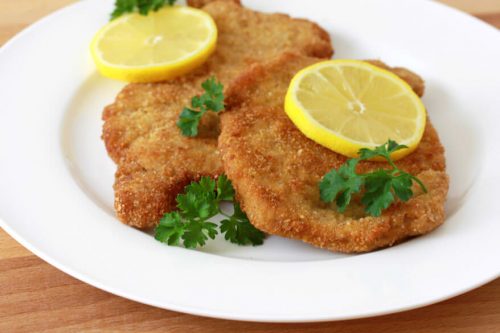



Photo via https://goo.gl/TvdAjn.

You might also like:

  • Gurkensalat Recipe – Classic German Cucumber Salad
    Gurkensalat – Traditional German Recipe
  • Gemischter Salat Recipe – Classic German Mixed Salad
    Gemischter Salat – Traditional German Mixed Salad Recipe
  • Bohnensalat Recipe – Classic German Green Bean Salad
    Bohnensalat – Traditional German Green Bean Salad Recipe
  • Kartoffelsalat – Traditional German Recipe
    Kartoffelsalat – Traditional German Recipe
  • Spargelsalat Recipe – Classic German Asparagus Salad
    Spargelsalat – Traditional German Asparagus Salad Recipe
  • Tomatensalat Recipe – Refreshing German Tomato Salad
    Tomatensalat – Traditional German Tomato Salad Recipe
  • Swabian Potato Salad Recipe – Authentic Schwäbischer Kartoffelsalat
    Schwäbischer Kartoffelsalat – Traditional German Recipe
  • Traditionally, the Coburger Bratwurst was grilled over pinecone firewood, which gave it a distinct smoky fragrance.
    Coburger Bratwurst - Traditional German Recipe

Recent Posts

Germany vs UK Culture: Key Differences

German Beer Culture: More Than Just Oktoberfest

German Breakfast Culture: What Germans Really Eat

Strange German Laws

Strange German Laws

Germany's bread culture

Why Do Germans Eat So Much Bread? Bread Culture Explained

Oktoberfest History Explained

Oktoberfest Explained: History, Culture and Myths

German Wedding Traditions: From Polterabend to Log Sawing

German Greeting Customs: Handshakes

Copyright © 2026 · German Culture

Go to mobile version