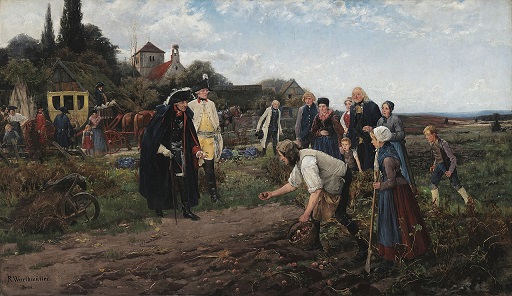
On a warm summer day in the 1740s, Prussian peasants working their fields reportedly witnessed a curious sight – royal guards posted around a royal potato field, ostensibly protecting the precious crops from theft. When bold peasants inevitably “stole” some of these valuable royal potatoes and planted them in their own plots, they unknowingly participated in one of history’s cleverest exercises in agricultural propaganda. Whether or not this specific story is entirely true, it captures the essence of Frederick the Great’s ingenious campaign to transform Prussian agriculture by convincing his reluctant subjects to embrace a foreign crop they had long feared and rejected – the humble potato.
The relationship between Frederick II of Prussia (1712-1786) and the potato has become one of European history’s most enduring agricultural legends, transforming a pragmatic king concerned with food security into the mythical “Potato King” whose vision revolutionized German diet and agriculture.
The Agricultural Crisis: Prussia’s Food Security Challenge
To understand why Frederick the Great became so passionate about potato promotion, we must first examine the agricultural and food security challenges facing 18th-century Prussia. The kingdom Frederick inherited in 1740 faced chronic problems that threatened both economic prosperity and political stability.
Prussia in the early 18th century remained primarily agricultural, with the vast majority of the population engaged in farming. However, Prussian agriculture faced significant limitations. Much of Prussia’s territory featured poor soil – sandy, acidic earth that struggled to support traditional grain crops like wheat and rye.
Weather variability created chronic food security problems. Cold, wet springs delayed planting, summer droughts stressed crops, and early frosts could destroy harvests before they matured.
War compounded these agricultural challenges. The War of Austrian Succession (1740-1748), which began shortly after Frederick’s accession, and the Seven Years’ War (1756-1763) devastated Prussian agriculture.
Frederick, whose military ambitions required substantial resources and whose absolutist political philosophy demanded a prosperous, well-fed population to serve state purposes, recognized that agricultural improvement wasn’t merely desirable but essential for Prussia’s survival as a great power. The king needed to feed his army, maintain tax revenues from a productive population, and ensure that food shortages didn’t create domestic unrest that would undermine his authority.
In this context, potatoes appeared to offer remarkable advantages. They could grow in poor soil that barely supported grain, required less labor than cereal crops, produced higher yields per acre, and demonstrated greater resistance to weather variability than wheat or rye.
Frederick wasn’t alone in recognizing these advantages – agricultural reformers and enlightened officials throughout Europe had been advocating potato cultivation for decades. However, actual peasant adoption remained minimal despite these obvious benefits, as deep-rooted cultural resistance prevented widespread cultivation. Overcoming this resistance would become Frederick’s agricultural mission and establish his legacy as the “Potato King.”
Peasant Resistance: Why Prussians Rejected Potatoes
Understanding the resistance Frederick faced requires appreciating that peasant reluctance to adopt potatoes wasn’t merely ignorant superstition but reflected rational concerns, cultural conservatism, and justified skepticism about unfamiliar foods. The barriers to potato adoption were multiple and deeply rooted, making Frederick’s eventual success all the more remarkable.
Religious suspicion represented one significant barrier. Potatoes weren’t mentioned in the Bible, leading some religiously conservative peasants to question whether God intended humans to eat them.
Cultural conservatism and attachment to traditional foods represented perhaps the deepest barrier. Prussian peasants had eaten rye bread, porridge, and root vegetables for generations. These familiar foods were embedded in cultural identity, religious practice, and daily routines. Bread, particularly, held profound cultural and religious significance – it appeared in prayers, religious rituals, and was central to how peasants understood proper meals. Potatoes couldn’t be made into traditional bread, making them seem like inadequate substitutes for “real” food.
Frederick’s Early Campaigns: Command and Coercion
Frederick’s initial potato promotion efforts, beginning shortly after his accession in 1740, relied primarily on royal authority and administrative pressure – an approach consistent with his absolutist political philosophy but ultimately inadequate for changing deeply rooted cultural practices.
The king’s first major potato initiative came in 1744, during the War of Austrian Succession, when food shortages made agricultural improvement urgent. Frederick issued royal orders to provincial administrators directing them to encourage potato cultivation among their peasant populations. These orders emphasized potatoes’ benefits – their productivity, their ability to grow in poor soil, their nutritional value – and instructed officials to distribute seed potatoes and cultivation instructions.
Peasant response to these early initiatives was largely negative. Royal orders might command planting, but they couldn’t compel genuine adoption. Peasants minimally complied – planting small plots to avoid punishment, then allowing the potatoes to rot or feeding them to livestock rather than consuming them.
Frederick grew frustrated with these minimal results. Subsequent orders became more forceful, threatening fines or other punishments for non-compliance. Provincial administrators were instructed to verify that peasants were actually planting and cultivating potatoes, not merely pretending to comply. Free distribution of seed potatoes expanded, removing the excuse that peasants lacked access to planting material.
The Seven Years’ War (1756-1763) created both opportunities and challenges for potato promotion. The devastating conflict created severe food shortages that made potato cultivation more attractive out of sheer necessity. Some regions experiencing particular hardship turned to potatoes as survival food, discovering through desperation that these tubers could indeed sustain life when other crops failed. The war demonstrated potatoes’ value in crisis conditions, validating Frederick’s arguments about their importance for food security.
The war’s end in 1763 brought renewed focus on agricultural reconstruction and improvement. Frederick, surveying war-damaged territories with severely depleted populations and destroyed agricultural infrastructure, saw potato cultivation as essential for rapid recovery.
The Mythology: Separating Fact from Legend
The stories surrounding Frederick the Great and potatoes have become so embellished through repetition that separating historical fact from later mythology requires careful attention to sources and acknowledgment of what we can and cannot verify with certainty.
The guarded potato field legend – with its careless guards and strategic “theft” – appears in numerous versions with varying details. Some versions place this in Potsdam, others in different locations. Some claim Frederick personally supervised the operation, others attribute it to subordinates implementing the king’s general approach. Documentary evidence directly confirming this specific stratagem is limited, leading historians to debate whether it actually occurred as described or represents later folkloric elaboration that captures the spirit of Frederick’s promotion strategies even if the specific details are embellished.
What we can verify is that Frederick did employ psychological approaches going beyond simple commands, that he understood the importance of making potatoes seem desirable rather than merely mandatory, and that innovative promotion strategies were discussed and implemented during his reign.
The royal potato tasting stories – Frederick publicly eating potatoes at court or offering them to visitors – have firmer historical foundation. Court records and contemporary accounts document potatoes appearing on royal menus and Frederick discussing their benefits.
The forceful command stories – Frederick ordering peasants to plant potatoes under threat of punishment – are well documented. Royal edicts, administrative correspondence, and contemporary accounts confirm that Frederick did issue orders and that provincial administrators were expected to enforce them.
The post-death mythology that developed around Frederick and potatoes reveals how historical figures become cultural symbols that transcend their actual historical roles. Frederick became the “Potato King” (Kartoffelkönig), with his grave at Sanssouci Palace traditionally decorated with potatoes left by visitors honoring his agricultural legacy.
Contemporary use of Frederick’s potato legacy reveals how history becomes cultural resource. The “Potato King” image appears in marketing, tourism, cultural celebrations, and political rhetoric. Sanssouci Palace tours emphasize Frederick’s potato advocacy, and Potsdam celebrates its connection to potato history.
The Potato King’s Enduring Legacy
The story of Frederick the Great and the potato represents one of history’s most successful campaigns to transform agricultural practice and dietary culture through deliberate government policy. Whether we emphasize the documented historical reality of Frederick’s orders, incentives, and strategies or the legendary tales of guarded fields and royal stratagems, the fundamental achievement remains impressive: a foreign crop that Prussian peasants had long rejected became, within a few generations, thoroughly integrated into German agriculture and cuisine.
The lasting impact of Frederick’s potato advocacy extends far beyond agricultural statistics or dietary changes. The “Potato King” became a cultural symbol, a historical narrative explaining how Germans came to love Kartoffeln, and a reminder that even the most cherished traditions often have identifiable historical origins rather than emerging from timeless cultural essence.
Today, when Germans enjoy their beloved potato dishes, few think consciously about Frederick the Great. Yet his legacy lives in every boiled potato, every crispy Bratkartoffel, every tender Kartoffelkloß served at German tables.
Related Articles:
Traditional German Potato Dishes You Should Know
Potatoes in German Culture
The Role of Potatoes in German Cuisine
Brägele – Fried Potatoes
Schupfnudeln – German Potato Dumplings
Kartoffelpuffer (German Potato Pancakes)
German Potato Soup Recipe (Kartoffelsuppe)