German Culture

All about Germany

  • Home
  • Learn German
    • German Language Basics
    • German Grammar & Vocabulary
    • German Learning Tips
    • German Idioms & Expressions
    • German Quizzes & Exercises
  • Articles
    • Famous Germans
    • German Holidays
    • German Cuisine
    • How To In Germany
    • Daily Life in Germany
    • German Facts
    • German Traditions
  • Facts About Germany
  • German History
    • Early History of Germany
    • Middle Ages in German History
    • German Reformation Period
    • 19th Century and German Unification
  • German Recipes
    • German Baking Recipes
    • German Bread Recipes
    • German Christmas Recipes
    • Desserts
    • German Easter Recipes
    • Halloween Recipes
    • Main Dishes
    • German Salad Recipes
    • German Salads
    • Sauerkraut Recipes
  • Travel to Germany
  • Contact

May 5 in German History

May 5, 1352

Birth of Rupert, the Elector of the Holy Roman Empire, in Amberg, Germany.

May 5, 1525

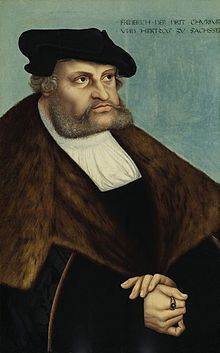
Death of Friedrich III (the Wise), Elector of Saxony in Lochau, Germany. Friederich served as the protector of Martin Luther after the imperial ban of 1521. He housed Luther at the castle named the Wartburg where Luther translated the Bible. Friedrich was a patron of Albrecht Dürer, and Lucas Cranach the Elder. He founded the University of Wittenberg in 1502.


May 5, 1747

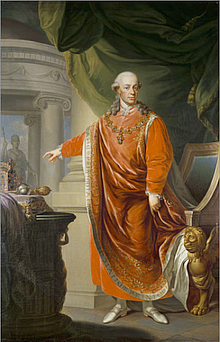
Leopold_II_in_the_Regalia_of_the_Golden_Fleece_(1806)

Birth of Leopold II in Vienna, an Emperor of the Holy Roman Empire. Born Peter Leopold Joseph Anton Joachim Pius Gotthard, Leopold II was Holy Roman Emperor and King of Hungary and Bohemia from 1790 to 1792, Archduke of Austria and Grand Duke of Tuscany from 1765 to 1790. He was a son of Emperor Francis I and his wife, Empress Maria Theresa. Leopold was a moderate proponent of enlightened absolutism.

May 5, 1818

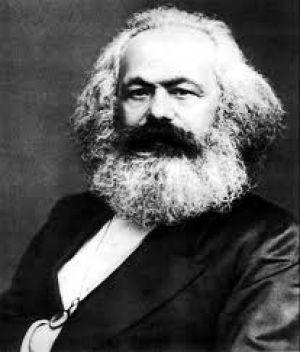
marx

Birth of Karl Marx in Trier, Germany. Karl Heinrich Marx (1818 – 1883) was a German philosopher and revolutionary socialist. His ideas played a significant role in the establishment of the social sciences and the development of the socialist movement. Marx’s work in economics laid the basis for our understanding of labor and its relation to capital, and has influenced much of subsequent economic thought. He published numerous books during his lifetime, the most notable being The Communist Manifesto (1848) and Capital (1867–1894).

May 5, 1833

Birth of August Fick in Petershagen, Germany. This linguist was a pioneer in Indo-European language studies. He made the first comprehensive study of the common vocabulary of Indo-European languages.

May 5, 1953

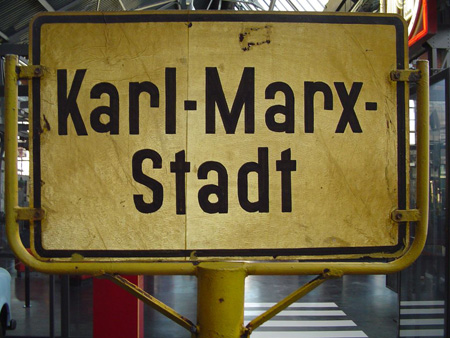
Karl-Marx-Stadt-

In honor of the 135th birthday of Karl Marx the East German city of Chemnitz was changed to Karl-Marx-Stadt.

May 5, 1955

West Germany is granted sovereignty by the United States, Great Britain and France.

May 5, 1859

Death of Peter Dirichlet in Düren, Germany. Dirichlet was a mathematician who was active at the universities of Breslau, Berlin and Göttingen. He was a significant contributor to the number theory. He developed the “Dirichlet problem” in the area of harmonic functions.

May 5, 1977

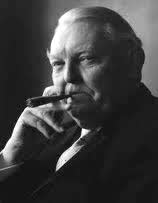
Death of Ludwig Erhard in Fürth, Germany. Erhard, the “Father of the Economic Miracle”, was active in German economic redevelopment beginning as early as 1945. In 1949 he became the minister of economics during the chancellorship of Konrad Adenauer. In that position he developed his vision of the “social market economy”. Erhard became the chancellor of West Germany in 1963.

May 5, 1996

Voters turn down a proposed merger of Berlin and Brandenburg.
Back to Today in German History Calendar

You might also like:

  • The Holy Roman Empire
    The Holy Roman Empire
  • Martin Luther and the 95 Theses
    Martin Luther and the 95 Theses
  • Kaiser Karl der Große
    German History: From the Holy Roman Empire to the Modern Era
  • Napoleon’s Impact on Germany: The Confederation of the Rhine
    The Napoleonic Wars and the Confederation of the Rhine
  • Luther’s Language Legacy: How One Translation Shaped German
    Luther’s Language Legacy: How One Translation Shaped German
  • Rise of Brandenburg-Prussia - Military Powerhouse
    Rise of Brandenburg-Prussia
  • German Reformation and Early Modern Period
    German Reformation and Early Modern Period
  • German Castles and Medieval Architecture: Fortresses, Fantasy, and Function
    German Castles and Medieval Architecture

Recent Posts

Are German stereotypes true?

German Stereotypes: What’s True and What’s Not

German work culture has many strength

German Work Culture: What Makes It So Different?

Why is German culture so efficient

Why Is German Culture So Efficient? The Secrets Behind It

Modern Germany is one of the most diverse countries in Europe.

What Do Germans Think of Foreigners? The Truth Explained

Foundation of German Culture

German Values and Beliefs: What Shapes Daily Life

German friendliness just looks different.

Are Germans Friendly or Rude? Breaking the Stereotype

Why Germans value rules so highly

Why Do Germans Love Rules? Ordnung Explained

Examples of German Directness

Why Are Germans So Direct? Understanding Blunt Communication

Copyright © 2026 · German Culture

Go to mobile version