Willy Brandt: Chancellor, Nobel Laureate and the Kniefall
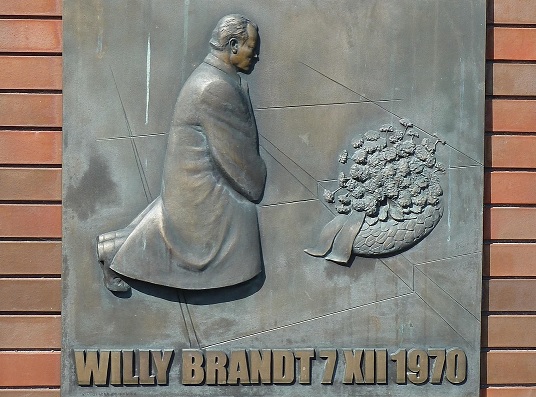
On 7 December 1970, in a Warsaw street, a German chancellor knelt down. He had come to Poland to sign a treaty, and before the ceremony he laid a wreath at the memorial to the victims of the Warsaw Ghetto. Then, without warning and without a word, Willy Brandt dropped to his knees and stayed there in silence.
No speech could have said what that silence said. The image went around the world, and it remains one of the most famous moments in postwar history. The man who knelt had been born Herbert Frahm, fled Hitler’s Germany as a teenager, and spent years in exile. This is his story, and the policy behind that gesture.
From Herbert Frahm to Willy Brandt
Willy Brandt was born on 18 December 1913 in Lübeck as Herbert Ernst Karl Frahm. He never knew his father and was raised largely by his grandfather, a member of the Social Democratic Party (SPD). He joined the party as a teenager in 1930, and later moved to a smaller left-wing party, but when Hitler took power in 1933 he went underground and then into exile.
He escaped via Denmark to Norway and took the name Willy Brandt to protect himself from Nazi persecution. In 1938, the Nazis stripped him of his German citizenship, and for two years he lived as a stateless refugee until Norway naturalized him. When Germany invaded Norway in 1940, he fled to neutral Sweden. He returned to Berlin after the war, first as a press attaché for the Norwegian military mission, regained German citizenship in 1948, and made Brandt his official name in 1949.
Berlin Mayor in the Cold War
Brandt entered West German politics quickly. He sat in the Bundestag from 1949, became president of the Berlin House of Representatives in 1955, and in 1957 was elected Governing Mayor of West Berlin, a post he held until 1966. He led the city through some of the most tense years of the Cold War, including the building of the Berlin Wall in 1961 and President John F. Kennedy’s visit in June 1963.
In December 1963, he helped negotiate the first pass agreement that allowed West Berliners to visit relatives in East Berlin during the Christmas period, a small but important human gesture across the divided city. From 1964 to 1987 he led the SPD, and from 1966 to 1969 he served as foreign minister in a grand coalition. For the story of the city’s division and its end, see our article on the fall of the Wall.
Chancellor and Ostpolitik
In October 1969, Brandt was elected chancellor, forming a coalition of the SPD and the Free Democrats (FDP) and becoming the first Social Democratic chancellor of the Federal Republic. In his inaugural address he promised to “dare more democracy” (mehr Demokratie wagen), a phrase that came to define the era’s hopes for reform.
His most important project was Neue Ostpolitik, or “new eastern policy.” Rather than refusing to recognize East Germany and the Soviet bloc, Brandt sought to reduce tension through direct negotiation, an approach often summed up as “change through rapprochement.” Its main steps were:
1970, Erfurt. The first meeting between the leaders of West and East Germany. When Brandt arrived by train, thousands of East Germans cheered him.
1970, Moscow Treaty. An agreement with the Soviet Union to renounce the use of force and accept existing European borders.
1970, Warsaw Treaty. A treaty with Poland that effectively recognized the Oder-Neisse line as its western border. This is the treaty he traveled to sign when he knelt.
1971, Berlin Agreement. A four-power agreement on the status of Berlin.
1972, Basic Treaty. An agreement between the two German states signed in East Berlin, establishing normal relations without recognizing East Germany as a foreign country.
The Kniefall in Warsaw
By most accounts, the kneeling in Warsaw was not part of the planned ceremony. Brandt, who had fought the Nazis rather than served them, was standing at a memorial to the victims of the 1943 uprising in the Warsaw Ghetto when he knelt as a gesture of apology and mourning on behalf of Germany. Many people around the world saw it as a profound act of humility. It was controversial at home, where some Germans felt it went too far, and the policy of Ostpolitik itself was fiercely opposed by conservatives and by organizations representing Germans expelled from former eastern territories.
Time magazine named him Man of the Year for 1970. In December 1971, he was awarded the Nobel Peace Prize for his work toward reconciliation between West Germany and its eastern neighbors.
Resignation: The Guillaume Affair
Brandt survived a parliamentary challenge in 1972 and was re-elected that year, but his second term ended abruptly. In 1974, one of his closest aides, Günter Guillaume, was unmasked as an East German spy. Although Guillaume apparently didn’t pass on much of importance, some people thought Brandt could be vulnerable to blackmail because Guillaume knew details of his private life.
Brandt resigned as chancellor on 6 May 1974, taking responsibility for “negligence” in the affair and stating that a chancellor must not be open to blackmail. He stayed on as leader of the SPD until 1987. Shortly after his resignation, he reportedly wrote that he had in reality been worn out.
Later Years and Death
Brandt remained influential after leaving office, chairing the Socialist International and leading a commission on North-South issues. In 1990, after reunification, he opened the first session of the all-German Bundestag as its oldest member, a symbolic moment for the man who had spent decades working toward détente. In 1991, he made the motion that led the Bundestag to vote for Berlin as the seat of government, and the same year he was diagnosed with cancer. He died on 8 October 1992 and was buried in Berlin-Zehlendorf.
Legacy
Brandt is one of the most admired chancellors in Germany, even though his term was short. His Ostpolitik laid some of the groundwork for the eventual end of the Cold War, and his Kniefall is still the best-known gesture of German remorse for the crimes of the Nazi era. Berlin’s international airport is named after him, and the SPD’s headquarters, the Willy-Brandt-Haus, stands in the city. His career also contrasts neatly with that of his predecessor Konrad Adenauer, who chose a firmly Western course, and his successors, including Angela Merkel. For the history that followed, see German reunification, and for the era he fled, our overview of Germany under Hitler.
FAQ
Who was Willy Brandt? A German Social Democrat who fled the Nazis, became Governing Mayor of West Berlin, and served as chancellor of West Germany from 1969 to 1974. He won the Nobel Peace Prize in 1971.
What is the Kniefall von Warschau? The moment on 7 December 1970 when Brandt knelt silently at the Warsaw Ghetto memorial, widely seen as a gesture of German apology.
What was Ostpolitik? Brandt’s policy of easing tensions with the Soviet Union, Poland, and East Germany through negotiation and treaties.
Why did Willy Brandt resign? In 1974, his close aide Günter Guillaume was exposed as an East German spy, and Brandt took political responsibility for negligence in the affair.