German Zeppelin: The Rise and Fall of Germany’s Giant Airships
When Count Ferdinand von Zeppelin’s first rigid airship lifted slowly into the sky over Lake Constance on July 2, 1900, witnesses watched a vision of the future take form – an enormous aluminum framework covered in fabric, filled with hydrogen gas, and powered by internal combustion engines, hovering majestically above the water before beginning its maiden flight.
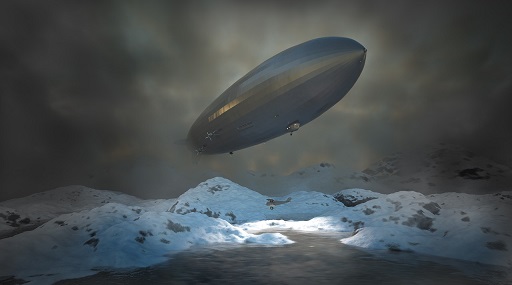
For a brief but dazzling moment in history, the German Zeppelin ruled the skies. Long before jet engines and budget airlines, these enormous airships promised a future where transatlantic travel was smooth, elegant, and almost silent. Floating like silver whales above cities and oceans, Zeppelins became symbols of German engineering genius and national pride. Their story, however, is not just one of innovation and glamour, but also of political ambition, technological limits, and a dramatic fall that changed aviation forever.
The Birth of the German Zeppelin
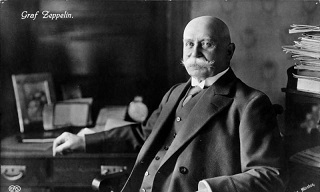
The story of the German Zeppelin begins with Count Ferdinand von Zeppelin, a retired German general with an obsession for controlled flight. Inspired by balloon experiments he had observed in the United States during the Civil War, Zeppelin became convinced that rigid airships were the future of long-distance travel.
The Count invested his personal fortune in developing his first Luftschiff Zeppelin (LZ 1), facing skepticism from engineering experts, military officials, and potential investors who doubted that such enormous structures could fly safely or economically.
In 1900, his vision finally took physical form with the launch of the LZ 1 over Lake Constance. Unlike simple balloons, the Zeppelin had a rigid aluminum framework, multiple gas cells, and powered propulsion. This design allowed it to be steered, stabilized, and scaled to unprecedented sizes. Although early flights were far from perfect, the concept worked well enough to attract military and industrial interest.
Germany, newly unified and eager to showcase its technological strength, embraced the Zeppelin as a national project.
Zeppelins and German National Ambition
Before the First World War, the German Zeppelin quickly became more than an experimental aircraft. It was a flying symbol of modernity, discipline, and industrial power. Public enthusiasm was enormous. Zeppelin flights drew massive crowds, and fundraising campaigns turned airship construction into a patriotic cause.
The German military also saw potential. Zeppelins could travel farther than airplanes of the time, carry heavy payloads, and remain airborne for extended periods. During World War I, they were used for reconnaissance and bombing raids over Britain and France. While their military effectiveness was limited and losses were high, their psychological impact was significant. The image of German airships looming over enemy cities left a deep impression on the public imagination.
After the war, military restrictions forced Germany to rethink the role of the Zeppelin. What followed was the airship’s most glamorous era.
The Golden Age of Zeppelin Travel
The 1920s and early 1930s marked the golden age of the German Zeppelin. Airships were reinvented as luxury passenger vehicles, offering an experience closer to an ocean liner than an airplane.
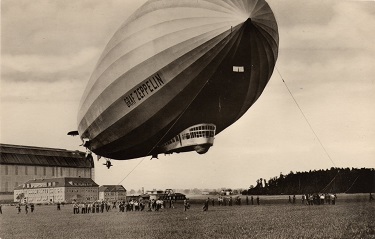
The Graf Zeppelin, launched in 1928 and named after Count von Zeppelin, became the most successful passenger airship in history. This 776-foot vessel completed 590 flights over nine years, carried thousands of passengers safely, and achieved remarkable milestones including a round-the-world journey in 1929 that captured global imagination. The Graf Zeppelin demonstrated that airship travel wasn’t just possible but could be reliable, comfortable, and commercially viable.
The most famous of these was the LZ 127 Graf Zeppelin. It completed hundreds of flights, including round-the-world journeys and regular transatlantic crossings. Passengers dined in elegant salons, slept in private cabins, and enjoyed panoramic views from observation windows. The flight was slow, but exceptionally smooth, and for wealthy travelers, it was unmatched in comfort.
At a time when airplanes were noisy, cramped, and unreliable, the Zeppelin felt like the future of civilized travel.
Technology Behind the Giants
What made the German Zeppelin possible was its rigid structure. Inside its metal skeleton were multiple hydrogen-filled gas cells that provided lift, while engines mounted on external gondolas supplied propulsion. This separation of structure and lift allowed Zeppelins to grow to extraordinary sizes without collapsing under their own weight.
However, the technology had a fatal flaw. Hydrogen, while lightweight and effective, was highly flammable. The safer alternative, helium, was tightly controlled by the United States and largely unavailable to Germany. Engineers understood the risks, but economic and political realities left them little choice.
As long as everything went right, the system worked beautifully. When something went wrong, the consequences could be catastrophic.
The Hindenburg and the End of an Era
The turning point in the history of the German Zeppelin came on May 6, 1937. The LZ 129 Hindenburg, the largest airship ever built, caught fire while attempting to land in Lakehurst, New Jersey. Within seconds, the massive structure was engulfed in flames and collapsed before a horrified crowd.
Newsreel footage and radio reports spread the disaster around the world almost instantly. Although most passengers survived, the visual impact was devastating. Public confidence in airships evaporated overnight.
The Hindenburg disaster did not occur in isolation, but it became the symbol of everything that could go wrong with lighter-than-air travel. Combined with rapid advances in airplane technology, it effectively ended the age of the passenger Zeppelin.
Why the German Zeppelin Failed
The fall of the German Zeppelin was not caused by a single accident alone. It was the result of several converging factors.
Airplanes were becoming faster, safer, and more economical. What once took days by airship could now be done in hours by plane. Airports required far less infrastructure than massive airship hangars and landing crews. Weather sensitivity, high operating costs, and political associations with Nazi Germany further damaged the Zeppelin’s image.
By the outbreak of World War II, the era of the giant airship was effectively over.
The Legacy of the German Zeppelin
Despite its dramatic end, the German Zeppelin left a lasting legacy. It proved that long-distance air travel was possible and helped establish international aviation routes. It pushed the boundaries of materials science, aerodynamics, and large-scale engineering.
Today, Zeppelins survive as cultural icons rather than commercial vehicles. Museums, restored airship hangars, and modern advertising airships keep the memory alive. The word “Zeppelin” itself has become synonymous with a bold, almost romantic vision of early flight.
In many ways, the German Zeppelin represents a uniquely German historical pattern – brilliant engineering, immense ambition, and a willingness to test the limits of what technology can do.
More Than a Failed Dream
It is tempting to view the German Zeppelin as a technological dead end, but that would be unfair. For a few remarkable decades, these giant airships connected continents, inspired awe, and reshaped how people imagined the sky. Their rise and fall tells a larger story about progress, risk, and the price of innovation.
The Zeppelins may no longer dominate the air, but their legacy still floats through history, reminding us of a time when the future seemed lighter than air.