Romantic Road Germany: Route, Towns and Best Stops
On 10 January 1950, with much of Germany still in ruins, the mayors of four Bavarian towns agreed to reopen a holiday road. Their goal was simple: to bring visitors back to the walled medieval towns and castles that had survived the war. The road had existed since 1900 under a rather dry name, “German Travel Route Number 1,” so they gave it a new one. They called it the Romantic Road.
It worked better than anyone could have hoped. More than 75 years later, the Romantische Straße is one of the most popular holiday routes in Germany, with the tourism association reporting over seven million overnight stays and tens of millions of day visitors a year. It’s a route of half-timbered houses, fortified towns, vineyards, and fairytale castles, and this guide explains how to travel it.
What Is the Romantic Road?
The Romantic Road is a marked tourist route, not a single road. It runs from Würzburg in Franconia in the north to Füssen at the foot of the Alps in the south, passing through Bavaria and Baden-Württemberg. According to the tourism association, the route is about 460 kilometers and links 29 places, though many older guidebooks describe it as around 350 kilometers, because the route was extended over time. It crosses the Main Valley, the Tauber Valley, the Swabian Jura, and the Alpine foothills.
The name “romantic” refers less to love than to the 19th-century idea of Romanticism, with its fascination for medieval towns, castles, and picturesque landscapes. Today, many visitors consider the region to represent a classic image of Germany.
The Main Stops
Stop
Known for
Würzburg
The Baroque Residence palace (UNESCO World Heritage), Marienberg Fortress, Franconian wine
Rothenburg ob der Tauber
The best-known stop: a walled medieval town of half-timbered houses, including the photogenic Plönlein junction
Dinkelsbühl
A pretty walled town with colorful, uniform-looking half-timbered facades and a moat walk
Nördlingen
A medieval town inside a meteorite crater, with a climbable church tower called the Daniel
Harburg
A castle overlooking the Wörnitz River
Augsburg
A Roman-origin city with the Fuggerei, a historic social housing complex, and a lively old town
Landsberg am Lech
A historic old town on the river Lech
Wieskirche
A rococo pilgrimage church near Steingaden and a UNESCO World Heritage Site
Füssen
An Alpine foothill town near Neuschwanstein and Hohenschwangau castles
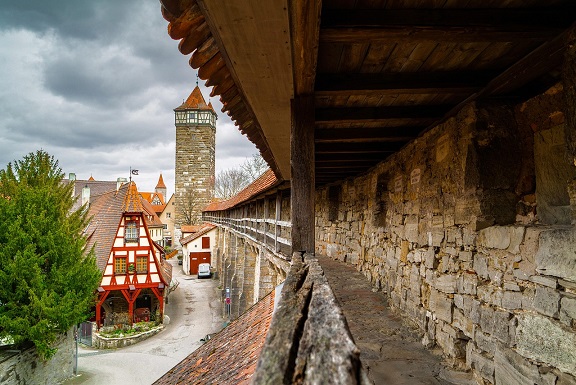
Rothenburg ob der Tauber, Dinkelsbühl, and Nördlingen are among the best-preserved walled towns in Germany, and you can walk along their old town walls. For more on the area’s most famous village, see the guides in our travel section.
How to Travel the Romantic Road
By car. A car is the most flexible option, because many of the best villages are between larger towns, and you can stop wherever you like. Route signs with a distinctive Romantic Road logo mark the way. Distances are manageable: for example, the stretch from Augsburg to Füssen is about 108 kilometers.
By bus. A seasonal tour bus service, the Europabus, has operated along the route in the warmer months, allowing you to hop on and off. Check the current schedule and fares before you plan around it.
By train. Würzburg, Augsburg, and Füssen have regular train connections, and a regional rail service links Nördlingen, Dinkelsbühl, and Feuchtwangen. Some of the smaller towns are harder to reach without a car.
By bike. Cyclists can follow marked stretches along rivers and country lanes, though the full distance is long for most visitors.
Sample Itineraries
Three Days: The Classics
Day 1. Würzburg’s Residence and old town, then on to Rothenburg ob der Tauber for the evening.
Day 2. Dinkelsbühl and Nördlingen, then continue to Augsburg.
Day 3. The Wieskirche and Füssen, with a visit to Neuschwanstein.
Five Days: More Time to Wander
Add stops at Weikersheim’s castle in the Tauber Valley, Harburg Castle, and Landsberg am Lech, and spend a full day in Augsburg exploring the Fuggerei and the old town.
What to Eat and Drink
The route crosses several culinary regions. Around Würzburg, you’ll find Franconian white wines, often served in a distinctive flat green bottle called a Bocksbeutel. In the Swabian and Bavarian stretches, expect hearty dishes such as sausages, Spätzle, and roast pork, and every walled town has cafés serving local cakes. In Rothenburg, you can try the local specialty pastry, the Schneeball, a ball of shortcrust dough dusted with sugar or chocolate.
When to Go
Spring and autumn. Quieter, with mild weather and fewer crowds, and good for walking the town walls.
Summer. The busiest season, with long days but crowded streets, especially in Rothenburg and at Neuschwanstein.
Winter. The Christmas season is a special time for many of the towns. See our guide to Germany’s Christmas markets.
Practical Tips
Don’t try to see everything. Pick four or five stops rather than all 29.
Stay overnight in the walled towns. After the day trippers leave, Rothenburg and Dinkelsbühl are far quieter and more atmospheric.
Book Neuschwanstein tickets in advance. Entry is by timed ticket, and it’s a popular site.
Check opening times. Small museums, churches, and castles often have seasonal or limited hours.
Carry a little cash. Smaller cafés and shops sometimes prefer it.
For another classic region to explore, see our guide to the Black Forest.
FAQ
How long is the Romantic Road? The tourism association describes the route as about 460 kilometers, though older sources give around 350 kilometers.
Where does the Romantic Road start and end? It starts in Würzburg and ends in Füssen, near Neuschwanstein Castle.
How many days do you need for the Romantic Road? Three days is enough for the highlights, while five to seven days allows a more relaxed trip with extra stops.
What is the best town on the Romantic Road? Rothenburg ob der Tauber is the best known, but Dinkelsbühl and Nördlingen are also well-preserved and often quieter.