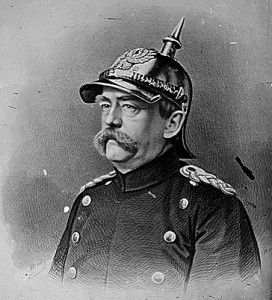
April 1, 1730 Birth of Salomon Gessner in Zürich, Switzerland. Gessner was a writer known for his rococo style. His most noted works are Idyllen (1756-1772) and Der Tod Abels (1758). Sir Walter Scott, and Lord Byron expressed admiration for Gessner's pastoral themes. April 1, 1815 Birth of Otto von Bismarck in Schönhausen, Germany. … [Read more...]
March 31 in German History
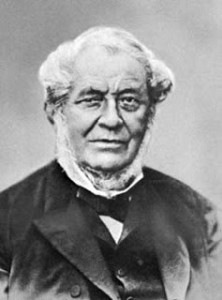
March 31, 1567 Death of Philip, Landgraf of Hesse, in Kassel, Germany. Philip became convinced that freedom for Protestantism could also be linked to greater independence for rulers such as he. He also realized that alliances would be needed. He formed the first alliance in 1526 with the Elector of Saxony and others followed. Philip thus … [Read more...]
March 30 in German History
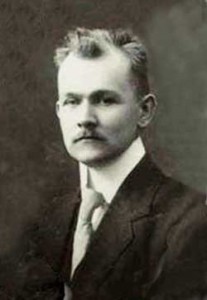
March 30, 1858 Birth of Lassa Francis Lawrence Oppenheim in Windecken, Germany. Oppenheim, a jurist, immigrated to London in 1895 to teach at the London School of Economics. In 1908 he became a professor at Cambridge University. He specialized in international law. He based his concept of international law on adherence to specific agreements and … [Read more...]
March 29 in German History
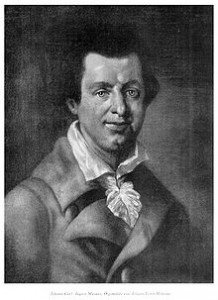
March 29, 1735 Birth of Johann Karl August Musäus (1735-1787) in Jena, Germany. Musäus was a writer known for his satire and his fairy tales. His Volksmärchen der Deutschen (5 vols. 1782-86) was a vehicle for his satirical bent. March 29, 1824 Birth of Ludwig Büchner (1824-1899) in Darmstadt, Germany. Ludwig Büchner was the younger … [Read more...]
The Outbreak of World War II
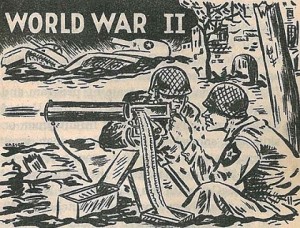
On September 1, 1939, German troops invaded Poland. Britain and France declared war on Germany two days later. By the end of the month, Hitler's armies had overrun western Poland. Soviet armies occupied eastern Poland, and the two countries subsequently formally divided Poland between them. In April 1940, German forces conquered Denmark and Norway, … [Read more...]
March 28 in German History
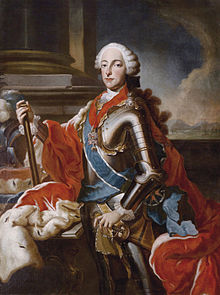
March 28, 1727 Birth of Maximilian III Joseph in Munich, Germany. Maximilian was the son of the Holy Roman emperor, Karl VII. He was the elector (Holy Roman Empire) of Bavaria. He gained his position in Bavaria by the peace of Füssen of April 22, 1745, and reigned till his death in 1777. He fostered science and industry in Bavaria. He … [Read more...]
The Third Reich: Foreign Policy
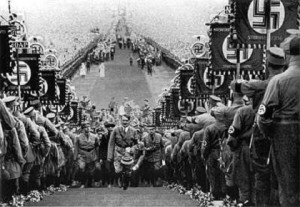
Once his regime was consolidated, Hitler took little interest in domestic policy, his sole concern being that Germany become sufficiently strong to realize his long-term geopolitical goal of creating a German empire that would dominate western Europe and extend deep into Russia. In a first step toward this goal, he made a de facto revision to the … [Read more...]
The Third Reich: Consolidation of Power
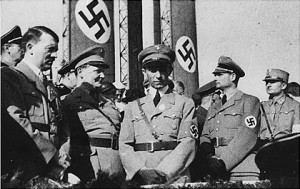
Hitler rapidly transformed the Weimar Republic into a dictatorship. The National Socialists accomplished their "revolution" within months, using a combination of legal procedure, persuasion, and terror. Because the parties forming the cabinet did not have a parliamentary majority, Hindenburg called for the dissolution of the Reichstag and set March … [Read more...]
Hitler and the Rise of National Socialism
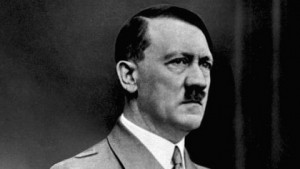
Adolf Hitler was born in the Austrian border town of Braunau am Inn in 1889. When he was seventeen, he was refused admission to the Vienna Art Academy, having been found insufficiently talented. He remained in Vienna, however, where he led a bohemian existence, acquiring an ideology based on belief in a German master race that was threatened by an … [Read more...]
The Stresemann Era in Weimar Republic
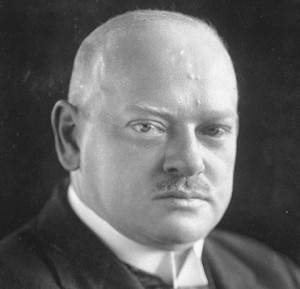
Gustav Stresemann, a German politician and statesman who served as Chancellor in 1923 (for a brief period of 102 days) and Foreign Minister 1923–1929, during the Weimar Republic. He was co-laureate of the Nobel Peace Prize in 1926. Stresemann was a Vernunftrepublikaner, that is, someone who supported the Weimar Republic because it seemed the best … [Read more...]
- « Previous Page
- 1
- …
- 129
- 130
- 131
- 132
- 133
- …
- 163
- Next Page »