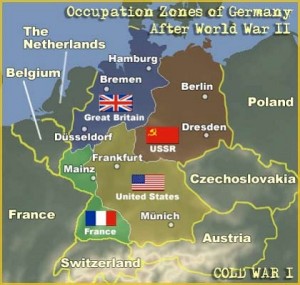
On May 8, 1945, the unconditional surrender of the German armed forces (Wehrmacht) was signed by Field Marshal Wilhelm Keitel in Berlin, ending World War II for Germany. The German people were suddenly confronted by a situation never before experienced in their history: the entire German territory was occupied by foreign armies, cities and … [Read more...]
World War II – Defeat
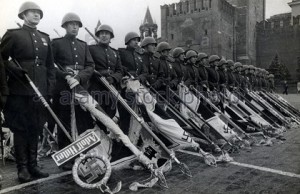
In June 1944, American, British, and Canadian forces invaded France, driving the Germans back and liberating Paris by August. A German counteroffensive in the Ardennes began in late December was beaten back after heavy fighting in what became known as the Battle of the Bulge. Soviet troops, meanwhile, advanced from the east. Western forces reached … [Read more...]
Total Mobilization, Resistance, and the Holocaust in Germany
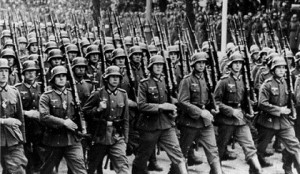
Once it became clear that the war would not be a short one, Germany's industry was reorganized for a total mobilization. Between February 1942 and July 1944, armaments production increased threefold despite intense Allied bombing raids. Much of the labor for this increase came from the employment of some 7 million foreigners, taken from their … [Read more...]
April 8 in German History
April 8, 1586 Death of Martin Chemnitz in Braunschweig, Germany. A leading Protestant theologian, Chemnitz did much to unify the Protestants in the early Lutheran church. April 8, 1695 Birth of Johann Christian Günther in Striegau, Germany. Günther was one of the leading lyric poets of the age. He made the transition from the Baroque to … [Read more...]
April 7 in German History
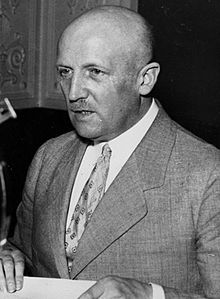
April 7, 1250 Death of St. Hermann Joseph von Steinfeld. St. Hermann Joseph was born in about 1150 in Cologne, Germany. His contemporary biographer relates that he was dedicated to the Blessed Virgin from his youth on. Many charming legends are told of his youthful dedication to Mary. At age 12 he entered the monastery at Steinfeld, Germany … [Read more...]
April 6 in German History
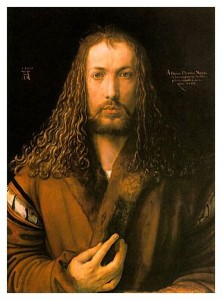
April 6, 912 Death of Bl. Notker Babulus (der Stammler)(ca. 840 - 912). Blessed Notker was born near St. Gallen, Switzerland in about 840. He studied at the school of the Monastery of St. Gallen and became a monk there. He wrote a large number of works during his lifetime as a teacher at the monastery school. He was beatified in 1512 by Pope … [Read more...]
April 5 in German History

April 5, 1643 Birth of Karl IV Leopold in Vienna, Austria. Karl was the Austrian Field Marshal who commanded the Austrian, Polish and German troops who successfully defended Vienna against the attacking Turks in 1683. He died on April 18 1690. April 5, 1744 Death of Blessed Maria Kreszentia Höß. Maria Kreszentia Höß was the daughter of a … [Read more...]
April 4 in German History

April 4, 397 Death of St. Ambrose (ca. 340 - 397) St. Ambrose was born in about 340, most likely in Trier (modern Germany). He was the son of a Roman nobleman who was serving in the northern provinces of the Roman Empire as Prefect of Gallia. Upon the death of his father in about 354 St. Ambrose moved with his family to Rome. The family had … [Read more...]
April 3 in German History

April 3, 1841 Birth of Hermann Carl Vogel (1841-1907) in Leipzig, Germany. Vogel was a German astrophysicist who pioneered the use of the spectroscope in astronomy. He applied this instrument to chemically analyze planetary atmospheres and in 1871 he was the first to establish Sun's rotational period using the Doppler effect. He was the … [Read more...]
April 2 in German History

April 2, ca. 742 Birth of Karl der Große (Charlemagne) (ca. 742-814) Karl der Große or Charlemagne was born near Aachen in about 742. He was the king of the Franks. (The Franks were a Germanic people who had extended their influence over parts of modern France and Belgium by this date in history.) On Christmas day of the year 800 he was … [Read more...]
- « Previous Page
- 1
- …
- 128
- 129
- 130
- 131
- 132
- …
- 163
- Next Page »