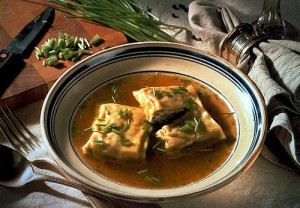
Swabian Meat Pockets (Maultaschen) are a typically Swabian specialty - pockets of noodle dough prepared and filled in various ways, e.g. with spinach, onions, eggs, soaked bread, and minced meat. On 22 October 2009, the European Union recognized Maultaschen (Schwäbische Maultaschen or Schwäbische Suppenmaultaschen) as a "regional specialty" and … [Read more...]
Glühwein

Glühwein is enjoyed at traditional Christmas Markets and is also known as an after-ski drink. Watch it: since you drink this wine warm, the alcohol goes to your head extra quick! Here's How: Place 1/2 cup water in a large saucepan with a piece of cinnamon, ginger, orange zest, 8 cloves, and 3/8 cup sugar. Bring to a boil and simmer … [Read more...]
Halloween Pumpkin Bread
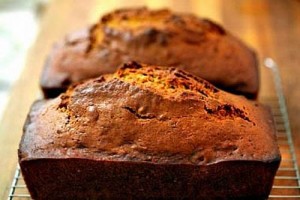
Ingredients: *-*-*-*-*-*-*-*-*-*-*-*-*-*-*-*-*-*-*-*-*-* 1 1/2 cups (200 g) flour 1/2 teaspoon of salt 1 cup (200 g) sugar 1 teaspoon baking soda 1 cup (240 ml) pumpkin purée* 1/2 cup (120 ml) olive oil 2 eggs, beaten 1/4 cup water 1/2 teaspoon nutmeg 1/2 teaspoon cinnamon 1/2 teaspoon allspice 1/2 cup (120 ml) chopped walnuts * … [Read more...]
Eggs in Frankfurter Green Sauce

Ingredients: 5 hard-boiled eggs 1/2 cup rapeseed oil 5 oz plain yogurt 5 oz sour cream 2 tablespoons finely chopped herbs (e.g. watercress, chives, sorrel, parsley, chervil etc) 1 garlic clove juice of half a lemon 1 tablespoon German prepared mustard salt and pepper to taste 1 pinch sugar 1 pickled German gherkin 1 onion Directions: 1. Peel … [Read more...]
November 30 in German History
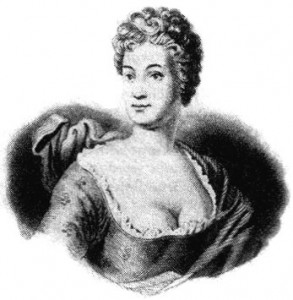
November 30, 1744 Birth of Karl Ludwig von Knebel near Nordlingen, Germany. Knebel was a poet and close friend of Johann Wolfgang von Goethe. It was Knebel who introduced Herzog Karl August to Goethe and arranged for Goethe to come to Weimar. November 30, 1760 Death of Caroline Neuber (born Friederike Caroline Weissenborn) in … [Read more...]
November 29 in German History

November 29, 1378 Death of Karl IV (King Wenceslas) in Prague, Bohemia. Karl raised Bohemia to a central power and after his rise to the rank of German King, Bohemia controlled that position for centuries. Karl was the son of the powerful John of Luxemburg. In 1343 Karl's father gave him the regency of Bohemia. In 1343 through Karl's efforts … [Read more...]
November 28 in German History
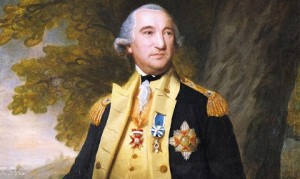
November 28, 1794 Death of Friedrich von Steuben in Remsen, New York (born in Magdeburg, Germany). Steuben was a Prussian officer who was induced by Benjamin Franklin to come to America on the side of the rebelling colonies. Arriving in 1777 he was placed in charge of the troops at Valley Forge. He retrained the forces and wrote a manual, … [Read more...]
November 27 in German History
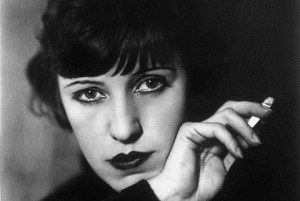
November 27, 1680 Death of Athanasius Kirchner in Rome (born in Geisa, Germany). Kirchner studied in Fulda, Paderborn, Cologne and Koblenz. In 1628 he was ordained a Jesuit priest in Mainz. In 1634 he moved to Rome and took up the task of assembling and organizing information sent by Jesuit missionaries from all parts of the world. November … [Read more...]
November 26 in German History
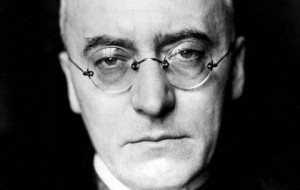
November 26, 1885 Birth of Heinrich Brüning in Münster, Germany. Brüning, a member of the Catholic Center Party, became chancellor of the Weimar Republic in 1930. Although he was considered an economics expert, the world depression along with the reparation payments of the Versailles Treaty made economic stability in Germany impossible. … [Read more...]
November 25 in German History
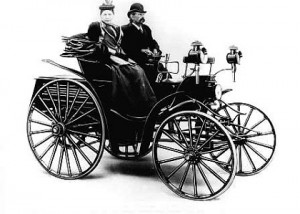
November 25, 1844 Birth of Carl Benz in Karlsruhe, Germany. In 1885 he built the world's first working automobile powered by an internal combustion engine. He founded the motor company, Benz u. Co. in 1883. The first four wheeled cars began to be produced in 1893. Benz merged with the Daimler-Motoren-Gesellschaft in 1926. It was the Daimler-Benz … [Read more...]
- « Previous Page
- 1
- …
- 91
- 92
- 93
- 94
- 95
- …
- 163
- Next Page »