
Following Brandt's resignation in May 1974, the SPD-FDP coalition partners unanimously agreed that Minister of Finance Helmut Schmidt should head the new government. At fifty-five, Helmut Schmidt became the youngest chancellor of the FRG. Born in Hamburg in 1918, he served as an officer in World War II. After the war, he joined the SPD and served … [Read more...]
Ostpolitik in Germany
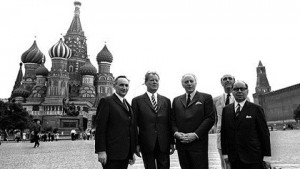
West Germany's relations with the East European states had virtually stagnated since the establishment of the Hallstein Doctrine in the mid-1950s. In 1970, in an attempt to lessen tensions in Europe, Brandt and his FDP minister for foreign affairs, Walter Scheel, agreed to negotiate with the communist bloc. For the first time since 1948, the top … [Read more...]
The Social Democratic-Free Democratic Coalition, 1969-82 and Willy Brandt

In the West German Bundestag elections of September 1969, the CDU/CSU remained the largest political group, holding eighteen more seats than the SPD. With the help of the FDP, which had earlier supported the candidacy of the SPD minister of justice Gustav Heinemann for the federal presidency, Willy Brandt was able to form an SPD-FDP coalition … [Read more...]
April 30 in German History

April 30 Walpurgis Night, or Witches' Sabbath--a legendary event on the Brocken Mountain in the Harz chain, made famous in Goethe's Faust. April 30, 1790 Death of Samuel Heinicke in Leipzig, Germany. Heinicke became interested in the problems of the deaf after reading Surdus loquens, a book in which it was described how a Swiss … [Read more...]
April 29 in German History

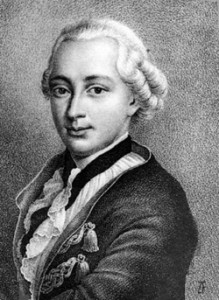
April 29, 1767 Birth of Karl Philipp Fürst von Wrede in Heidelberg, Germany. Karl was a German general who, however, formed an alliance with Napoleon until 1813 (the year of the battle of Leipzig in which Napoleon was first defeated in battle). He then switched sides and joined the coalition of nations against France. April 29, … [Read more...]
April 28 in German History
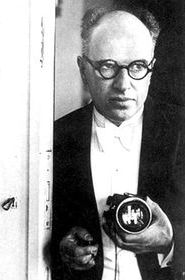
April 28, 1849 On this date the Prussian king Friedrich Wilhelm rejected the title of "Kaiser" as offered to him by the Frankfurt Parliament a month before. He also rejected the new constitution of the parliament, finding it to be subversive. April 28, 1853 Death of Ludwig Tieck in Berlin, a leading writer and theorist of the romantic … [Read more...]
April 27 in German History
April 27 Feast day of St. Peter Canisius. Peter de Hondt (St. Peter Canisius) was born in Nimwegen (Germany at that time, now the Netherlands). In 1536 he began his studies at the University of Cologne. In 1543 he became the first German to enter the order of Jesuits. He founded the first Jesuit house in Germany in Cologne. During his lifetime … [Read more...]
The “Socialist State of the German Nation”

The building of the Wall effectively halted large-scale emigration from the GDR. Although the SED failed to gain the active support of the majority of the population, young people, especially, began to tolerate the regime, at least passively. In the absence of any alternatives, they fulfilled their routine duties in youth organizations, schools, … [Read more...]
The Berlin Wall
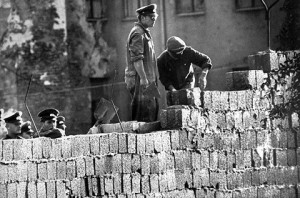
Besides its increasing economic difficulties, by the end of the 1950s the GDR encountered another problem that began to threaten its existence: large numbers of people were leaving East Germany for the West. Nearly half of those who fled the GDR were under twenty-five years of age. Although crossing the border between the two German states had … [Read more...]
The Warsaw Pact and the National People’s Army

The Soviet Union and seven of its European satellites sign a treaty establishing the Warsaw Pact, a mutual defense organization that put the Soviets in command of the armed forces of the member states. The Warsaw Pact, so named because the treaty was signed in Warsaw, included the Soviet Union, Albania, Poland, Romania, Hungary, East Germany, … [Read more...]
- « Previous Page
- 1
- …
- 124
- 125
- 126
- 127
- 128
- …
- 163
- Next Page »