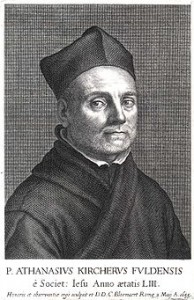
May 2, 1507 Martin Luther is consecrated a priest at the Augustinian monastery in Erfurt, Germany. May 2, 1601 Birth of Athanasius Kircher (1601-1680) in Geisa, Germany. Kircher studied in Fulda, Paderborn, Cologne and Koblenz. In 1628 he was ordained a Jesuit priest in Mainz. In 1634 he moved to Rome and took up the task of assembling … [Read more...]
The Peace Movement and Internal Resistance in GDR
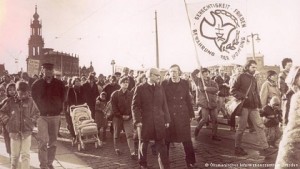
The GDR leadership welcomed protests against weapons and war as long as they occurred in the FRG. However, when a small group of East German pacifists advocating the conversion of "swords into plowshares" demonstrated in 1981 against the presence of Soviet missiles on GDR soil, as well as against the destruction of the environment by the dumping of … [Read more...]
May 1 in German History
May 1 Tag der Arbeit (Labor Day) May 1, 178 Saint Boniface (Winfried) is named Archbishop of Mainz and Primate of Germany by Pope Zachary. May 1, 1218 Birth of Rudolf I in Limburg-im-Breisgau, Germany. Rudolf was the first King of the Germans from the Habsburg dynasty. He was elected German king in Frankfurt am Main and … [Read more...]
Relations Between the Two Germanys
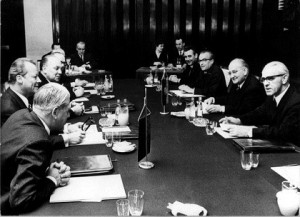
Although Honecker pursued a tough policy against internal dissidents and carefully guarded the GDR's unique identity as the state in which the old Marxist dream of socialism had become a reality, he was keenly aware of the necessity for communication and reasonable working relations with the FRG. His dream of being received at the White House as a … [Read more...]
The Conference on Security and Cooperation in Europe
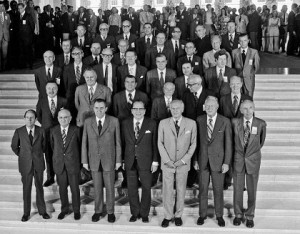
Keen to gain international recognition of its sphere of interest and believing that such recognition would solidify its grip on its East European satellite states, the Soviet Union, beginning in the early 1970s, sponsored an initiative calling for the convening of a Conference on Security and Cooperation in Europe (CSCE). For the West, such … [Read more...]
The New East German Constitution and the Question of Identity
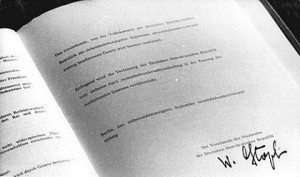
Although the GDR had finally achieved its goal of international recognition with the signing of the Basic Treaty in December 1972, renewed concerns about the stability and identity of the GDR as a second German state drove the SED Politburo toward a policy of reaffirming the socialist nature of the state. As early as 1971, Honecker had launched a … [Read more...]
The Honecker Era, 1971-1989
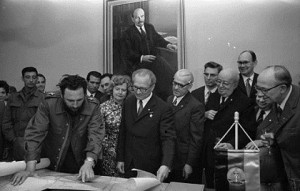
Ulbricht's successor in East Germany was Erich Honecker. Born in 1913 in Saarland, Honecker joined the Communist Party of Germany (Kommunistische Partei Deutschlands--KPD) in 1929. As a full-time functionary of the party, he continued his work in the underground movement after Hitler came to power in 1933 and until arrested by the Nazis in 1935. … [Read more...]
The Christian Democratic/Christian Socialist-Free Democratic Coalition, 1983-
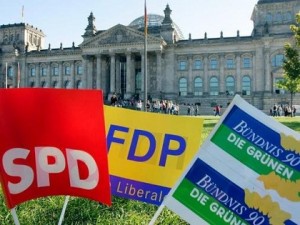
The SPD-FDP coalition formed in 1969 became increasingly strained in the early 1980s, leading to concerns among the FDP leadership about its stability. The SPD had become deeply divided because many of its members found Chancellor Schmidt's policies too conservative. Particularly troublesome was his position on NATO's Dual-Track Decision, which … [Read more...]
The Greens in Germany

In the aftermath of the oil crisis of 1973, regional political groups concerned with environmental issues began to put up candidates in communal and regional elections. In 1980 a number of ecological groups, alternative action movements, and various women's rights organizations banded together on the national level to form the political party that … [Read more...]
The Student Movement and Terrorism in Germany
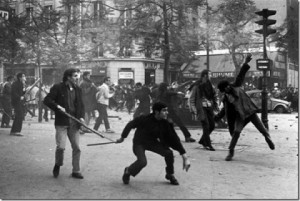
In addition to troubling economic and environmental problems for which no easy solutions were available, West Germany and its politicians had to contend with two new sources of social unrest: the student movement of the late 1960s and early 1970s, and left-wing terrorism, which originated in the late 1960s, but which had its greatest impact in the … [Read more...]
- « Previous Page
- 1
- …
- 123
- 124
- 125
- 126
- 127
- …
- 163
- Next Page »