On the opposite end of the political spectrum from the Greens are two parties of the far right, the Republikaner (Die Republikaner--REP), with about 23,000 members, and the German People's Union (Deutsche Volksunion--DVU), with 26,000 members. As of mid- 1995, these two parties had not gained sufficient support to win seats in the Bundestag, but … [Read more...]
Green Party of Germany
In the early years of the FRG, several minor parties representing a range of political views from the neo-Nazi right to the communist left played a role in the political system. Support for these parties dwindled over time, and, after 1961, the FDP was the only smaller party to cross the 5 percent threshold necessary to gain Bundestag … [Read more...]
Free Democratic Party of Germany
The Free Democratic Party (Freie Demokratische Partei--FDP) is much smaller than the CDU or SPD, but its limited electoral strength masks the party's inordinate influence. Prior to the 1994 election, the FDP had experienced its worst results in national elections in 1969 (5.8 percent) and 1983 (7 percent). Both of those poor showings occurred … [Read more...]
Social Democratic Party of Germany
Founded in 1875, the Social Democratic Party of Germany (Sozialdemokratische Partei Deutschlands--SPD) is Germany's oldest political party and its largest in terms of membership. After World War II, under the leadership of Kurt Schumacher, the SPD reestablished itself as an ideological party, representing the interests of the working class and the … [Read more...]
Christian Democratic Union/Christian Social Union
Following World War II, the Christian Democratic Union (Christlich Demokratische Union--CDU) was founded by a diverse group of Catholics and Protestants, businesspeople and trade unionists, and conservatives and moderates. The party espoused a Christian approach to politics and rejected both Nazism and communism. CDU members advocated conservative … [Read more...]
German Flag
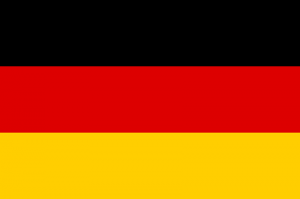
The flag of Germany was adopted in its present form in 1919. It was readopted with the new constitution of 1949. It is a tricolour, made of three equal horizontal bands coloured black (top), red, and gold (bottom). There are several theories regarding the origins of the German flag color scheme and its meaning. The most popular theory is that the … [Read more...]
Extraparty Political Forces in Germany
German society is highly organized into associations that represent the occupational, socioeconomic, religious, and recreational interests of individuals--a tradition that dates back to the corporate guild system of the Middle Ages. Most Germans belong to at least one voluntary association, and many belong to several. The vast majority of these … [Read more...]
German Political Parties
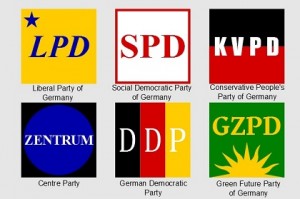
Observers often describe political parties as critical stabilizing institutions in democratic systems of government. Because of the central role played by German political parties, many observers refer to Germany as a "party state." The government of this type of state rests on the principle that competition among parties provides for both popular … [Read more...]
Electoral System of Germany

The Basic Law guarantees the right to vote by secret ballot in direct and free elections to every German citizen eighteen years of age or older. To be eligible to vote, an individual must have resided in a constituency district for at least three months prior to an election. Officials who are popularly elected include Bundestag deputies at the … [Read more...]
Bundesrat of Germany
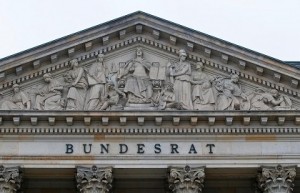
The second legislative chamber, the Bundesrat, is the federal body in which the sixteen Land governments are directly represented. It exemplifies Germany's federalist system of government. Members of the Bundesrat are not popularly elected but are appointed by their respective Land governments. Members tend to be Land government ministers. The … [Read more...]
- « Previous Page
- 1
- …
- 8
- 9
- 10
- 11
- 12
- …
- 14
- Next Page »