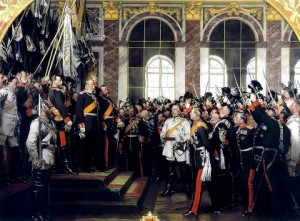
After the decline of the Holy Roman Empire, the Kingdom of Prussia eventually emerged as the dominant power in central Europe. Prussia had been colonized and Germanized during the thirteenth and fourteenth centuries by the Knights of the Teutonic Order, a military order of German monks that pushed back or overran the Slavs in the area. The knights … [Read more...]
National Security in Germany
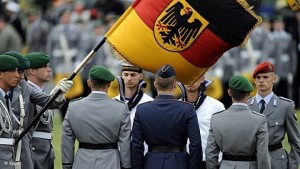
The Federal armed forces (Bundeswehr) of the Federal Republic of Germany (FRG, or West Germany) came into being in 1955. Assigned a solely defensive role, the Bundeswehr at its creation constituted the largest component of the North Atlantic Treaty Organization (NATO) ground forces in Central Europe. Throughout the Cold War, the fighter aircraft … [Read more...]
The Mass Media in Germany
Until 1990 Germany was a divided country. The media system of the former GDR was highly centralized and worked under the control of the Communist Party. It disappeared during the process of unification, but patterns of media usage still differ between East and West. Today, the major media production centers are located in the “old” West, newspapers … [Read more...]
Radio and Television in Germany
Radio and television are administered in a decentralized fashion as prescribed in the Basic Law. The intent behind the pattern of regional decentralization is to prevent the exploitation of the media by a strong national government, as had happened under the Nazi dictatorship. Germany has two public broadcasting corporations. The first, ARD, was … [Read more...]
Newspapers in Germany
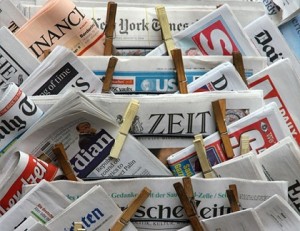
West Germany has always had highly developed mass media. The independence of the press and its freedom from censorship are guaranteed in Article 5 of the Basic Law. Conversely, the communist regime in East Germany tightly controlled the media. Despite government censorship, East Germans were voracious newspaper and magazine readers. More than three … [Read more...]
Citizens’ Initiative Associations as a Political Force in Germany
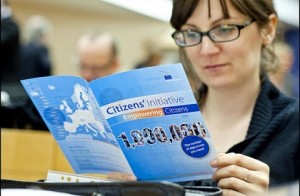
In the early 1970s, a new form of political participation in the form of citizens' initiative associations sprang up throughout West Germany. These associations, in essence nontraditional interest groups, were loosely and often temporarily organized groups of citizens mobilized in response to one particular local issue. Concerns ranged from school … [Read more...]
The Churches as a Political Force in Germany
Religious associations represent a third major group of organized interests in the German policy process. The experience of the Third Reich had a profound influence on the postwar development of Protestant and Roman Catholic churches in the Federal Republic. Both espoused the view that moral responsibility extends to political responsibility and … [Read more...]
Labour Unions as a Political Force in Germany
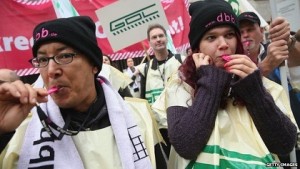
During the Weimar Republic, labor unions were divided along partisan lines, a situation that led to competition among the socialist, communist, Catholic, and liberal trade associations. After World War II, labor leaders wanted to break with the past and form a trade union federation independent of political parties. The result was the establishment … [Read more...]
Business and Industry as a Political Force in Germany
There are three levels at which business and industrial interests seek representation. First, business wants its perspective heard as the government formulates policy. Second, business needs representation in negotiations with labor unions. Third, business may desire support in cultivating new clients or suppliers. Each of these objectives is met … [Read more...]
Party of Democratic Socialism
The communist party that ran East Germany was the Socialist Unity Party of Germany (Sozialistische Einheitspartei Deutschlands--SED). Founded in 1946, the SED controlled the government and the electoral process and supervised the omnipresent State Security Service (Staatssicherheitsdienst--Stasi). To be considered for important positions in East … [Read more...]
- « Previous Page
- 1
- …
- 7
- 8
- 9
- 10
- 11
- …
- 14
- Next Page »