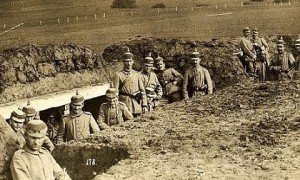
Prussian-German excellence in military matters was an accepted fact of life, but in the twentieth century the excessive accent on militarism led to two disastrous world wars. Germany's insistence on building a fleet that could challenge Britain's naval domination underscored German bellicosity and pushed Britain toward alignment with France and … [Read more...]
July 3 in German History

July 3, 1709 Birth of Wilhelmine Friederike Sophie, Margravine of Bayreuth, in Berlin. She made Bayreuth a cultural center, constructing an opera house and attracted intellectuals and artists to Bayreuth. July 3, 1789 Birth of the painter Johann Friedrich Overbeck (1789-1869) in Lübeck. Overbeck was a German painter and member of the … [Read more...]
July 2 in German History
July 2, 1298 Death of Graf Adolf von Nassau near Worms, Germany. He was King of the Germans until deposed by the Habsburg, Albert I. July 2, 1648 Photo by NOMINE e.V. - Norddeutsche Orgelmusikkultur in Niedersachsen und Europa - via Mail, CC BY 3.0, https://commons.wikimedia.org/w/index.php?curid=8390199 Birth of Arp Schnitger in … [Read more...]
July 1 in German History

July 1, 1646 Birth of Gottfried Leibniz (1646-1716) in Leipzig. Leibniz was a German mathematician and philosopher. He occupies a prominent place in the history of mathematics and the history of philosophy. Leibniz developed the infinitesimal calculus independently of Isaac Newton, and Leibniz's mathematical notation has been widely used … [Read more...]
Prussia’s Emergence as a Military Power
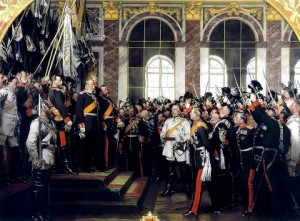
After the decline of the Holy Roman Empire, the Kingdom of Prussia eventually emerged as the dominant power in central Europe. Prussia had been colonized and Germanized during the thirteenth and fourteenth centuries by the Knights of the Teutonic Order, a military order of German monks that pushed back or overran the Slavs in the area. The knights … [Read more...]
National Security in Germany
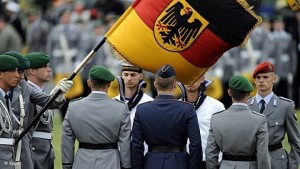
The Federal armed forces (Bundeswehr) of the Federal Republic of Germany (FRG, or West Germany) came into being in 1955. Assigned a solely defensive role, the Bundeswehr at its creation constituted the largest component of the North Atlantic Treaty Organization (NATO) ground forces in Central Europe. Throughout the Cold War, the fighter aircraft … [Read more...]
June 30 in German History

June 30, 1807 Birth of Friedrich Theodor von Vischer in Ludwigsburg, Germany. A literary critic, he set the theoretical basis for the period of realism in literature. June 30, 1853 Birth of archaeologist Adolf Furtwängler in Freiburg, Germany. His catalogs of ancient Greek art established an historic order. He was Professor of Archaeology … [Read more...]
June 29 in German History
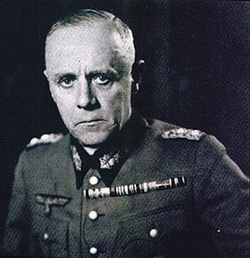
June 29, 1721 Birth of Johann Kalb in Hüttendorf, Germany. Experienced as an officer in a German regiment of the French infantry, he secured a commission in the American Continental Army and immigrated in 1777. June 29, 1779 Death of Anton Raphael Mengs in Rome (born in Aussig, Bohemia (now in the Czech Republic)). Mengs was a painter who … [Read more...]
June 28 in German History
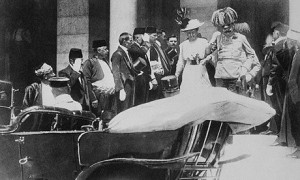
June 28, 1490 Birth of Albrecht von Brandenburg, Cardinal, Elector of the Holy Roman Empire and Archbishop of Mainz, against whom Luther struggled on the matter of the sale of indulgences. June 28, 1807 Birth of publisher Philipp Reclam in Leipzig, Germany. June 28, 1825 Heinrich Heine is baptized in the Protestant … [Read more...]
June 27 in German History
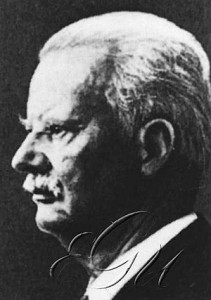
June 27, 1786 Death of Joseph Green, Immanuel Kant's closest friend over many years. The two of them dined together very frequently and had long conversations. Some of the vocabulary of mercantilism used by Kant in his books originates from Green. Kant was in the habit of discussing new ideas with Green before other academics and asking Green to … [Read more...]
- « Previous Page
- 1
- …
- 111
- 112
- 113
- 114
- 115
- …
- 163
- Next Page »