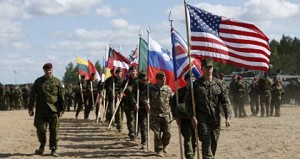
Since the end of World War II, the military forces of six NATO Allies have been deployed in West Germany--first as occupation troops. Soviet troops were stationed in East Germany as part of the Warsaw Pact forces. Although the United States maintained the largest of the foreign NATO contingents, Britain and France also deployed substantial forces. … [Read more...]
German Uniforms, Ranks, and Insignia
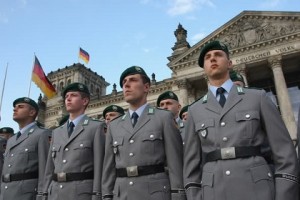
The service uniform is the most common type of Bundeswehr uniform for general duty and most off-post activity. The army's service uniform consists of a light gray, single-breasted coat and darker gray trousers, worn with a light blue or white shirt, black tie, and black shoes. The peaked, visored cap has been replaced by the beret as the most … [Read more...]
Military Justice in Germany

Members of the German armed forces are subject to the civil criminal code and are tried for common criminal offenses in the civil court system. There are no military correction facilities; incarcerated military offenders serve their sentences in ordinary civilian prisons. Soldiers enjoy the same civil rights and liberties possessed by other … [Read more...]
German Air Force – Luftwaffe
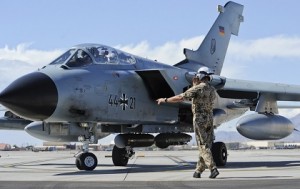
The German Air Force (Luftwaffe) has faced dramatic changes in structure and strategic concepts as a result of the diminished threat in Central Europe and shrinking budgetary resources for modernized weapons systems. Prior to the demise of the Warsaw Pact, the German air force had as its primary mission the air defense of Central Europe in … [Read more...]
German Navy – Bundesmarine
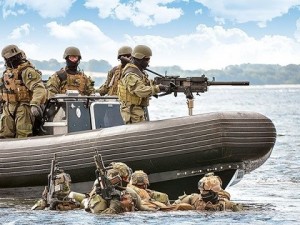
The primary areas of operation of the German navy (Bundesmarine) in the event of war are the Baltic Sea and the North Sea. Until 1990 the navy's mission had been to block the Baltic approaches on behalf of NATO to prevent the deployment of the Soviet Baltic Fleet in the North Sea and the Atlantic Ocean. The German navy also contributed to … [Read more...]
German Army – Heer
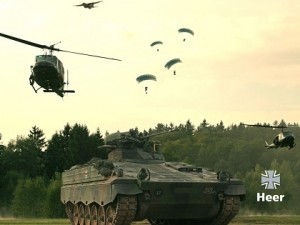
In early 1995, the German army (Deutsches Heer), headquartered in Koblenz, had a personnel strength of appropriately 255,000, including 123,000 conscripts. German army was composed of two principal elements, the field army and the much smaller territorial army. Territorial army units were slated to be merged with the field army by the end of 1995. … [Read more...]
July 6 in German History
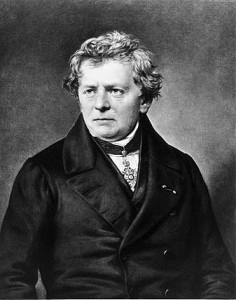
July 6, 649 St. Goar died on this date in 649. St. Goar was born in Auitaine (modern France) in about 585. He became a priest. He determined to live his life in isolated prayer. In about 618 he found a location at Oberwesel near Trier (modern Germany). Word of his holiness soon spread, however, and his isolation was interrupted by numbers of … [Read more...]
Creation of the Bundeswehr
In the summer of 1955, ten years after the Nazi surrender and the end of World War II, the West German Bundestag (lower house of parliament) voted to authorize the recruitment of volunteers for the initial formation of the Bundeswehr (Federal Armed Forces). Later in the year, a cadre of about 100 officers and NCOs were sworn in at a ceremony in … [Read more...]
July 5 in German History
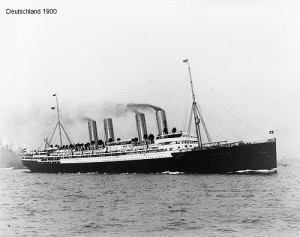
July 5, 1900 The German passenger ship, Deutschland, wins the Blue Ribbon (Blue Riband), the award for the fastest crossing of the North Atlantic. Deutschland reached 23.06 knots (42.71 km/h) on one of her 1900 Blue Riband voyages. At this time in history the fastest crossing of the Atlantic had come to have enormous national and corporate … [Read more...]
July 4 in German History

July 4, 966 Death of Pope Benedict V in Hamburg, Germany. Benedict had been elected Pope in defiance to the wishes of the Emperor of the Holy Roman Empire, Otto I. After serving for several months he was deposed through the intervention of Otto's army. Otto then placed him in clerical service in Hamburg where he remained until his death later … [Read more...]
- « Previous Page
- 1
- …
- 110
- 111
- 112
- 113
- 114
- …
- 163
- Next Page »